

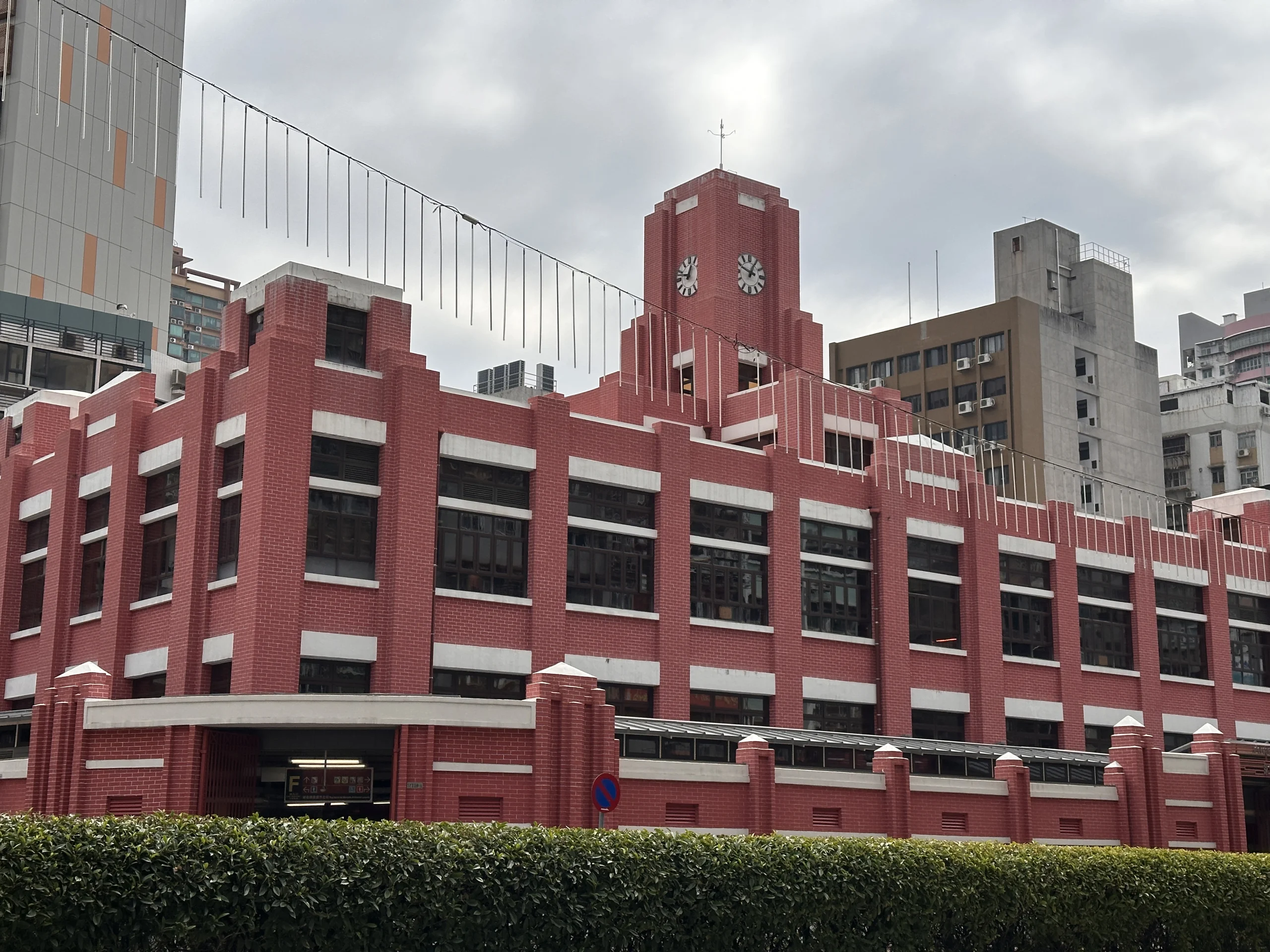
Since the launch of the festival in May 2025, the artistic collective My Land has focused on exhibitions, workshops and publications to bring the public closer to the culture of municipal markets. The initiative aims to counter the declining relevance of these spaces in a context dominated by supermarkets and online shopping, proposing new ways of using and interacting with public space.
In March, representatives of the UNESCO Creative Cities Network visited the Red Market, taking part in a workshop that combined gastronomy and visual arts.
By late spring, Hong Kong artist Pak Sheung Chuen will return to Macau for an artist residency centred on the market, exploring the idea that the space itself can be understood as a contemporary artwork. Among the projects developed, the zine “I got a pocket, a pocketful of Red Market”, by Macau illustrator Yang Sio Maan, was selected for the Bologna Illustrators Exhibition.
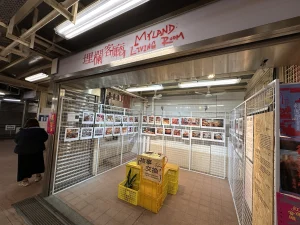
At present, there are some vacant stalls in the Red Market. Pal Lok and her team have used two of them as spaces for exhibitions and activities
Speaking to PLATAFORMA, Pal Lok explained that the idea stemmed from a personal connection to markets and the observation of declining foot traffic. “At the beginning we didn’t really know how to start,” she recalls, also acknowledging initial resistance from the community, with some residents arguing that “art and culture are useless” or questioning “how that would boost business”.
Read more: Culture’s value puts Hong Kong on the world stage
To overcome this distance, the team invested in small-scale workshops and community-based activities, involving residents, vendors and visitors. Today, she argues, the market still plays a relevant role: “Residents and stallholders who come here know each other and come to the market to talk.” The aim is to position the space as a kind of urban “living room”, where social interaction complements commercial activity and reinforces local identity.
The festival is built around three objectives: boosting consumption by attracting foot traffic, preserving local memories and know-how, and clarifying the role of markets within the community. “We want to start this discussion about what is most appropriate for this space,” says Pal Lok, stressing that any revitalisation process requires a balance between vendors, residents, government and the tourism sector.
In this context, the project has also been gathering data on how markets function and are experienced. Through an “Observer Programme”, young people from different academic backgrounds were invited to follow the day-to-day life of the Red Market, contributing to data collection and reflections that may support future decisions.
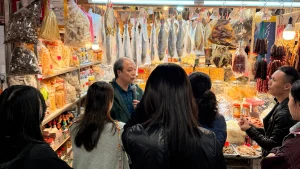
The Red Market Art & Cultural Fest has also implemented an artist residency programme, inviting different artists to create works inspired by the market
A new centrality
This reflection is also shared by Lei Chong In, a member of the Municipal Affairs Consultative Council. For him, the central issue in revitalisation is defining “who the transformation is for”. In his view, markets should evolve from “simple trading spaces into points of convergence between community life, cultural creativity and tourism experience,” he told PLATAFORMA.
Lei Chong In believes that markets in tourist areas should focus on “complementarity with the surrounding urban fabric”, while those in residential areas should strengthen the “shopping experience and community cohesion”, given competition from supermarkets, street shops and cross-border consumption in mainland China.
Read more: Macau: More Culture, Less ‘Decoration’
He also advocates a strategic approach, with differentiated planning and a review of management models, including more flexible mechanisms for the entry and exit of operators. He stresses that “the success of market revitalisation does not depend only on innovation within the space”, but on its integration into urban life and the construction of a positive public image.
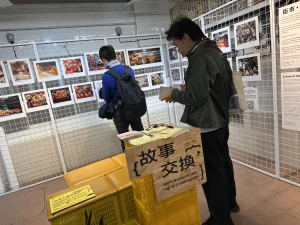
Revitalisation in full swing
According to an inquiry by legislator Lei Cheng I in December 2025, there were 329 vacant stalls across Macau’s eight public markets, representing about 30.95% of the total, mainly concentrated in Iao Hon Market, São Lourenço Market and São Domingos Market. In addition, there were 100 vacant stalls in hawker areas, around 17.3% of the total, mostly located around São Domingos Market and in the Fai Chi Kei and Rua de Fernão Mendes Pinto hawker zones.
Following the Patane Market, Horta da Mitra Market and Red Market, the gastronomy and cultural and creative industries zone at Taipa Market officially opened in December 2025.
In January this year, the Municipal Affairs Bureau (IAM) revealed that, after revitalisation, the market attracted more than 200,000 visitors, with a daily average of around 7,000 — more than four times higher than before.
In February, the IAM launched the “Revitalisation Plan for the Former Coloane Municipal Market”, and in March announced that the Toi San Market redevelopment will include a food court. Public briefing sessions on the tender were held at the Patane Activity Centre between 13 and 15 April.
