

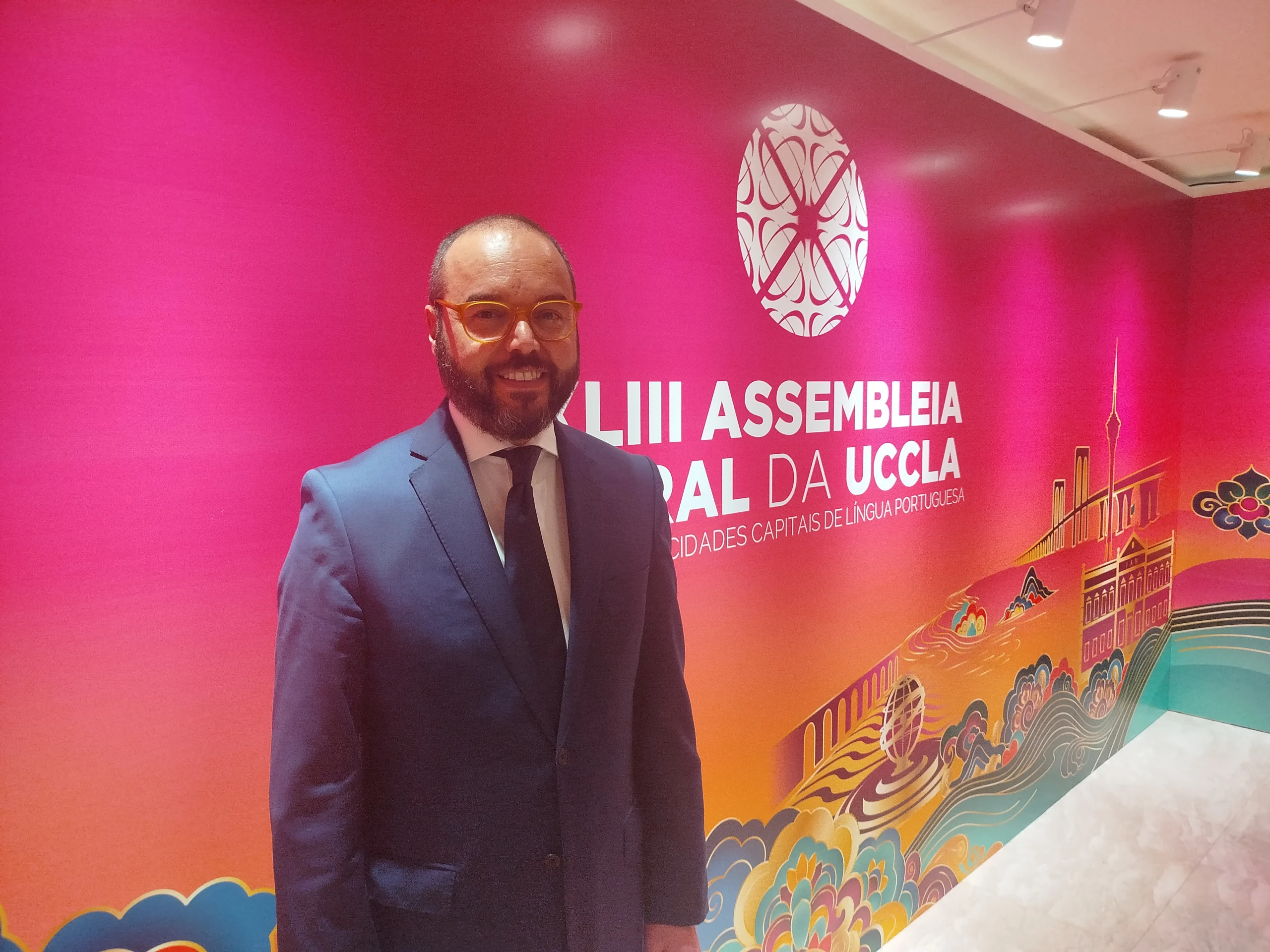
– What does Fundão specifically bring to Macau in this participation at the UCCLA General Assembly? What objectives do you hope to achieve?
Luís M. Gavinhos – The municipality of Fundão strongly believes in cooperation networks. We are part of more than 50 cooperation networks between different cities, mostly within the European context. We also have growing ties in Africa, namely with the city of Tarrafal in Cape Verde. At the same time, we have a historical connection with Macau. We believe strongly in this relationship, which is grounded in the Portuguese language, and we see this network of cities as a space for learning from different municipalities.
What we see here in Macau is, at the very least, inspiring in terms of development goals for these cities. About fifteen years ago, we carried out a major promotion of Fundão’s products here, particularly Fundão cherries, and we are ready to do so again.
We are also keen to use this historical and linguistic channel to strengthen ties with our business community. We are pleased with the showcase of products here and with the fact that some of the products currently displayed on Macau’s trade platform are from Fundão. We want to deepen this connection. We believe this model is appropriate: combining economic diplomacy with institutional events, while clearly ensuring that the economic dimension — what can actually reach the market — is explored in these meetings.
I also took the opportunity, during the General Assembly, to propose that the municipality of Fundão, in partnership with its neighbouring municipality of Covilhã, could host a future UCCLA General Assembly.
Read more: Portugal should resist pressures to reduce relations with China, warns Martins da Cruz
– In 2024, tourist stays in Fundão grew by more than 30% compared to the pre-pandemic period. What strategy is in place to sustain this growth, and what role could the Chinese market play?
L.M.G. – Macau is an excellent example of how to promote tourism. We are talking about a region with fewer than 800,000 residents that receives 47 million tourists a year. Portugal, with around 11 million inhabitants, receives 30 million visitors.
In Fundão, we established ourselves nationally through the promotion of cherries, especially at major national events. We have significant tourism programmes linked to cherries, whether during the blossom season or the fruit harvest, as well as the major Cherry Festival. We also offer tourist trains, hot air balloon rides and cycling routes, alongside a cultural and tourism programme that runs throughout the year.
I would highlight a major gastronomic festival focused on mushrooms, Míscaros, and the Chocalhos festival, which mobilises the entire village of Alpedrinha and typically attracts around 50,000 visitors over a weekend.
What we have seen is exponential growth. We are now above 190,000 overnight stays. In other words, there has been a surge in demand in Fundão, driven by programming and by the consolidation of Fundão as a destination brand, but also by the evolution of the private sector, which has significantly expanded its offering of new services.
Macau is an excellent example on how to do tourist promotion
– What competitive advantages does Fundão offer to foreign investors, particularly compared to other regions in Portugal?
L.M.G. – In recent years, we have strengthened the technology sector, as well as precision metalworking, producing small components for highly demanding and growing markets such as watchmaking. We also have a strong presence in garment manufacturing for major global brands. However, in recent years, attraction has been more focused on the agri-food sector and new technologies.
We carried out a national campaign to attract companies, particularly addressing the recruitment challenges faced by tech companies in major urban centres. The cost of living in those areas is a barrier, and that becomes a competitive advantage for a municipality like Fundão, which is not a large urban centre.
We are talking about a municipality of 27,000 inhabitants that positioned itself close to companies, ensuring proximity between home and workplace, and supporting the rental market to attract skilled workers. That has made us clearly differentiated.
Read also: China willing to expand cooperation with Portugal using Macau as platform
– What type of investment are you looking to attract from Chinese entrepreneurs, namely from the Greater Bay Area and Macau, and which sectors are priorities?
L.M.G. – Regarding the Chinese market, we are continuing to deepen our economic relationship with China. In the agri-food sector, we have developed a product catalogue fully translated into Mandarin. Some of these products are already present here, which shows that this path is being developed. At the same time, in the technology sector, we are seeing an increasing number of workers and collaborators of Asian origin. So these are two channels that should definitely be strengthened in the future.
We are pleased with the showcase of products here and with the fact that some of the products currently displayed on Macau’s trade platform are from Fundão
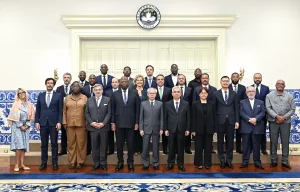
The Chief Executive, Sam Hou Fai, and the delegation of the 43rd General Assembly of the Union of Portuguese-Speaking Capital Cities (UCCLA), at Government Headquarters
– Fundão cherries are one of the region’s main symbols. Do you see potential to develop partnerships with the Chinese market, whether through export, processing or value creation?
L.M.G. – We believe the Chinese market appreciates cherries very much. However, we cannot, and do not expect, to export fresh cherries to China on a daily basis. In the catalogue we developed, translated into Mandarin, we have a range of export-ready products, including olive oil, sausages and other agri-food products with strong potential. We have already seen some of the most relevant Portuguese products being marketed here in Macau. As for cherries, we have cherry-based products such as gin, liqueurs, teas and more than 40 diversified products, which can be marketed beyond the seasonal period. To ensure export, cherries must be processed products. We have also created a digital platform for the sale and distribution of these products, which we aim to promote as a channel for international outreach.
– How can Macau function as a platform linking Fundão to the Chinese market?
L.M.G. – As we know, China’s scale poses challenges for countries like ours. Supplying products to large hotel chains, for instance, would exceed our national production capacity. These are completely different scales. We will try to target niche markets and develop more direct relationships with regions like Macau, allowing for more manageable transactions. At a national scale, we would not be competitive. However, the openness shown — we were received by the Chief Executive — demonstrates a willingness to foster this type of relationship, not only diplomatically but also in terms of aligning economic interests.
