

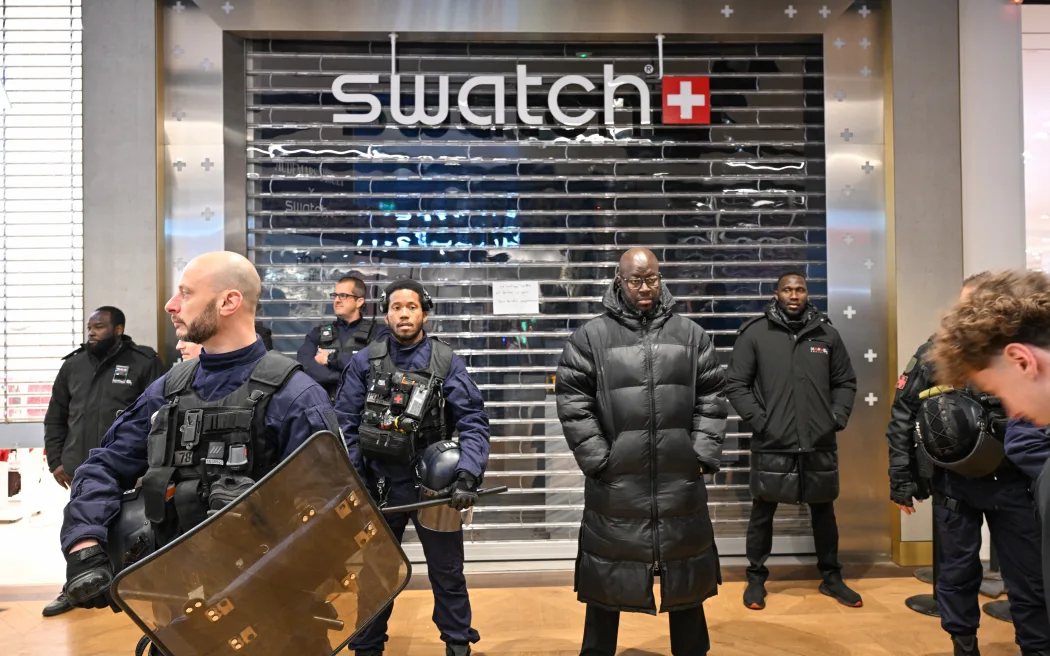
Grown adults sleeping on shopping mall floors. Police deploying tear gas outside a watch boutique. Hundreds of people forming overnight queues at centres like Colombo in Lisbon and NorteShopping in Porto — for the chance to buy a pocket watch made of plastic. Yet this has become the defining retail spectacle of the mid-2020s, and Swatch has not made the most of it.
MoonSwatch blueprint
The template was set in March of 2022, when Swatch and Omega — both part of the Swatch Group — launched the MoonSwatch at roughly $260. The Speedmaster is the watch worn on the moon. The MoonSwatch was its mass-market avatar, and the world responded accordingly.
Long queues formed overnight in New York, London, Paris, Tokyo, and Zurich, according to watch publication Hodinkee, which documented the scenes as “MoonSwatch Madness.”
The chaos, paradoxically, was the best possible advertising. The MoonSwatch went on to sell over two million units across 36+ colourways. According to Swatch Group CEO Nick Hayek, the launch also boosted sales of the original Omega Speedmaster by roughly 50%.
Royal Pop around Europe
On May 16, 2026, Swatch launched the Royal Pop — a collaboration with Audemars Piguet, whose Royal Oak is among the most coveted watches in the world, with new models typically retailing from €20,000 upwards. It was the first time AP had ever licensed its Royal Oak silhouette to an outside manufacturer. The result was a bioceramic pocket watch in eight colourways, priced at €385–€400.
Swatch confirmed the collection would be sold exclusively in-store at 200 boutiques worldwide, with a limit of one watch per person per day and mandatory ID.
What followed exceeded the MoonSwatch chaos. In France, approximately 300 people gathered outside a Swatch boutique at the Westfield Parly 2 shopping centre near Paris. According to RFM and Techenet, police deployed tear gas to disperse the crowd; the sale was cancelled without a rescheduled date. In the UK, locations in London, Liverpool, Manchester, Birmingham, Sheffield, Glasgow, and Cardiff all closed. In Milan, there were reported shoving incidents. In New York, queues persisted for several days.
Portugal frenzy
In Portugal, only two stores received the Royal Pop: the Swatch boutique at Centro Colombo in Lisbon and the one at NorteShopping in Porto. Around 500 people queued at each city, said the brand to ECO. According to SIC Notícias, at both Colombo and NorteShopping, several people spent the night in line to guarantee their spot.
For many buyers, the goal was not to wear the watch but to flip it: within hours of the launch, models were already appearing on platforms like Vinted for over €2,700. A growing number of people, buying a product like this “stopped being just consumption” and became an investment.
Dozens of people spent the night in queues at both locations, Jornal de Notícias reported. “The rule was clear: one watch per person, one purchase per day, and extremely limited stock. Even so, many ended up leaving empty-handed,” according to RFM. Approximately 500 people queued at each city location, said ECO, Portugal’s financial and lifestyle publication.
A missed opportunity
The industry reaction to the Royal Pop launch was pointed. “Swatch completely bungled the release, just as it did in 2022 with the MoonSwatch,” wrote Tony Traina on his watch-collecting Substack, Unpolished. “They had to know what was coming, and either didn’t plan for the Royal Pop, or were wilfully ignorant about how it might go down on May 16. MoonSwatch showed that the line between hype and a teenager getting punched is, sadly, thinner than we’d like to admit.”
WatchPro editor Rob Corder was similarly direct: “The mishandling of the Swatch x Audemars Piguet Royal Pop launch is inexcusable because it was so predictable. Swatch knew, having seen the reaction to the first MoonSwatch in 2022, that this was coming.”
Content strategy publication ContentGrip framed the phenomenon in marketing terms: “The queue itself became part of the product experience. Photos, TikTok videos, Instagram reels, and viral footage from crowded stores helped fuel additional demand. The chaos reinforced the perception that the launch mattered. The spectacle became the marketing engine.”
