

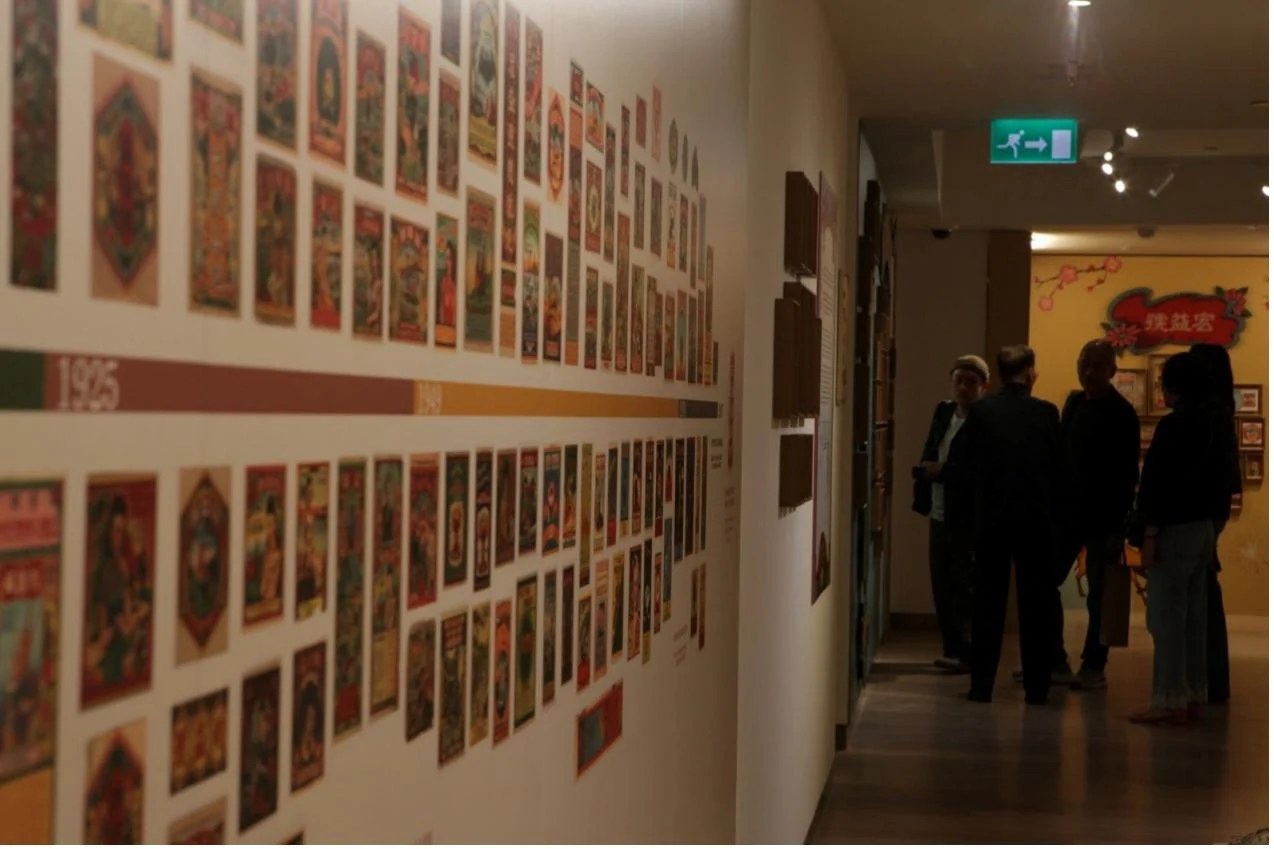
Organized by Sands China Ltd., the exhibition is supported by the Cultural Affairs Bureau and the Macao Government Tourism Office, with contributions from the Macao Museum, the Archives of Macao, and the Macau University of Science and Technology Library and Faculty of Humanities and Arts.
EXHIBITION DETAILS:
Until August 31, 2026
Sands Gallery, Level 6, The Grand Suites at Four Seasons
11:00 a.m. – 7:00 p.m. daily
Free Admission
Memory Rebuilt Piece by Piece
On display at Sands Gallery through August 31, A Century of Iec Long Firecracker Factory in Radiance tells the story of the hundred-year-long trajectory of Macao’s firecracker industry. An urban industrial landscape that had gradually receded from memory has been reconstructed and brought back to life through archival collections, firecracker-making tools, packaging labels, trade documents, and photographs.
Strolling through the gallery, visitors can discover what made the firecracker industry distinctive and understand how it profoundly shaped Macao’s economy, landscape, and daily life throughout the twentieth century.
Behind this historical reconstruction lies the curator Ung Vai Meng’s over three decades of dedicated accumulation. What began as a personal passion for historical artifacts, documents, and packaging design gradually evolved into a mission of preservation that has amassed a collection of significant pieces related to Macao’s firecracker industry. As factories ceased operations one after another and former workers grew older, Ung realized that an entire industry was fading away with them, one that had supported thousands of families and accounted for nearly one- third of Macao’s exports at its peak.
The exhibition guides visitors through this world with remarkable intimacy. Business contracts, negotiations between factory owners and workers, security guard logs, and gasoline receipts bearing prices that seem almost unbelievable today all reveal everyday aspects of industrial life. Each item offers a glimpse into a demanding and often dangerous profession shaped by the constant presence of gunpowder. Archival photographs and film footage deepen this sense of time travel, bringing back industrial landscapes that once defined entire neighborhoods and streets that are now barely recognizable.
The exhibition also comes with profound artistic depth. The curator’s detailed illustrations reconstruct production processes, tools, and the repetitive gestures performed daily by factory workers.
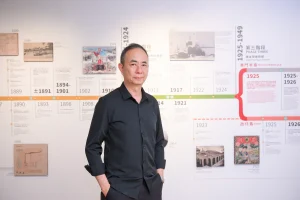
The layout of Sands Gallery itself enhances the immersive experience. Ung Vai Meng uses the gallery’s natural divisions to create a series of smaller spaces with distinct atmospheres, allowing visitors to move through different chapters of history. “Each room has its own identity and rhythm,” he explains.
For the curator, one of the most fascinating elements is the packaging used to market firecrackers. Peafowls, dragons, camels, and vibrant colors formed a visual language designed to appeal to different markets around the world.
“Designers put a great deal of thought into these images,” he says. “We can clearly see differences between products intended for the Chinese market and those designed for the United States. They reveal different aesthetics, consumer habits, and even cross-cultural exchanges.”
Read more: Sands China presents Macao firecracker heritage exhibition at Sands Gallery
At the center of the exhibition’s narrative stands the former Iec Long Firecracker Factory. Founded in 1925, the factory became one of Macao’s leading firecracker production facilities before the industry’s gradual decline beginning in the 1970s. Following years of preservation and restoration work, Ung Vai Meng emphasizes its exceptional heritage value: “It is probably the most intact firecracker factory relic in southern China.”
Today, this industrial landmark is open to the public, retaining original spaces connected to different stages of production, from storage areas to workshops where fuses were prepared and firecrackers assembled.
A Journey Through Memory
Scene 2
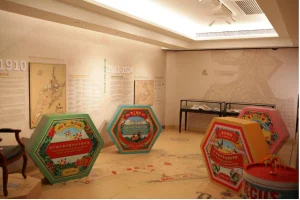
Maps reveal the Macao firecracker industry’s rise and fall over the decades, alongside the growth of old Macao itself. During the 1920s, severe shortages of raw materials forced factories to recycle old newspapers to create the paper tubes used for firecracker casings.
Scene 3
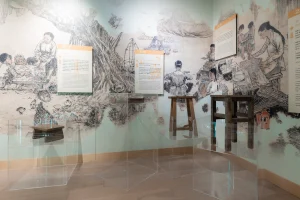
Original tools, workbenches, and illustrations of manufacturing processes recreate the dangerous environment of the old factories. Workers who handled black powder were known as the “kings” of production because their bodies would be completely covered in soot. Those who worked with white powder began before dawn, surrounded by a fine and hazardous cloud of silver aluminum dust.
Scene 4
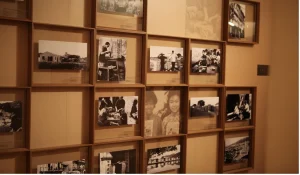
Photographs, receipts, and historical documents reveal the daily lives of factories and their workers. One emergency letter from a technician to a factory owner requests travel expenses for four skilled workers to come to Macao, showing that they traveled from rural China to Macao on a journey that could cost more than 3,000 patacas per person.
Scene 6
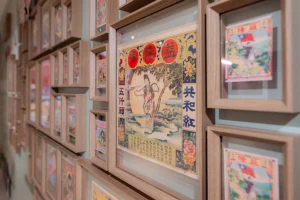
Graphic designs reveal how Macao’s firecracker brands developed visual identities for different markets, while also documenting the logistics networks of the era. The “Dragon Fire” package bears the inscription “Made in Guangxi, Packaged in Macao,” evidence that by the 1950s the city was already serving as an export platform linking the Chinese mainland to overseas markets.
Macao’s Identity on the International Stage
The exhibition gained an international dimension through Sands Gallery’s debut participation in Art Central in Hong Kong in March, where displays from “A Century of Iec Long Firecracker Industry in Radiance” were presented alongside works by three emerging Macao artists.
“By bringing this story to international platforms, we show that Macao is not only a tourism destination, but also a place with a rich and distinctive cultural heritage,” says Sands China Executive Vice Chairman Dr. Wilfred Wong.
The response in Hong Kong surprised even the curator. “It wasn’t only Chinese visitors who showed interest. Many international visitors were fascinated by the exhibition, and some later traveled to Macao specifically to see it.”
“I hope residents and scholars alike will gain a deeper understanding of the firecracker industry and, through that understanding, develop a greater appreciation for Macao itself,” Ung Vai Meng adds.
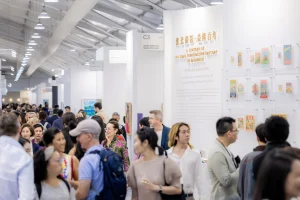
Visitors in Macao have also highlighted the exhibition’s impact. One visitor born in Macao in the 1960s described the experience as “a return to childhood,” recalling manufacturing processes in which he once participated and expressing gratitude for seeing part of his own life reflected in the exhibition.
Many parents say they discovered, together with their children, the historical importance of the firecracker industry and the role it played in Macao’s development.
“It was only because we came to Sands Gallery that we learned Macao once had three major handicraft industries,” one visitor explains. “Before this, neither my child nor I even knew they existed. After visiting the exhibition, my child began looking at artistic creation differently and developed a much richer imagination.”
Among the visitors was William Bascaule, Director of the Alliance Française of Macao, who emphasized the importance of preserving collective memory. “Congratulations on this magnificent exhibition. It is essential that we know our history.”
Parallel Activities
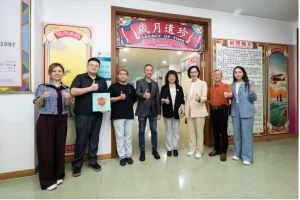
The project has driven several academic and cultural initiatives, including the Historical Memories of the Taipa Firecracker Factory held at MUST.
Among them is the academic dialogue Historical Memories of the Taipa Firecracker Factory, held at Macau University of Science and Technology, where curator Ung Vai Meng and Lai Hong Kin discussed the industry’s historical legacy through packaging design and the testimonies of former workers.
In Hong Kong, Art Central also hosted the seminar Aesthetics Within a Square Inch, in which Ung Vai Meng explored a century of visual culture through firecracker packaging produced in Macao.
Additionally, MUST hosted the exhibitions Historical Resonance: Firecracker Label Art from Eastern Guangdong and Timeless Treasures: Archival Materials of Macao’s Firecracker Industry. Together, these exhibitions featured maps, invoices, telegrams, packaging labels and other materials that help reconstruct the history of the industry and its contribution to Macao’s economic and social development.
The “Timeless Treasures” exhibition is currently showcasing at the Arts and Culture Gallery, 3/F, Block N, Library Building of the Macau University of Science and Technology.
According to MUST Library Director Long Xiao, “This is not only about preserving historical materials, but also about studying them, contextualizing them, and making them accessible to future generations.”
