


Technology is no longer just a technical promise. In the field of social innovation, it is beginning to be used to identify talent, ease teachers’ administrative workload, combat the isolation of older people and create more inclusive solutions. In Macau, this potential was discussed at a University of Saint Joseph seminar with founders of technology-based social enterprises from Hong Kong.
The number of social enterprises in Macau is proportional to the city’s size, but Florence Lei admits that, by moving beyond the “traditional model”, the “map of social innovation is, in fact, quite broad”.
The coordinator of the Sustainable Business Lab argues that platforms such as the Lab are promoting a “transition towards human-capital-intensive models, bringing large companies and SMEs closer together”.
Read also: Artificial intelligence and neuroscience bring Macau and Portugal universities closer together
On Macau’s entrepreneurial vitality, Florence Lei stresses that local support and infrastructure are among the most abundant in the region. The Government’s push for “appropriate economic diversification”, particularly in the areas of “big health” and high technology, has created a “relevant policy framework” and made it “easier for social innovators to adopt advanced tools such as artificial intelligence”, she explains to PLATAFORMA.
We are on the right track, but the true results of these efforts require long-term accumulation and cannot be achieved overnight – Florence Lei, USJ professor
“We are on the right track, but the true results of these efforts require long-term accumulation and cannot be achieved overnight,” she says.
The ability to master and adapt to emerging technologies “is not just an advantage, but a necessary condition for survival and sustainable development in a rapidly changing global market”, she states.
Technology to service the people
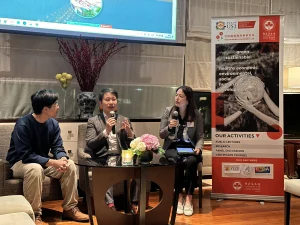
It was in this context that USJ’s Sustainable Business Lab recently organised the seminar “AI Applications for Social Entrepreneurs”, bringing together in Macau Ernest Chan, founder of AESIR.hk, and Patrick Lau, founder of Snaildy Education and Snaildy Education Charity, both from Hong Kong.
The focus of the future should not be only on artificial intelligence, “but rather on how we effectively use technology to make our society and education more inclusive and equitable”, explains Ernest Chan.
Artificial intelligence can discover some possibilities that escape us – Patrick Lau, founder of Snaildy Education and Snaildy Education Charity
AESIR.hk develops augmented reality and virtual reality solutions for educational needs, including learning tools, situational experiences and rehabilitation training.
Snaildy Education uses artificial intelligence and other technologies to support students with special educational needs and gifted students, while also easing teachers’ administrative workload. The company’s services are already available in Macau.
The two experiences show how technology can be applied beyond the technical dimension. AESIR.hk was recognised as one of Asia’s top 12 social enterprises and one of the world’s 500 best technology startups. Patrick Lau was selected for the “Forbes 30 Under 30 Asia” list in the social impact category.
Read also: Shooter planned attack with artificial intelligence. Can ChatGPT be accused of homicide?
During the seminar, Ernest Chan presented a sports game with motion sensors designed for older people. As many have difficulty using new technologies, the company trained students with special needs — who face greater obstacles in the traditional labour market — to act as “technology ambassadors”, supporting care homes in the use of the system.
The game has already been expanded to Australia and Singapore. “They use VR to train fencing together and can compete with players from Hong Kong.”
For Ernest Chan, this type of solution shows that technology can also combat social isolation: “With this, we show society that being older does not mean having fewer friends; through online games, people can also make friends,” he says. He also adds that “the model implemented in Hong Kong may one day be applied not only in Macau, but also in other parts of the world”.
Technological models created in Hong Kong can also be adapted to Macau’s reality, Patrick Lau argues. In his presentation, he explains that Snaildy Education’s system helps identify the potential of students with special educational needs. “Artificial intelligence can discover some possibilities that escape us,” explains Patrick Lau.
