

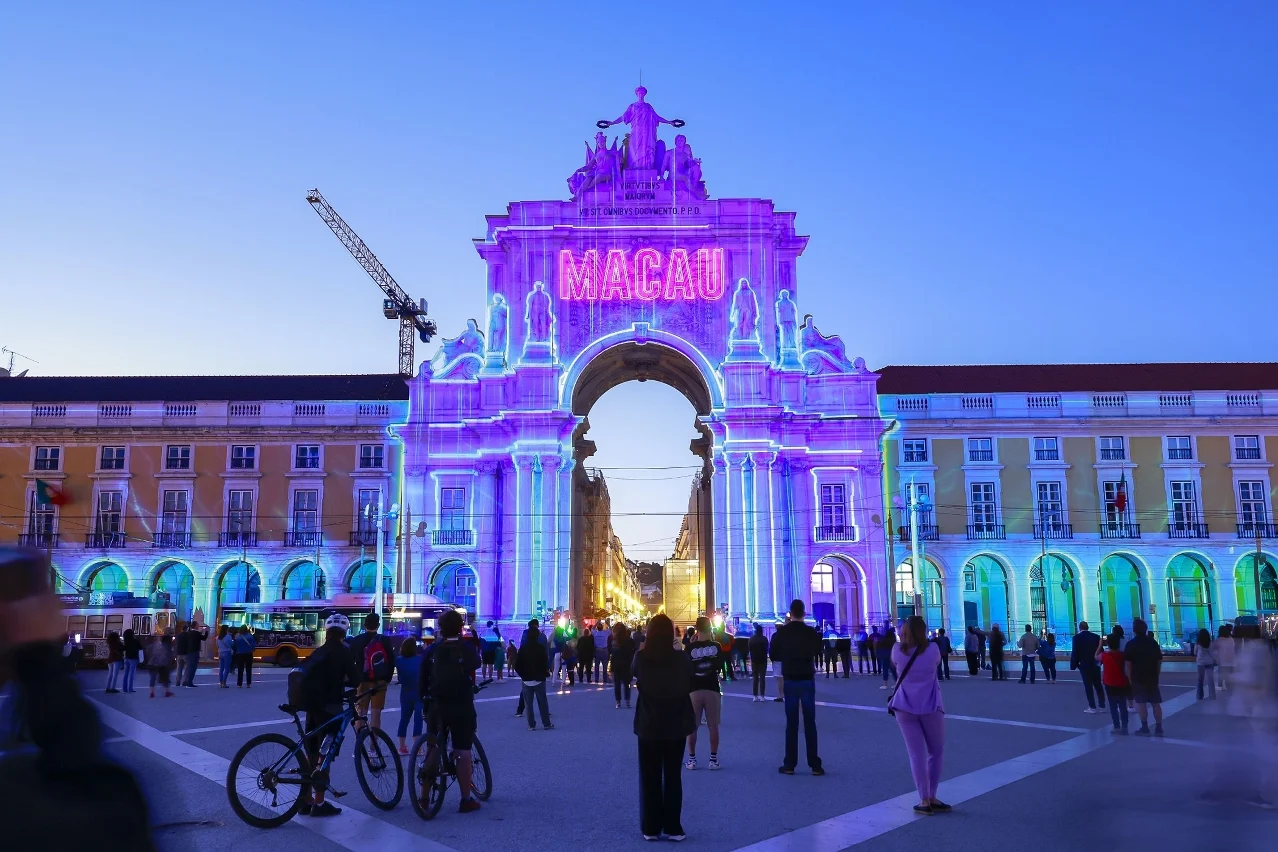
Sam Hou Fai will arrive in Lisbon on 18 April, marking the start of an official visit to Portugal and Spain — with stops in Geneva and Brussels — accompanied by a delegation of around 120 businesspeople and more than 20 companies from the Greater Bay Area and other provinces of China.
In an interview with Canal Macau and Rádio Macau, the Chief Executive highlighted that, in addition to political meetings, the visit will place particular emphasis on economic and commercial matters, in what is his first trip abroad since taking office.
“More than 39 cooperation agreements will be signed with Portuguese entities or companies, covering areas such as trade and the economy, the China–Portuguese-speaking platform, education, culture, tourism, talent development, Big Health and advanced technology,” he said in the interview.
For the Macau House Foundation, the focus is on the economic dimension, albeit with caution. Daniel Pedro, a representative of the association, believes that the presence of businesspeople “shows a willingness to deepen concrete economic relations, going beyond symbolic diplomacy”, while stressing that the impact will depend on the creation of “real mechanisms to support investment and monitor agreements”.
If there is continuity, this could be a real opportunity to relaunch Macau–Portugal relations – Daniel Pedro, Macau House Foundation in Portugal
The association also notes that Macau remains an underused strategic platform. “Macau remains a privileged gateway to the Greater Bay Area and mainland China. Portugal can benefit from this, but only with a consistent strategy from both sides,” he told PLATAFORMA.
Read more: Sam Hou Fai outlines integration goals between Hengqin and Macau
The Association of Macanese and Portuguese from Macau in Portugal also highlights the symbolic importance of the visit. Artur Ângelo believes it represents “the recognition of a shared history and a human connection that goes beyond politics and economics”, arguing that cooperation should go beyond formal agreements. “We hope this visit will not be limited to the economic sphere. There is room to strengthen education, culture and youth mobility,” he says.
For Carmen Amado Mendes, president of the Macau Scientific and Cultural Centre (Lisbon), the region’s role remains unique. “Macau continues to have a very particular and highly relevant position in the relationship between China and Portugal. It has an advantage that no other region has: it combines Portuguese historical heritage with full integration into contemporary China,” she told PLATAFORMA.
Macau as a space of mediation
This position allows Macau to function as a space of mediation and trust. “Macau acts as an intermediate space of translation and trust: linguistic, legal, institutional and even cultural translation,” she explains, while noting that it does not replace direct state-to-state channels.
She argues that the main challenge is to make this role more concrete. “The priority for Chinese decision-makers should be to turn Macau into a truly operational platform, with more visible and more regular results (and not just rhetoric…),” she says, pointing to the need for stronger institutional coordination and articulation with Hengqin to gain scale.
In her view, Macau can enhance its relevance by strengthening specific areas where it already has comparative advantages, particularly financial services linked to China and the Lusophone world, innovation, scientific and technological cooperation, and support for small and medium-sized enterprises, including start-ups.
The priority for Chinese decision-makers should be to turn Macau into a truly operational platform, with more visible and more regular results (and not just rhetoric…) – Carmen Mendes, president of the Macau Scientific and Cultural Centre (Lisbon)
Regarding the visit, Carmen Mendes believes it may signal a shift in approach. “My expectation is that this trip will move from a more institutional and protocol-driven logic to operational results, with projects, business contacts and more concrete follow-up mechanisms that benefit all parties,” she says.
Read more: Sam Hou Fai outlines a four-point vision for women’s development in Macao
She also considers it essential for Macau to position itself “less as a symbol and more as a practical instrument of cooperation”, arguing that it should be “less of a stage and more of a service platform”. The key challenge, she adds, is not to justify its historical relevance, but to “turn that historical uniqueness into regular operational capacity, useful for all CPLP countries and not just some”.
Beyond the economic dimension, she highlights areas where cooperation with Portugal can be strengthened, namely “higher education, bilingual training, science, culture, legal translation and talent mobility”.
“I hope that Sam Hou Fai’s visit helps to build trust, raise Macau’s visibility in Portugal and, above all, carry clear political value,” she stresses.
At the institutional level, the Macau Scientific and Cultural Centre stands out as one of the instruments of this connection. “The Macau Scientific and Cultural Centre reflects this close relationship and the ties of friendship we have built,” she says, highlighting its role in research, training and cultural promotion.
Overall, the visit represents an opportunity to relaunch Macau–Portugal relations at a time when efforts are being made to give greater economic and strategic depth to a historically grounded relationship. “If there is continuity, this could be a real opportunity to relaunch Macau–Portugal relations,” concludes Daniel Pedro.
