

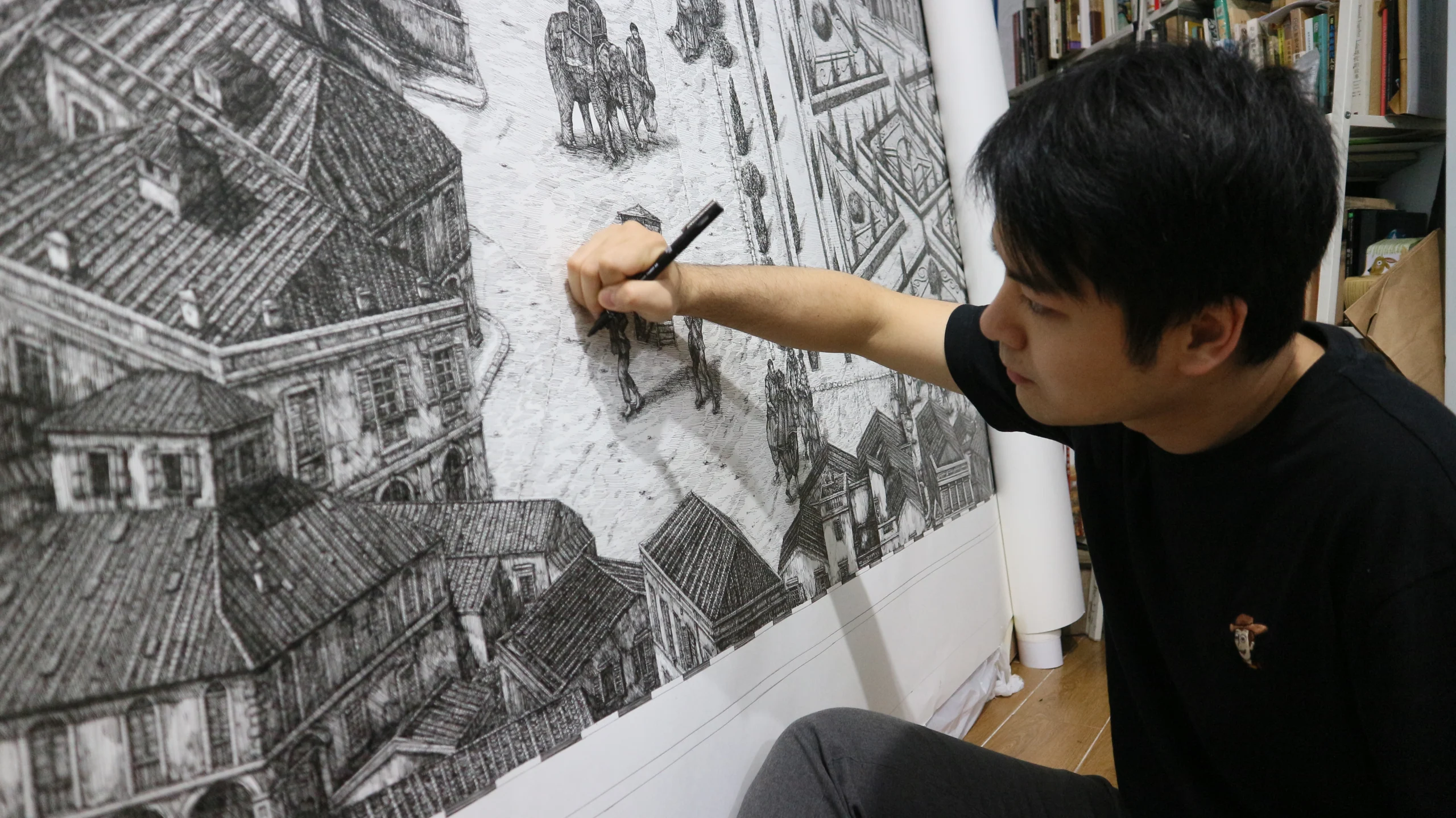
Eric Fok draws Macau as though searching for a city within another. In his works, sixteenth-century Portuguese ships intersect with casinos, churches, neon lights, and skyscrapers; past and present appear on the same plane, in the form of reinvented old maps. “When I looked at one old map after another, I began to think: so this is what Macau was like – why is it now completely different?”
It is in this gesture – looking at the city and trying to understand what remained, what disappeared, and what was added – that much of the artist’s work is grounded. Known for his “old map” style, Fok says drawing began very early: “In fact, I have liked drawing since childhood. Like many children, I loved watching cartoons, and I really wanted to have those characters. Besides buying toys, I also wanted to draw them in order to record them.”
At a time when art was not seen as an obvious path, that was nevertheless where he found security. “I was not particularly good at the other subjects at school; my best subject was art. (…) Art was the only subject that gave me confidence.”
Read more: National security now covers education and culture
The change came in secondary school, when he met the sculptor Wong Ka Long through the summer programme “Snowball Project.” “There, I saw that studying art could become a profession. When I met him, I began to have a dream.” Later, he studied visual arts at the Macao Polytechnic University, while working part-time in a museum. “I was very happy during that period.”
Understanding art
Over time, drawing ceased to be just practice and also became reflection. “Art is not simply painting a scene again, it is not just reproducing it. There is a great deal of philosophy and theoretical grounding involved. Later, when creating art, I realised there were many things I did not understand.”
That recognition led him to pursue further studies in Taiwan and, before that, in Florence, where he studied oil painting restoration. Leaving Macau allowed him to gain distance: to see the city “as an outsider,” in his words.
The visual language that distinguishes him today was born, in part, from a trip to Malacca in 2011. “A friend and I went to Singapore by chance. We knew nothing about the place and had not planned the itinerary.” Passing through Malacca and the Santiago Fortress made him think about the way cities accumulate layers and memories. At the same time, Macau was changing rapidly. “Seeing how quickly the casinos changed Macau, with so many taxis and tourists,” he recalls.
Later, when he accepted a job that required drawing an old map, he immersed himself in historical documents and old cartography of Macau. From that point on, the map ceased to be merely a visual reference and became a method. “Absolutely, absolutely very much,” he replies, when asked about the weight of research in his creative process. “Because without that foundation, without that context, I could not have painted that image.”
Read more: Sands China brings Macao to Art Central with international debut
Fok speaks of constant reading, historical research, and fieldwork. “Because, in the past, no one in Macau’s education system told you about the history of Macau.” And he adds: “After understanding the city’s history, I suddenly felt that the place was very special. A place can have so many stories.”
That research also came to shape the internal balance of his works. “At first, the emphasis was on aesthetics and composition, trying to consider things from various angles. Now, both are present, but the proportion varies over time. At the moment, aesthetics and content each represent about half.”
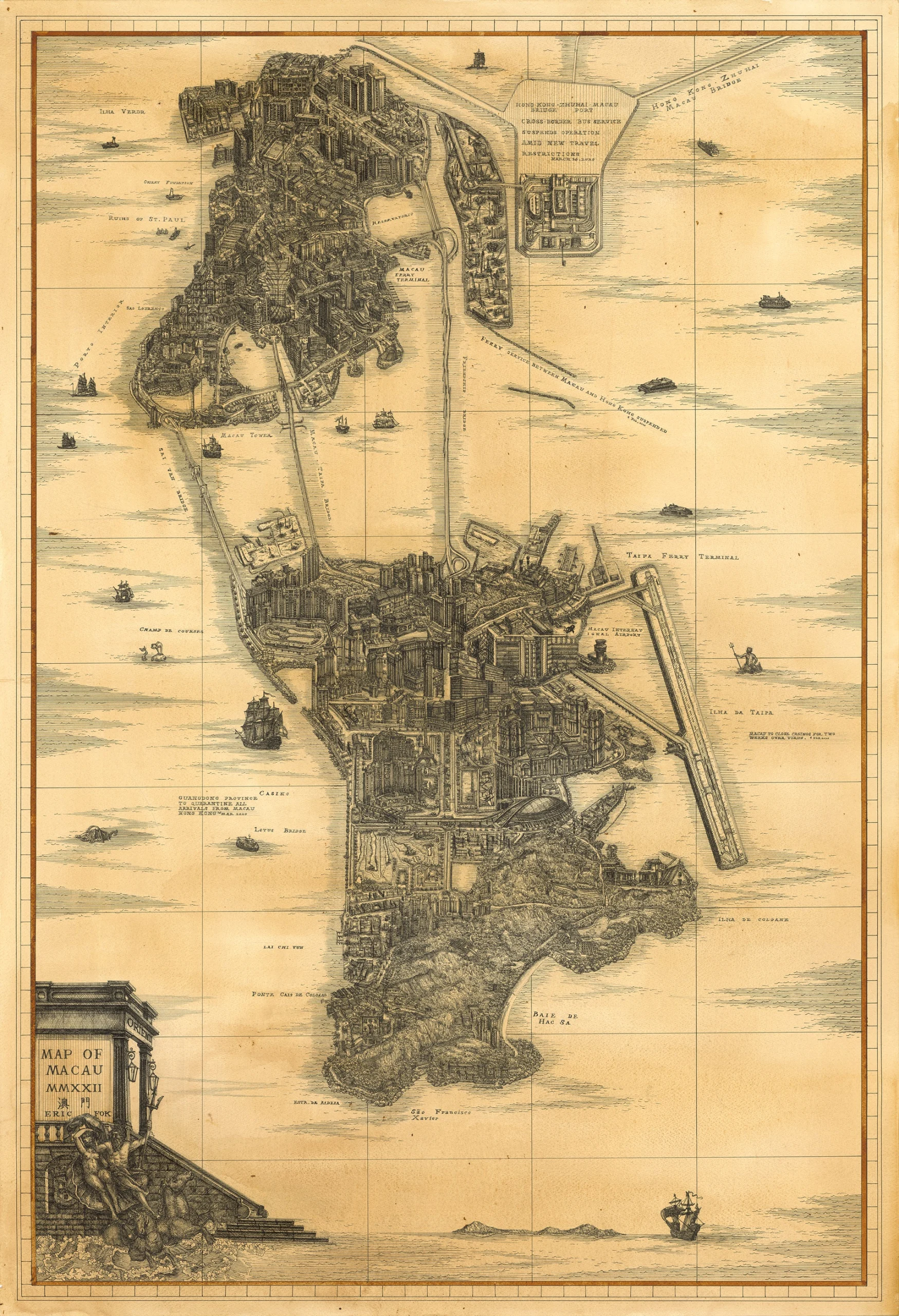
Over the years, however, the artist himself felt the need to broaden the focus. “In fact, they may not even be interested in Macau itself. Many people may feel drawn to it because my art has a regional character. I also need to think about how to talk about Macau while at the same time engaging audiences from different places.”
And he admits: “I have been talking about Macau for so many years that I am starting to get a little bored. I am also thinking about what other aspects might be explored.”
Contradictory policies
The political dimension enters precisely there: in the way the city changes, in the tensions of tourism, in the limits of the art market, and in the way culture is supported. “From that initial youthful indignation? Now I see many policies that I cannot understand; it is very contradictory.”
When he speaks about tourism, the tension appears again. “If I were in the tourism sector, of course I would be happy; but if more than 40 million people are out on the streets near your home every day taking photographs, and you have to manage crowds when you return home, then local residents will be affected. Finding a balance is really difficult.”
That same difficulty in finding balance arises when he speaks about the survival of artists in Macau. “There is buying and selling of art; people in Macau do buy paintings, but this has still not become a trend, nor an activity on the scale of an industry. It is only a few sporadic purchases and sales.”
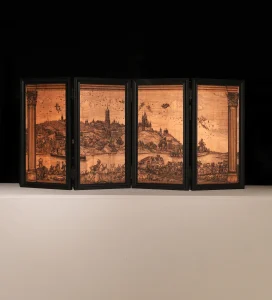
“After understanding the history of the city, I suddenly felt that place was very special. A place can have so many stories.” – Eric Fok
For Fok, the problem is not solved merely with isolated projects. “If we are talking purely about buying and selling, there needs to be policy support or cooperation between the private sector and the Government.”
“The Government is also constantly developing many projects or revitalising old areas. But it seems that art is used for… embellishment, more for decoration than for true creation. There seems to be less focus on creation or on the development of the industry. I think the most important thing is policy—how can policies help create an industry?”
Between research and drawing, between the archive and the lived city, Eric Fok continues to work at that intersection. “I like sitting in my studio painting, but at the same time I need to absorb from all sides.” Perhaps that is the logic most faithful to his work: looking at Macau as an open map, still to be deciphered.
