

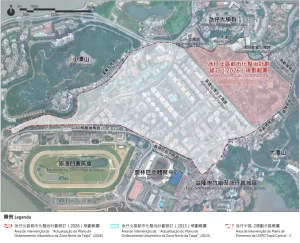
The new planning proposal for the Northern Taipa district, presented earlier this month — the “Northern Taipa Urban Planning Update (2026)” — covers around 222,000 square metres. The overall vision is to create a “residential and commercial zone integrated into the hillside landscape”, with capacity for around 20,000 residents.
For Nuno Soares, director of CURB — the Centre for Architecture and Urbanism — the plan has clear merits, particularly in the creation of public space, the strengthening of pedestrian mobility and the preservation of old trees.
Even so, he regrets that the rural identity of the former Cheok Ka village was not more fully incorporated into the urban design. “The idea of giving continuity to the village was a missed opportunity in this regard,” he told PLATAFORMA.
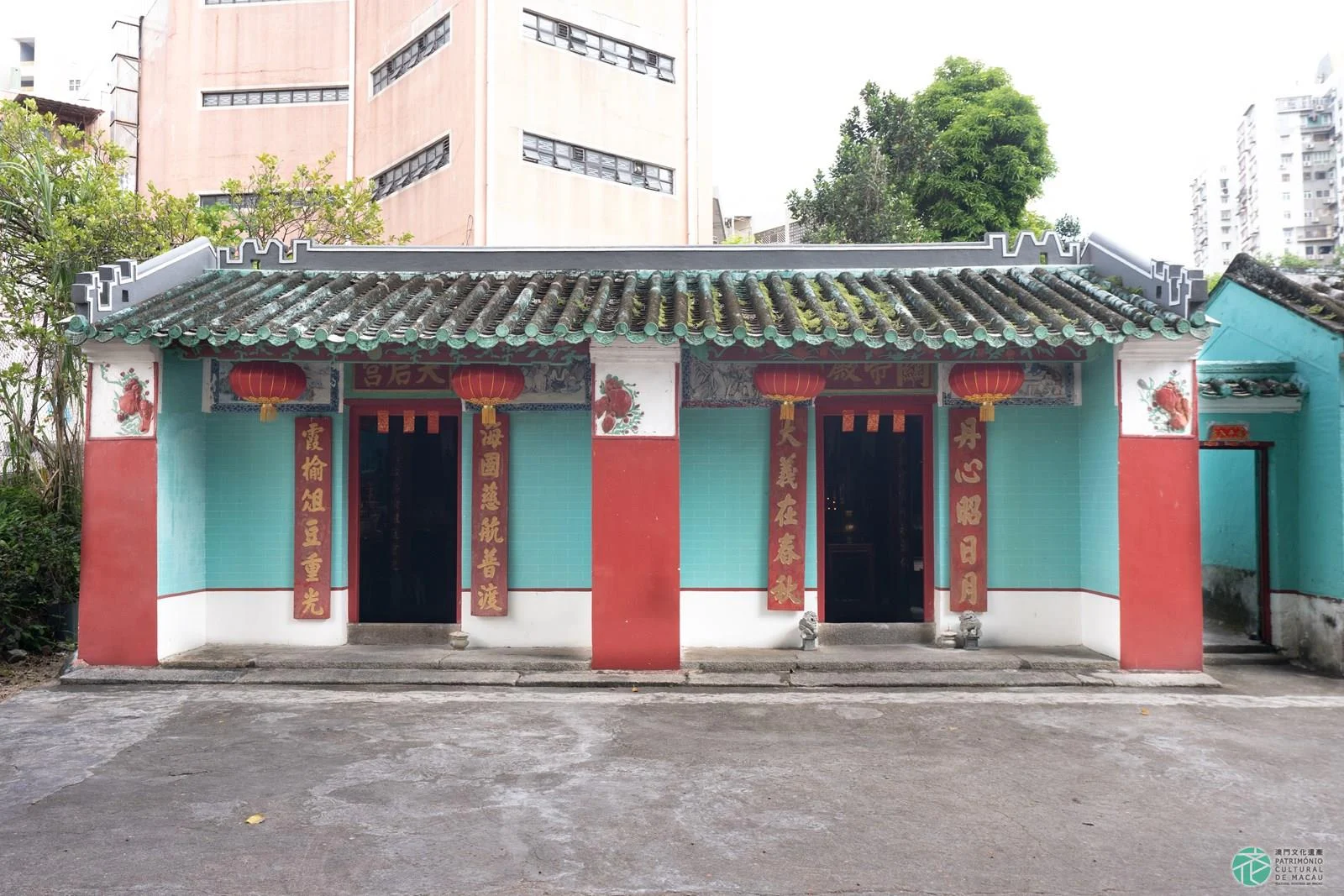
The project also includes the construction of the Ancient Trees Park and the Northern Taipa Park. The Kuan Tai and Tin Hau Temple, along with 23 ancient trees, will be protected under the Cultural Heritage Protection Law, with a designated surrounding protection zone.
According to the document, the area faces several constraints, including the “scattered distribution of private land plots”, the need to “safeguard cultural heritage” and “tree resources”, the “insufficient road network” and “green spaces”, as well as the “integration with adjacent areas”.
Read also: Open House Macau is back
Nuno Soares acknowledges that the proposal addresses a longstanding issue: the disconnection between the consolidated area of Taipa and this district. The plan places emphasis on pedestrian circulation and on a central green corridor where the old trees play a prominent role. Their preservation, he argues, “is positive and can improve urban quality of life”: “Once the plan is implemented, Taipa will have a public space with better connections.”
Between density and memory
The most sensitive issue lies in how the new development relates to the former Cheok Ka village. Many private land plots are located around the old trees, in an area associated with Taipa’s rural memory.
For Nuno Soares, the need for urban density “is understandable”, given the “scarcity of land in Macau”. But that should not prevent the preservation of a difference in scale between the old village and the new urban fabric.
“We need tall, high-density buildings because we do not have much land in Macau. But sometimes it is important to maintain this contrast between villages and urban development,” Soares explains.
The architect argues that the former village could have been adopted as a “structuring element” of the new neighbourhood: “That way, people would not simply say they live in Northern Taipa, but rather in the new development of Cheok Ka Village.”
Read also: Sam Hou Fai calls on associations to provide more support for Macau’s government
A former agricultural village, Cheok Ka represents more than the trees that are now being preserved, according to Soares. The agricultural and productive landscape should also help distinguish the future urban space, “so that we do not end up with the same type of parks everywhere in Macau”.
For the architect, the landscape should reflect the area’s own conditions rather than replicate models applied elsewhere in the city. Soares also stresses the importance of better connecting Northern Taipa to Taipa Village and planning public transport networks, such as the Light Rapid Transit system, “so that we do not need to invest so heavily in private transport”.
New plan, 13 years later
The proposal for Northern Taipa revives a process first launched in 2013, which was later suspended due to public opposition and the implementation of the Urban Planning Law in March 2014. The original plan envisaged 223,000 square metres of land, 1.26 million square metres of gross floor area and 36,500 residents.
According to the Land and Urban Construction Bureau (DSSCU), the original plan included “the need to transplant old trees, carry out large-scale land swaps and address the lack of interaction with adjacent areas”. Tree preservation became controversial again in 2022, when a new road project would have required the relocation of ten ancient trees. Following public backlash, the Government suspended the project.
In this new version, the area of green and public spaces per resident is 2.2 times larger than in the 2013 plan, while collective facilities have increased by 1.7 times.
