

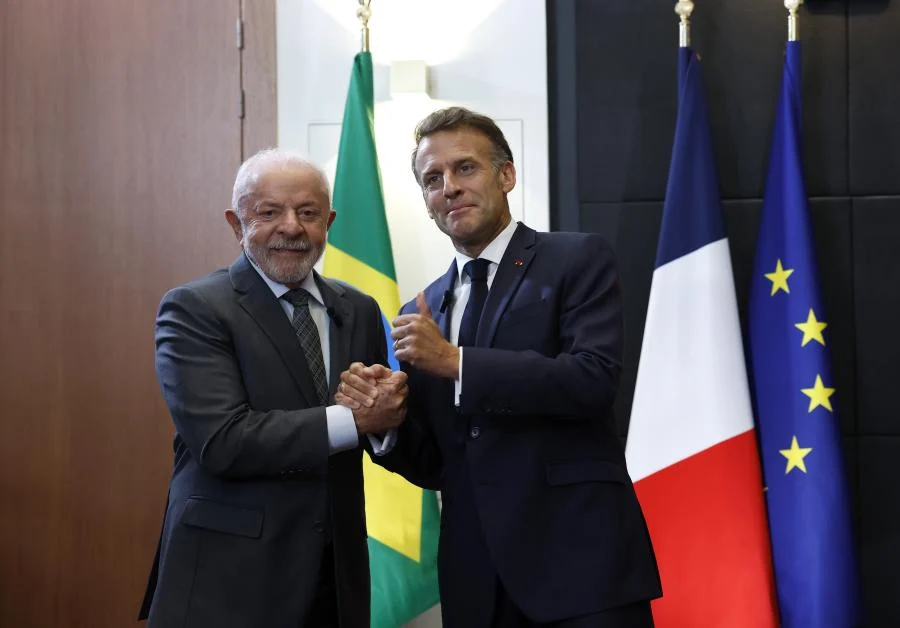
Brazilian President Luiz Inácio Lula da Silva and French President Emmanuel Macron met today to discuss strengthening bilateral cooperation in defense, digital sovereignty, and cross-border integration between French Guiana and the Brazilian state of Amapá. The 40-minute meeting took place on the sidelines of the G7 Summit in Évian, France, according to details released by the Brazilian government.
During the session, the two leaders reaffirmed progress in defense cooperation, highlighting the Submarine Development Program (PROSUB), a joint initiative between Brazil and France. According to a statement from the Planalto Palace, they also agreed to finalize measures to deepen integration along the shared border of French Guiana and Amapá.
Additionally, Macron reiterated France’s interest in participating in Brazilian efforts to acquire supercomputers, an initiative designed to bolster Brazil’s digital sovereignty.
Prior to his meeting with the French president, Lula traveled to Geneva to meet with Swiss President Guy Parmelin to discuss bilateral trade and strategies to diversify exports between their respective nations. The two leaders agreed that the trade agreement between Mercosur and the European Free Trade Association (EFTA) presents a significant opportunity to expand market access amid a global rise in protectionism and unilateralism.
Read more about this topic: Trump tells Macron he doesn’t need “much help” to reopen Hormuz (with video)
Lula and Parmelin also resolved to expand partnerships in cutting-edge sectors, including artificial intelligence, energy transition, critical minerals, biotechnology, health, and defense.
Lula arrived in Europe today to participate in the G7 meetings at the invitation of Macron, where he will engage in working sessions focused on international partnerships, economic growth, and artificial intelligence through Wednesday, alongside several bilateral meetings.
The left-wing leader is also expected to meet with United States President Donald Trump following a sharp escalation in diplomatic tensions between Washington and Brasília over the past few weeks.
The strain began when the United States designated Brazil’s two largest criminal factions—the Primeiro Comando da Capital (PCC) and the Comando Vermelho (CV)—as terrorist organizations, a move opposed by the Brazilian government.
Read more: Brazil: woman dies after rope-jumping instructors fail to secure cord (with video)
Following the designations, Washington announced new tariffs on Brazilian imports after concluding that the South American country’s commercial policies disadvantage American commerce.
Among the practices cited by the United States as supposedly burdening or restricting trade are Brazil’s instant payment system (PIX), illegal deforestation, digital piracy, failures in enforcing anti-corruption laws, weak intellectual property protections, and barriers to the ethanol market.
