

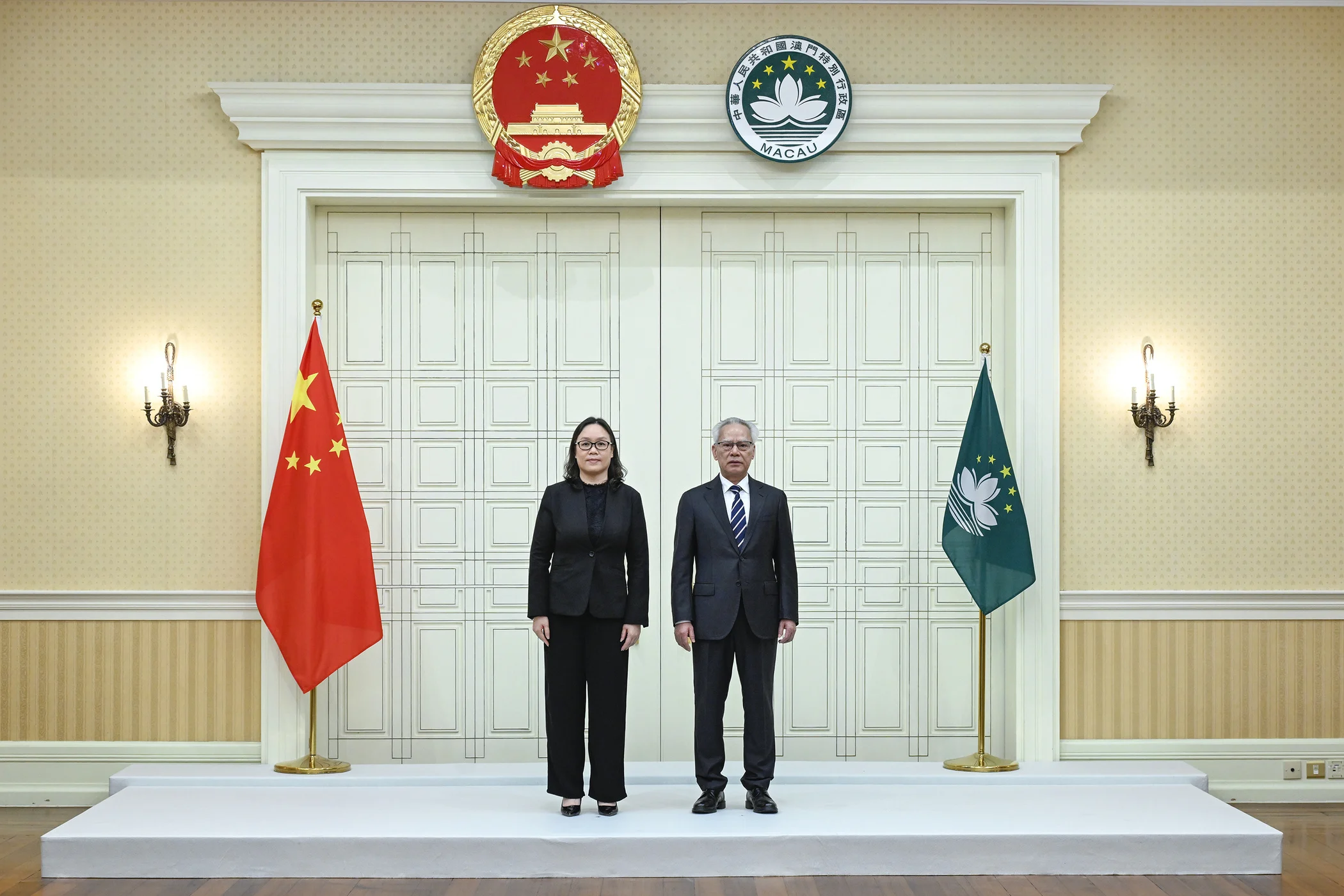
Ng Wai Han is the first woman to take charge of the Economy and Finance portfolio since Macau’s handover in 1999. Until now director of the Gaming Inspection and Coordination Bureau (DICJ), she was appointed by the State Council following a proposal from Chief Executive Sam Hou Fai, after the post had remained vacant for almost two months.
The new Secretary replaces Tai Kin Ip, who resigned in April for “personal reasons”. In her inauguration speech, Ng Wai Han pledged to promote economic diversification and “strengthen Macau’s economic resilience”, arguing that, “in the face of the complexity and volatility of the current external economic environment”, the fruits of development should translate into “tangible benefits for residents”.
According to Sales Marques, the inauguration speech was “short but incisive”. “It struck the right tone and identified the main priorities of her administration,” he told PLATAFORMA. The economist stressed that those who have worked with the new Secretary in previous roles describe her as “open to dialogue” and as someone who “does not shy away from problems”.
That capacity for dialogue, he believes, will be essential at a time when the economic recovery remains uneven. “I believe the first priority must be dialogue with everyone, in order to restore a certain degree of confidence in the direction of the local economic recovery, in the pace and orientation of diversification projects, and in the prospects for Hengqin’s development,” Sales Marques said.
Read also: Macau: Executive dominance “essential for economy”, says Sam Hou Fai
Before joining the DICJ, the new Secretary worked for 21 years at the Labour Affairs Bureau and for a further five years at the Public Administration and Civil Service Bureau. Sales Marques believes that this background puts her “in a good position to engage in dialogue” with the “labour, civil service and gaming sectors”. However, “the business and financial worlds are still missing”, he added.
Speaking to Lusa, Félix Pontes, a former director of the Monetary Authority of Macao, warned that diversification “will not be easy” and could take “five to ten years”, with gaming remaining the Government’s main source of revenue. The economist also highlighted the vulnerability of a “small and open” economy exposed to geopolitical tensions and the slowdown in the Chinese economy.
Labour is among the obstacles identified. Félix Pontes believes that “irrational restrictions on importing skilled labour” have been “inevitably delaying” economic diversification.
Pressure is also being felt in the small retail sector. Carlos Cid Álvares, president of the Macau-based Portugal-China Chamber of Commerce and Industry, told Lusa that expectations surrounding Ng Wai Han are high and will depend on her ability to balance economic diversification with the difficulties facing small and medium-sized enterprises. The chairman of Banco Nacional Ultramarino also warned that “many small street businesses” are at risk of closing, under pressure from online commerce and from residents travelling to Zhuhai, where prices are lower.
Sales Marques also expressed reservations regarding Hengqin. In his view, Ng Wai Han should oversee the cooperation zone “only indirectly, through economic projects”, because the administration of the joint zone represents “too heavy a burden for one person alone”.
