

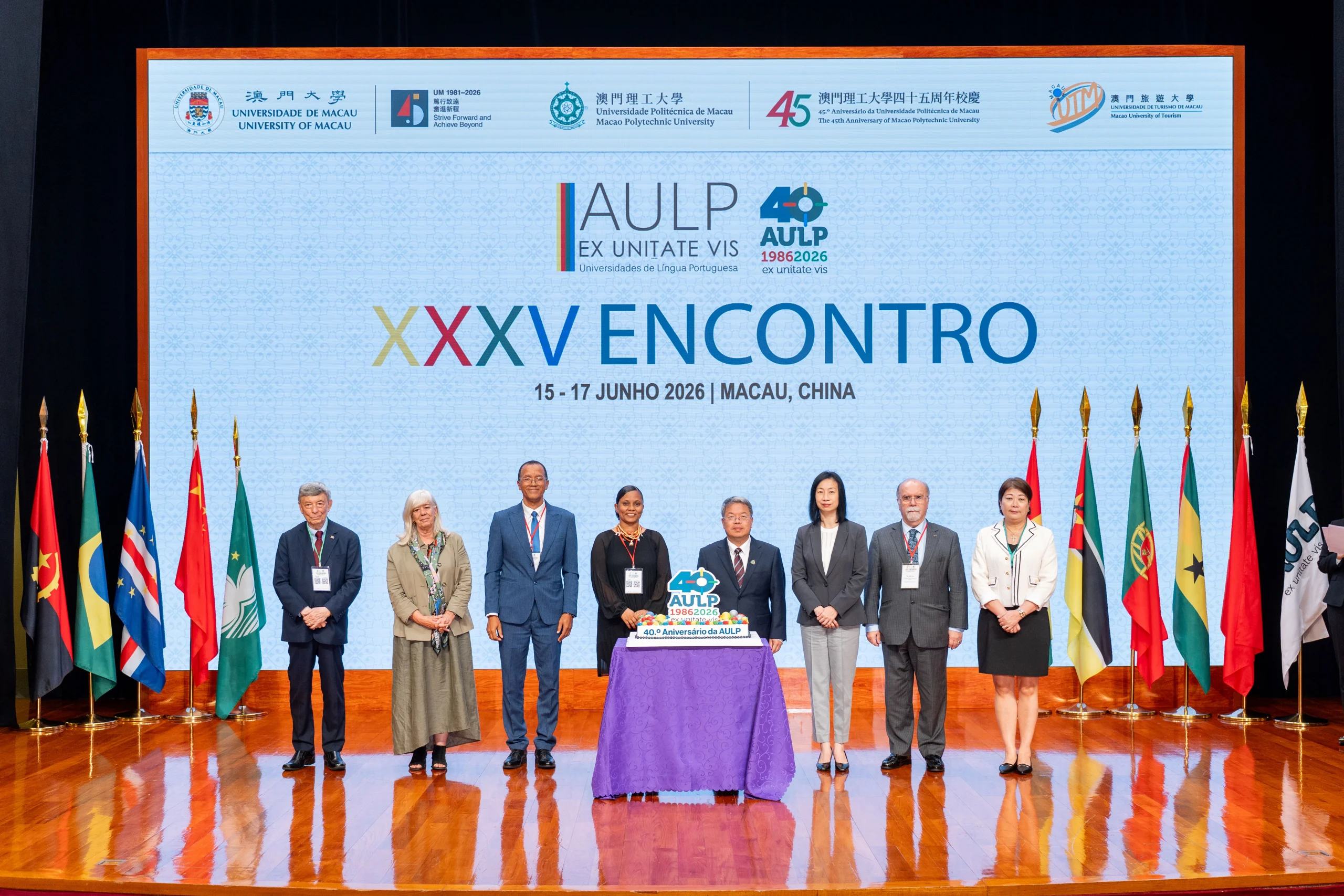
“University collaboration is extremely important in promoting social transformation, and this is the way forward, because knowledge is only valuable when it is shared. Through university collaboration, we can promote social transformation and have a territorial impact,” Astrigilda Silveira, rector of the University of Cabo Verde and president of the AULP, told PLATAFORMA. “Beyond languages and interactions, we need to consider the impact within the real context of our countries.”
“Partnerships are very important. However, we must act according to the local context and development,” she said, while addressing challenges as complex as “digital transformation, artificial intelligence, the energy transition, climate change, food security and sustainable development — the blue economy and the green economy.”
I appeal to the spirit of cooperation that characterises Macau, so that new ideas, projects, partnerships and renewed ambition may emerge from here — Astrigilda Silveira, president of the AULP
Contact with China is “extremely important” for Cabo Verde and, as the Portuguese language is also a “shared heritage” in Macau and a “strategic asset”, it is above all “an instrument for bringing people closer together and a platform for global solutions based on diverse realities”. Silveira appealed to the “spirit of cooperation that characterises Macau” so that “new ideas, projects, partnerships and renewed ambition may emerge from here” as the AULP approaches its 40th anniversary.
Petrilson Pinheiro, director of the Institute of Language Studies at the University of Campinas in Brazil, highlighted the role of universities as “catalysts and the ideal setting for thinking about interculturality, transculturality and translingualism”.
In a politically turbulent world, Petrilson spoke to PLATAFORMA about internationalisation with “care”. Far beyond English-language programmes for everyone, “we need to think about strategies that increase universities’ participation in society, taking into account different contexts and countries, and considering what each can best offer across different fields of knowledge”.
Despite the physical and geographical distances, we are not so far apart. We are here in China speaking Portuguese — and that is incredible! — Petrilson Pinheiro, director of the Institute of Language Studies at the University of Campinas
Brazil is currently very close to China, and “Macau has that feeling. The Portuguese-language dimension is very strong, and thinking about this Portugal-Brazil-China axis at an event like this is very important. Despite the physical and geographical distances, we are not so far apart. We are here in China speaking Portuguese — and that is incredible!” Pinheiro exclaimed.
Read also: Macau: MGTO launches platform and study programme to boost “tourism + education”
António José da Cruz Belo, president of the Lisbon Polytechnic Institute, told PLATAFORMA that “more than training technicians or qualified professionals, the aim of universities is to educate global citizens. Looking at today’s international reality, the need for people who see the world as a whole has become even more urgent.”
More than training technicians or qualified professionals, the aim of universities is to educate global citizens — Cruz Belo, president of the Lisbon Polytechnic Institute
“Relations between countries and exchanges of students and lecturers enrich this mission of educating citizens and trying to move towards a more understanding and more humane society.”
In this context, Belo explained that the global teaching of English “reduces distances, but does not truly bring us closer. What brings us closer is learning each other’s languages and cultures”, drawing us “closer to a global culture, rather than the isolationism in which everyone believes their own country must come first”.
Academic platform
The AULP is the “main international academic bridge for consolidating the global Portuguese-speaking higher education system”, said Yonghua Song, rector of the University of Macau, which organised the meeting. During the opening ceremony, he described the UM’s “consolidation” and its contribution to “the development of Macau and the Greater Bay Area, serving the country and strengthening its global presence”.
This is a time of “expansion” and “unprecedented development opportunities”, particularly with the construction of the new campus in Hengqin. The “dual-campus” model, Yonghua Song said, “strengthens Macau’s unique advantages as a platform between China and Portuguese-speaking countries”, reinforcing “points of convergence for academic, cultural and talent exchanges, and injecting new vitality into bilateral cooperation”.
Budgets moving at different speeds
The rector of the Pedagogical University of Maputo (UPM) expressed regret that the impact of partnerships between Portuguese-speaking higher education institutions is limited by financial constraints. He argued that the AULP should also provide a forum for discussing the “different speeds” of universities in Portugal and Brazil compared with those in Portuguese-speaking African countries.
Speaking to Lusa, Jorge Ferrão explained that universities “sign agreements almost every day; each of us signs between 20 and 30 every year”, usually following the same model: “Mobility for students and lecturers, and research opportunities.”
In Portuguese-speaking African countries, the priority remains access to postgraduate education in Portugal and Brazil. “It helps to address shortcomings among lecturers who need those qualifications,” he said, adding that “our research, being at an early stage, needs to be anchored by researchers who have access to different laboratories, materials and equipment”.
However, cooperation “only takes place when there is sufficient financial capital”, while budget cuts affecting universities in Portuguese-speaking African countries are repeated “year after year”. As the AULP was founded in 1986, “we cannot continue wearing the same shoes we wore 40 years ago”, because “they no longer fit everyone”, Ferrão said.
Read also: Macau highlights the historical legacy of the Chinese Army and reinforces patriotic education
Profound transformation
The AULP president warned of a “profound transformation” taking place in Portuguese-speaking universities. “Artificial intelligence is changing the way we produce, share and use knowledge, while digital transformation is redefining teaching, learning and research processes,” Astrigilda Silveira said during the event’s opening ceremony.
Meanwhile, “climate change particularly challenges small island states, coastal regions and the most vulnerable communities”, meaning that universities must be “leaders and promoters of change”, educating “highly qualified professionals and citizens committed” to sustainable development.
“No university, however strong, will be able to respond alone to the major global challenges. We need collaborative science, research networks and the sharing of infrastructure, knowledge and talent,” stressed the rector of the University of Cabo Verde.
Portugal’s Minister of Education, Science and Innovation, Fernando Alexandre, announced that the Portuguese-language artificial intelligence model “Amália” would be presented “this month”. The Ministry for State Reform has described the AI model as “strategic for Portugal” and announced that it would be “geared towards developing new use cases, including within the education system”, supporting students and teachers in the Portuguese context.
A world still waiting to be opened
Wang Xin, vice-rector of Shanghai International Studies University, delivered a speech aligned with multiculturalism and globalisation. In that context, language teaching is not an end in itself, but an “instrument for sharing knowledge between cultures and civilisations”. Responding to a question from the audience, she said that even arts education forms part of this intercultural connection.
However, when invited by our newspaper to expand on her argument and comment on the current importance of the Portuguese language in China, she politely declined. There are “rules” governing contact with the media. She was willing to exchange views informally, but not to make statements.
This was immediately confirmed by a young man accompanying her, who approached, looked at his watch and explained that they had “other commitments”. Wang Xin could not speak.
