

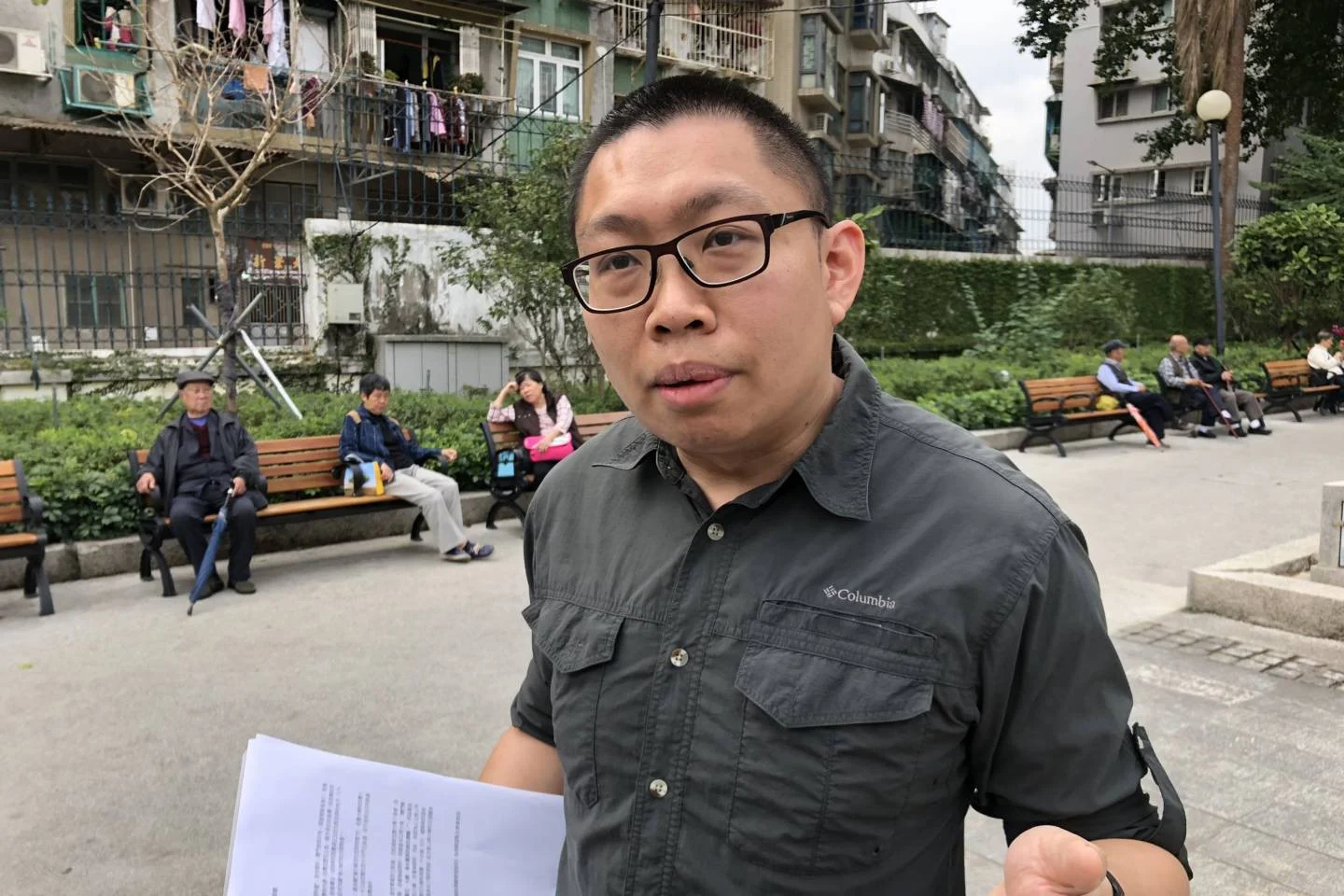
– You chose to study Land Economics at National Chengchi University in Taiwan. Why, and what impact did that education have on your work in public participation?
Rhino Lam – I chose to study Land Economics solely because of my personal interest in map-related subjects. As the courses focused on land resource planning, they had a certain practical application, which is why I made that choice.
Although Taiwan and Macau are both predominantly Chinese societies, Taiwan underwent many changes during the 2000s. I witnessed the positive and negative aspects of different places, cultural concepts and systems, and I also interacted with many ethnic Chinese students from Southeast Asia. Those experiences were very useful. Even when we speak the same language and write the same characters, our ideas can differ greatly. The most important thing in public participation is to accept differences in people’s ideas; too many prejudices prevent communication.
– When you returned to Macau, how did you see the city, and how did you become involved in community planning?
R.L. – In the 2000s, the Macao SAR Government had only recently been established and there was no comprehensive urban planning system, while the economy was developing rapidly. I felt Macau urgently needed urban planning, but I did not pursue that route. I did not want to wait for the Government to complete all the supporting measures, including the main laws and professional systems.
I tried to work with a group of friends and spoke to leaders of neighbourhood associations I knew about whether community development and planning could be a starting point. With their support, the neighbourhood association leaders agreed to give it a try.
I believe Macau has already moved beyond the period of greatest conflict between development and conservation
– You were among the first in Macau to promote community planning and public participation, and also one of the first certified urban planners. Over two decades, what were the main opportunities and obstacles? Was there a decisive moment?
R.L. – Looking back, the most unforgettable moment in my career was, as I mentioned, when the leaders of neighbourhood associations dared to place their trust in a group of recent graduates to do something that probably no one had ever done before in Macau: public participation planning for a street.
On that basis, the Land and Urban Construction Bureau later began to cooperate with us. It was a very significant process and opportunity.
Public participation has also encountered obstacles. I think many residents have felt that the Government’s consultation work in recent years is different from what it was during the first decade after the handover. It is now undoubtedly more standardised, with clearer rules to ensure that residents have access to information. Relatively speaking, however, the Government’s flexibility and enthusiasm for consultation are no longer as strong as they once were. That is my personal impression.
– You served on the Urban Planning Council between 2014 and 2020 and were also a member of the Cultural Heritage Council. What did you learn from moving from civic advocacy into an official advisory structure? What is the greatest difficulty in defending conservation and planning from within the system?
R.L. – My term as a member of the Cultural Heritage Council ended in May. I remain myself, even when sitting in the position of an adviser, and I continue to try to consider every issue under discussion from the perspective of a resident.
Of course, during my time as an adviser, I learned more about the Government’s decision-making process, and sometimes it genuinely faces difficulties. The hardest part is clearly understanding those difficulties while still being unable to refrain from offering opinions, or even criticism, because otherwise it is difficult for things to improve. A balance has to be found.
– In 2008, you founded the community planning cooperative Root Planning with a group of urban planner friends, choosing the San Kio district, closely linked to your childhood memories, as the first area of intervention. What did the project represent at the time, and how do you assess the development of public participation in Macau today?
R.L. – Root Planning’s Chinese name is aligned with the theme of public participation in urban planning. As for the English name, it was chosen by a team member with a strong command of English. ROOT, the root, represents the public and residents as the foundation of the city, and also points to public participation in urban planning.
“Miraculous assistance” is a common feature of cooperation between many NGOs and the Government in Macau. When government policies and resources are available, things can move forward; without them, they have to stop. This works both ways. There has been considerable criticism of changes in government policies in the past, not only in the field of urban planning. However, as a planner, I also need to examine my own role. The ability to operate effectively without official resources is the fundamental principle of bottom-up development, and this is a direction that still needs to be explored.
Promoting public participation requires persuading others, but also being prepared to be persuaded. The best answers are found among the public, not in air-conditioned rooms
– You have made technical contributions to several recent public debates, from pedestrian overpasses in New Urban Zones A and B to the revitalisation of the Lai Chi Vun shipyards and the redevelopment of the Iao Hon district. How should Macau balance development and conservation in such a densely populated city with so much heritage?
R.L. – Personally, I believe Macau has already moved beyond the period of greatest conflict between development and conservation. Urban planning and cultural heritage systems have been established over roughly the past decade, and society has adapted to the existence of those restrictions. Today, few people challenge those systems.
The balance between development and conservation is related to public awareness of these issues. Perceptions change. For example, before the handover, the Government excavated the Mount Fortress to build the Macao Museum, but something similar would be unlikely to happen today.
– You have long been committed to public participation in urban planning and to promoting cultural heritage. Why is it important to tell the public the “story of Macau”? And how is this connected to your planning work?
R.L. – If we do not know Macau’s history, it is difficult to say what should be preserved. The value of cultural relics, landscapes and other elements depends to a large extent on the story they tell and the impact that story has on Macau.
For example, when the Guia Lighthouse and the Macau-Taipa Bridge become symbols of Macau, their value goes beyond that of merely being a tower or a bridge. This naturally influences the technical judgements that must be made in urban planning.
– What advice would you give young people who want to work in urban planning and public participation?
R.L. – In the future, Macau will certainly continue to need people working in urban planning. Artificial intelligence cannot replace human beings when it comes to persuading others.
However, we should not be overly optimistic about this profession, because Macau has already gone through two decades of rapid development. Promoting public participation requires persuading others, but also being prepared to be persuaded. The best answers are found among the public, not in air-conditioned rooms.
– If you could change one rule in Macau’s urban planning over the next 20 years, what would it be? What kind of city do you imagine for the future?
R.L. – I want everyone to understand that protecting cultural relics, streetscapes and urban landscapes can generate considerable commercial benefits; it is definitely not a losing proposition. My vision is for Macau residents to live increasingly comfortable lives.
