

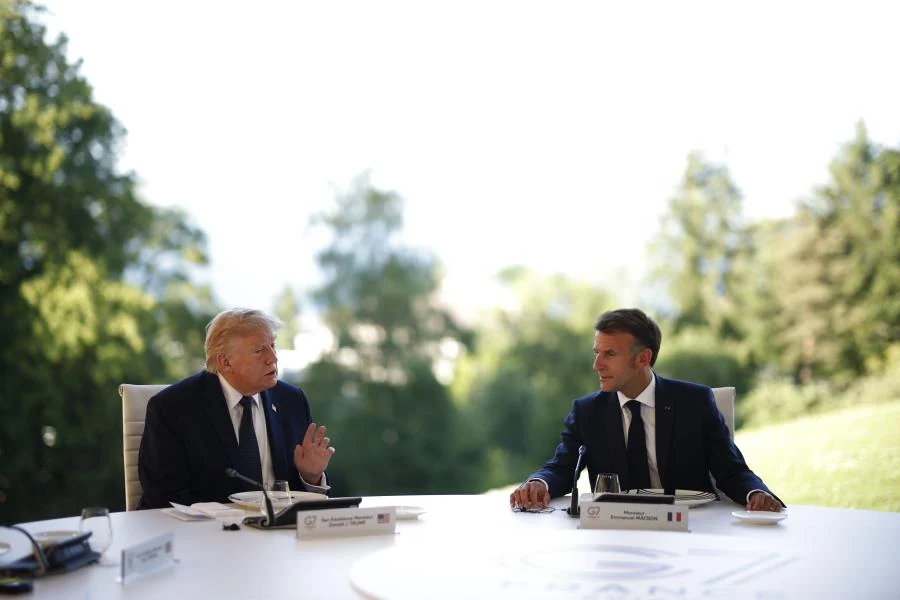
US President Donald Trump declared today at the G7 Summit in Évian, France, that he does not need “much help” from the international community to reopen the Strait of Hormuz following the conclusion of a peace agreement with Iran.
Addressing French President Emmanuel Macron, Trump remarked, “But I don’t think it’s a bad idea to have one or two boats from a few countries—your country would be very good for that, because you never know.” Macron had reiterated France’s offer of a joint Franco-British international military mission to assist with maritime security in the region.
In response to Trump’s comments, the French Head of State acknowledged the US position, noting that while an international presence might not be desired or necessary, the offer remains a clear demonstration of Europe’s willingness to assist. Shortly before their bilateral meeting, which serves as a prelude to the wider G7 meetings, Macron told Trump that approximately 20 nations are prepared to contribute to restoring free navigation through the vital maritime corridor.
However, Macron emphasized that any deployment of the joint coalition would depend entirely on the explicit request and consent of both the United States and Iran.
Read more about this topic: Trump confirms deal with Iran and reopening of Hormuz (with video)
The European-led coalition, spearheaded by France and the United Kingdom, was originally formed shortly after the outbreak of the war involving the United States, Israel, and Iran on February 28, during which Tehran retaliated by closing the critical shipping lane.
The alliance of neutral nations was established to guarantee the restoration of free trade in the event of a ceasefire, provided both warring parties agreed.
Macron hailed Sunday’s peace announcement between Washington and Tehran as a monumental milestone for global stability, noting that it addresses Iran’s nuclear program—which he termed a critical issue for world peace—while paving the way for the reopening of Hormuz and anticipating secondary peace developments in Lebanon.
The French leader stressed that the diplomatic breakthrough is vital not only for peace seekers but also for the global economy, which has suffered severe disruptions since the closure of the strait.
