

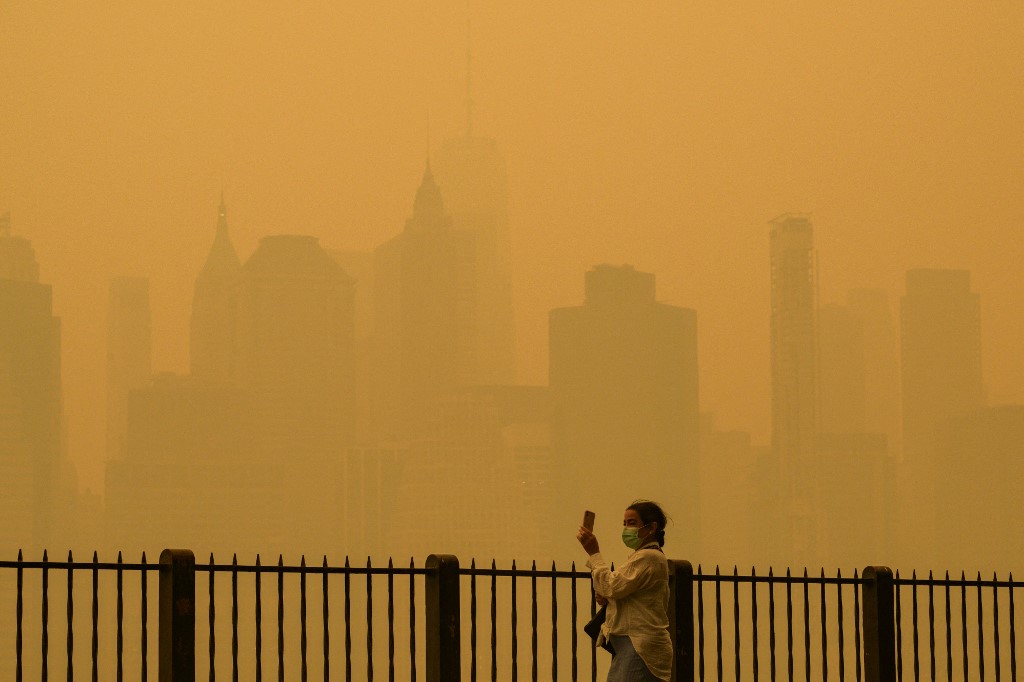
Human-caused climate change doubled the likelihood of the extreme weather conditions that fueled Canada’s massive summer wildfires, according to a study released Thursday, complicating President Trump’s repeated claims that the fires stem from poor forest management, according to a report from the AP.
The research, conducted by World Weather Attribution, examined the fire-prone weather in the Northwest Territories and northwestern Ontario, weather marked by heat, dryness, low humidity and wind, and found global warming made those conditions roughly twice as likely. That’s comparable to the group’s earlier findings on France’s summer fires, though less pronounced than in Spain, where climate change was found to have made fire conditions 20 times more likely.
Comparing current conditions to a pre-industrial world without the roughly 2.5 degrees Fahrenheit of warming caused by fossil fuel emissions, researchers found that the week-long weather pattern behind Ontario’s fires now recurs roughly every six years, rather than the rare, once-in-a-lifetime event it would have been before industrialization, according to study co-author Jonathan Boucher, a fire scientist with Canada’s Forest Service.
Outside experts said the findings align with a broader pattern of hotter, drier conditions fueling more frequent and intense wildfires. Mike Flannigan, a fire scientist at Thompson Rivers University who wasn’t involved in the study, described nature as “burning” for ages but now doing so “on amphetamines” due to continued fossil fuel use.
Read more about this topic: Canada: 800 wildfires send toxic smoke into the US
The wildfire smoke spread across both Canada and the U.S. this summer, choking major cities including New York. In the sprawling Northwest Territories fires, which burned more than 5,000 square miles, researchers said lightning sparked the initial blazes, but climate conditions caused them to burn more intensely and spread beyond control.
While roughly half of Canada’s wildfires are human-caused, lightning-sparked fires account for more than 90% of the total area burned annually, according to Flannigan.
“What we’re facing here is more of a climate related problem than a forest management problem,” Boucher said.
Trump has taken a different view, telling reporters in July that Canada isn’t managing its forests properly and blaming the country for smoke drifting into cities like New York and Detroit. Speaking to reporters aboard Air Force One Sunday, he said he had decided on unspecified punitive measures against Canada, promising details would come soon.
Read more: Carney embraced Trump’s “nasty” jab at Canada. A 50% tariff deadline is now two weeks away
Canadian scientists pushed back on that framing. University of Victoria climate scientist Andrew Weaver said that while wildfire smoke doesn’t carry a passport, carbon emissions do have a documented history, one showing the United States has contributed more than any other country.
He argued Trump is focused on the smoke while overlooking America’s own role in the underlying climate conditions. Study co-author Friederike Otto, a climate scientist at Imperial College London, said continued fossil fuel use carries consequences that are already being felt, regardless of who is most affected.
Canada has warmed 65% faster than the United States in recent decades, and the area burned annually by Canadian wildfires has risen about 50% over the past 30 years, compared with more than double in the U.S. over the same period. Boucher and Flannigan noted that much of Canada’s forest lies in remote, northern regions dominated by spruce and pine, species that burn fast and hard, making rapid containment extremely difficult.
Flannigan said crews often have only about a 30-minute window to extinguish a fire before it becomes unmanageable, a narrow margin complicated by the fact that many fires ignite in areas more than 30 minutes from the nearest airport, meaning even flawless detection systems couldn’t guarantee a fast enough response.
