

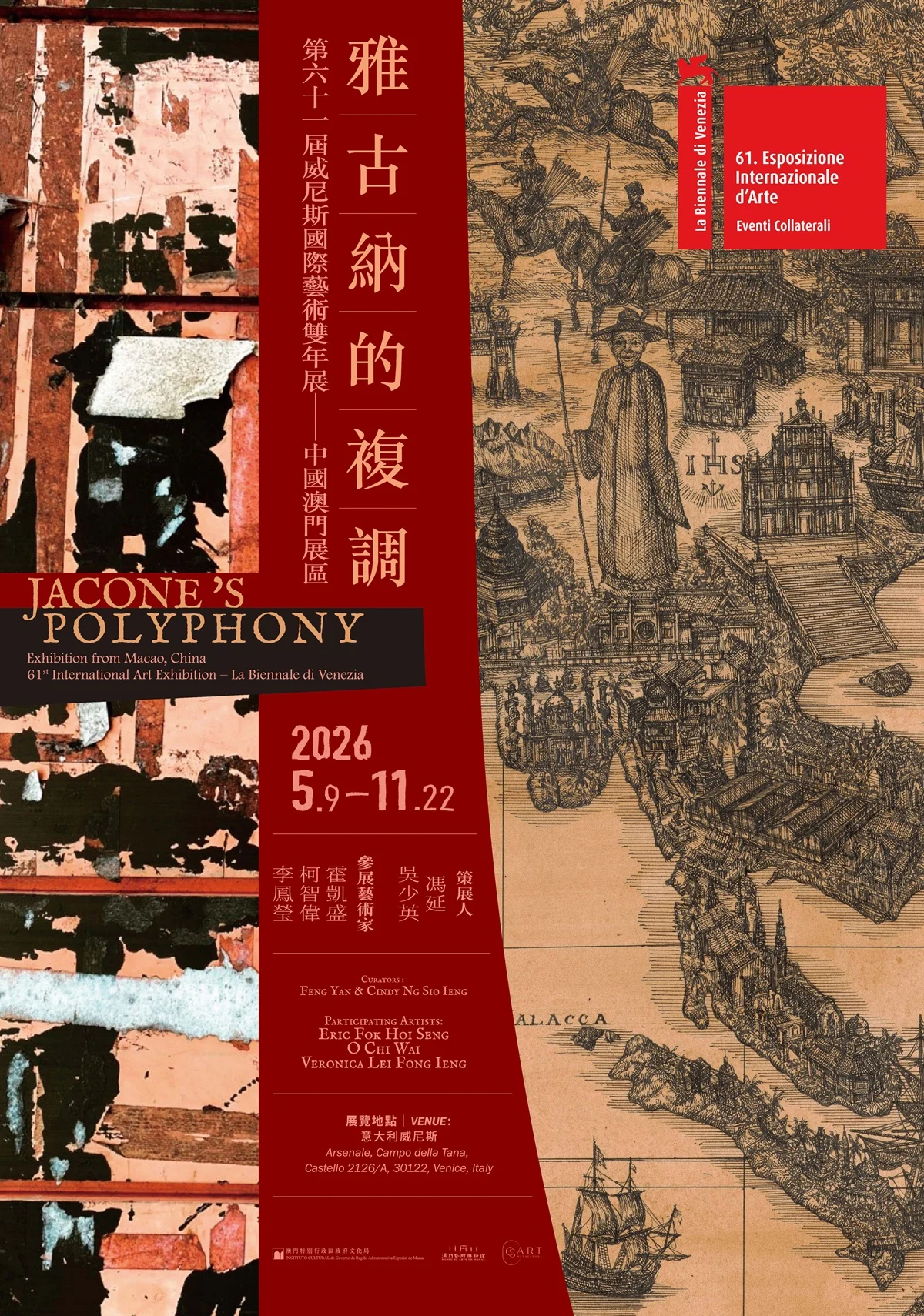
Curated jointly by Feng Yan and Cindy Ng Sio Ieng, “Jacone Polyphony” was selected as Macau’s Collateral Event in the current edition of the Venice Biennale. The exhibition brings together installations, paintings, and video works by the three Macau artists, taking as its starting point the life and spiritual journey of Wu Li.
Wu Li is recognized as one of the “Six Great Painters of the Early Qing Dynasty”. After being baptized, he adopted the name Simão Xavierus and the Portuguese surname Cunha. The term “Jacone”, a transliteration of Cunha, is the origin of the exhibition’s title.
In 1681, Wu Li travelled to Macau to accompany missionaries on a journey to Rome, where he intended to study theology. The trip did not materialize, but the painter remained in the city to deepen his religious studies. The experience was recorded in Sanba Ji – Collection of Poems of St. Paul -, where he described the landscape and the encounter between cultures in Macau.
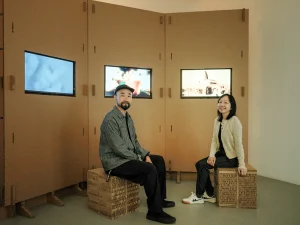
The Cultural Affairs Bureau invited the finalist curators of the Local Curatorial Project for “Arte Macau: Macau International Art Biennale 2025” to submit proposals for the Macau, China Collateral Event at the Venice Biennale, from which the final concept was selected
Eric Fok notes that “the poetry collection portrays many scenes of Macau, such as dark-skinned people dancing during Christmas”. The poems also mention “his difficulties in his studies, as well as the longing he felt for his late wife and his teacher”, among other aspects.
An “unconventional” figure
From O Chi Wai’s perspective, the work they are now presenting is a “spiritual transformation of Wu Li”. “At that time, he was unable to reach Italy, but we brought an exhibition about him to Italy.”
The life and spirit of Wu Li served as inspiration for the works of O Chi Wai and Eric Fok.
Wu Li was an “unconventional” figure for his time, explains O Chi Wai. “He knew Buddhism, later converted to Catholicism, painted ink landscapes and composed Catholic hymns using the musical structure of Chinese opera.”
The artist stresses, however, that the starting point of his work was not directly “Sino-Western cultural fusion”, but rather “telling a story based on the entire life conditions” of Wu Li.
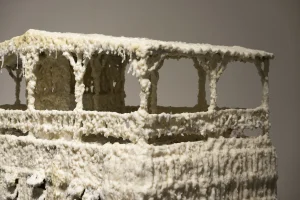
The work ‘Sigh of Migration’ by another participating artist, Veronica Lei. According to the information provided, the artist seeks possible connections between fragmented history and fragments of contemporary memory through her work, thereby echoing the process of reclaiming the individual’s spiritual sustenance in cultural migration
The three videos created for the exhibition are played in a continuous loop, with no clear beginning or end, as if maintaining a dialogue with one another. “I hope the audience, after watching, can reflect a little.”
Eric Fok started from another possibility: what would have happened if Wu Li had managed to reach Europe? From this hypothesis, the artist seeks to encourage reflection on Macau and on the city’s historical importance.
“He was a citizen of the Ming dynasty. As an intellectual under a new regime, he could have had many opportunities, but he may have been affected by the tensions between the Han and the Manchus at the time. He did not go with the flow, which I consider a rare quality.”
Wu Li’s presence in Macau also allowed Eric Fok to revisit the city’s role as a bridge between China and the outside world.
“He, originally from Jiangsu, came specifically to Macau to catch a ship to Europe, because Macau was, at the time, an important port in the Far East,” Fok tells PLATFORM. “Through this story, we aim to talk about the importance of Macau at that time, and also about what Macau is and what it means,”
O Chi Wai’s ‘A Cappella Reverie’. Through a walking tour and a narrative video, the work reimagines Wu Li’s life journey and fosters a spiritual dialogue. By bringing Wu Li’s transcultural life experience to life, it explores the multiple possibilities of identity in the context of globalization
What remains after Venice
This edition marks Macau’s tenth participation in the Venice Biennale, since its debut in 2007. For O Chi Wai and Eric Fok, the Biennale’s structure of national and regional pavilions allows them to “observe different ways of presenting local identities and cultures on an international stage.”
“You can see the characteristics of different countries; some are more open, others more traditional,” says O Chi Wai. The experience also led the artist to reflect on the “continuity” of his creative practice and on how he can “represent the reality of Macau” through artistic work.
“I returned about a month ago, and from now on I feel I should think about how to continue making related works, or how I should use my work to express more of the condition of this place,” he explains.
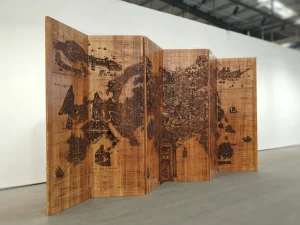
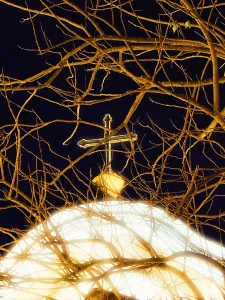
‘Silent Travelogues’ by Eric Fok. Taking historical absence as its central starting point, the work unfolds as an imaginative exploration of the historical lament surrounding Wu Li’s unfulfilled journey to Rome. Through this small opening, which conveys an imaginary narrative, the audience catches a glimpse of another dimension of Wu Li’s journey
For Eric Fok, the Biennale represents a “rare opportunity” for Macao artists and may help “increase the confidence of commercial galleries” and “collectors” in locally produced work. “Many connections can emerge in these moments, and creators themselves need to seize the opportunities.”
However, the artist considers that “the work cannot end with participation in the exhibition”. He argues that the impact should be “extended” through greater “media coverage, critical engagement and follow-up.”
“International art festivals are important,” he says, “but being seen only once is something that is quickly forgotten; only we ourselves remember it.”
