

Invoke the name Na Tcha, and for many, the image that springs to mind is that of a valiant child god, soaring upon his Wind-and-Fire Wheels and wielding a Fire-tipped Spear. Na Tchais a child figure in Chinese mythology, featuring prominently in classical literature. In Journey to the West, his relationship with the Monkey King famously begins in conflict before blossoming into mutual respect; in the Investiture of the Gods (Fengshen Yanyi), he is the third son of Li Jing, the Pagoda-Bearing Heavenly King and military commander of Chentang Pass.
However, historical scholarship suggests that Na Tcha originally emerged as a Buddhist protector deity, tracing his roots back to Indian mythology. It was only after the Tang and Song dynasties that he was woven into the fabric of traditional Chinese folk belief, gradually evolving into a prominent deity within the Daoist pantheon. Propelled by the immense popularity of fantastical vernacular novels, his iconic image as a formidable child deity became deeply etched into the public consciousness.
Read more:No Ifs in History: The Guangxu Emperor’s Unfulfilled Hundred Days Reform
Across the Chinese diaspora, Na Tcha stands as a symbol of bravery, rebellion, and uncorrupted innocence. Yet, in Macau—a city defined by its profound synthesis of Eastern and Western cultures—Na Tcha transcends his literary origins. For over a century, he has been a vital anchor of folk belief, safeguarding the local populace and binding the community together.
Macau, indeed, boasts its own unique vernacular legends surrounding the deity. It is said that during the early Qing dynasty, Na Tcha manifested himself on Mount Hill (or Shi Shan), protecting the local residents who subsequently erected a shrine upon a boulder in his honour. Later, during a devastating plague in the late 19th century, the residents of Pátio do Espinho(near the Ruins of St Paul’s) reportedly received a vision of Na Tcha in a dream. Following his divine intervention, the pestilence was eradicated, prompting the grateful townsfolk to build a temple in thanksgiving. Since then, Macau’s Na Tcha customs have been passed down through centuries, not merely bearing witness to the city’s historical evolution, but serving as a quintessential microcosm of its religious tolerance and cultural plurality.
Neighbours in the Divine: A Rare Cultural Spectacle
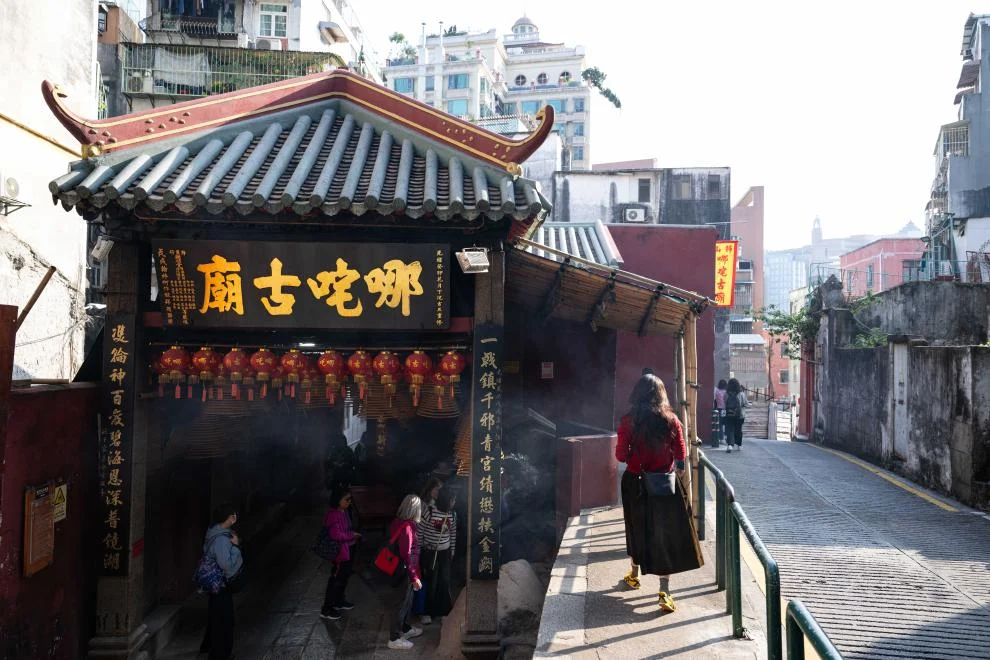
While the worship of Na Tcha is widespread across Chinese communities, the geographical placement of the Na Tcha Temple near the Ruins of St Paul’s is entirely without parallel.
The Na Tcha Temple is a modest, unadorned structure of traditional Chinese design. Yet, standing in immediate proximity is the imposing, majestic façade of the Ruins of St Paul’s. On one side sits a Daoist deity representing Eastern folk religion; on the other, a monumental historical landmark of Western Catholicism. For over a century, these two distinct worlds have shared the exact same plot of earth.
This striking juxtaposition of Eastern and Western divinities residing as neighbours does not feel the least bit incongruous. On the contrary, it forms one of Macau’s most captivating urban landscapes. It is a profound architectural articulation of Macau’s centuries-old identity as a crossroads of East and West: a place where differing races, religions, and cultures do not merely coexist, but do so with mutual respect and harmony.
 Keeping the Flame Alive: Intangible Heritage in the Streets
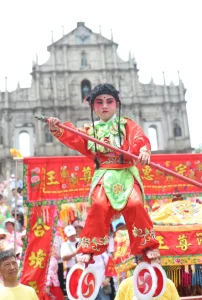
The Feast of Na Tcha remains one of the most animated days on Macau’s calendar. To commemorate his birth, both of the city’s Na Tcha temples orchestrate magnificent celebrations. The itinerary is exhaustive: solemn prayer ceremonies, the rhythmic spectacle of lion dances, traditional ‘thanksgiving operas’ performed for the gods, and the distribution of ‘blessed rice’ to the public, symbolising peace and good health.
The undisputed highlight, however, is the grand Na Tcha procession, featuring the visually arresting parade (or Piao Se). This year, for instance, the procession from the Na TchaTemple at the Ruins of St Paul’s weaves its way through the Macau Peninsula and Taipa; meanwhile, the parade originating from the ancient Mount Hill temple sees the child god escorted by golden dragons and flower-scattering celestial maidens, making its way to Senado Square to receive the veneration of the faithful.
Bolstered by its rich historical resonance and deep-rooted community support, the Macau Na Tcha customs were successfully inscribed as a ‘National Intangible Cultural Heritage’ in 2014, and subsequently added to Macau’s own intangible cultural heritage list in 2019. This recognition is not merely an official endorsement of Macau’s folk traditions; it has provided a vital shot in the arm for the preservation and continuation of this ancient practice.
A Cultural Anchor for the Future
As the wheels of time turn ever onward, Macau has metamorphosed from a sleepy fishing village into a cosmopolitan metropolis of international renown. Gleaming skyscrapers now pierce the skyline, and modern lifestyles evolve at a dizzying pace. Yet, nestled amongst the grey bricks and green tiles beside the Ruins of St Paul’s, amidst the crashing gongs and drums of the festival, this ancient faith retains a vibrant, pulsating life force.
Macau’s Na Tcha customs have long since become a cultural bridge linking the past to the present, anchoring the local population’s sense of community and identity. No matter how the eras may shift, this child god upon his Wind-and-Fire Wheels will undoubtedly continue to stand at the crossroads of East and West, quietly keeping watch over this endlessly fascinating, legendary city.
