

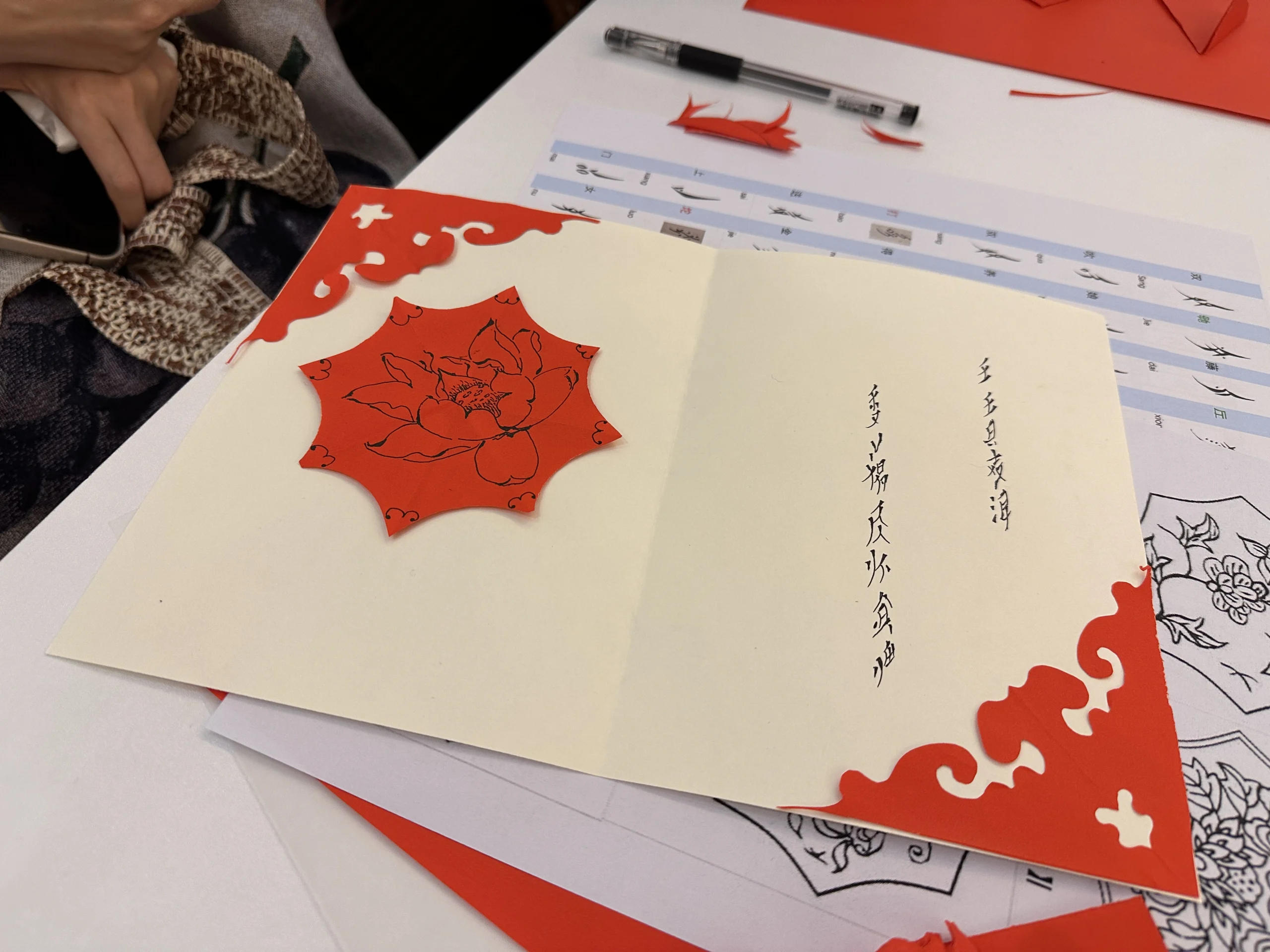
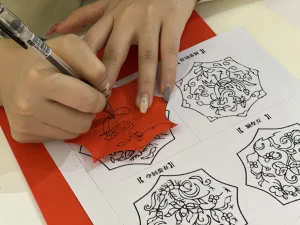
Participants of various nationalities were softly humming songs in Nüshu with the help of Pinyin –
official system of Mandarin romanization – as they became familiar with this unique calligraphy, or drew the characters, experiencing this ancient form of “confidence between close friends.”
“Macau is a plural and inclusive city where Eastern and Western cultures intersect,” says Pan Shengwen. “The workshop features participants who speak different languages, but everyone learns the same culture and feels mutual identification. This is precisely the embodiment of the concept of ‘sisters of one family,’ ” she explains to PLATAFORMA.
The Nüshu is a writing system exclusive to women that, in the past, was popular in the Jiangyong region of Hunan province and was included in the first batch of National Intangible Cultural Heritage in 2006. The characters appear in a slanted diamond shape, resembling willow leaves.
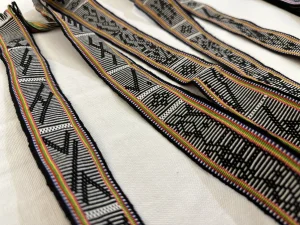
Nüshu was not limited to being written on paper or silk; it could be woven into belts and handkerchiefs, embroidered onto lace, or inscribed on fans, and was also transmitted orally in the form of ballads. Its content included intimate confidences, vows of sisterhood, and more, constituting a precious living heritage for the study of Chinese women’s history and popular culture.
Macau is a plural and inclusive city where Eastern and Western cultures intersect – Pan Shengwen, founder of the Nüshu Art Development Project
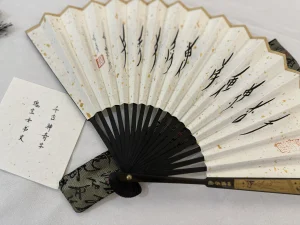
Passed down from generation to generation, from mothers to daughters and never to men, and due to the strict custom of “burning the writings after the author’s death,” surviving works are extremely rare. The oldest record found to date is a copper coin minted at the end of the Qing dynasty (1644-1912), on which there is an engraving of Nüshu: ‘All women in the world form one big family of sisters.’
Born in the 2000s, Pan Shengwen made this practice her vocation from the moment she first came into contact with the culture. Nüshu, for four years. His artistic creation focuses on calligraphy. They have also launched an artistic project of a solidarity nature based on the concept “Intangible Cultural Heritage + Public Co-creation”. Its goal is to raise awareness among more people about the challenges of women’s development and to help women grow and become their best selves.
Digital salvation
In 2002, the Ecological Museum was inaugurated in Jiangyong, Hunan, which over the years has promoted and preserved this culture through various means. Recently, the museum underwent renovation works, now promoting and transmitting Nüshu through Augmented Reality (AR) and other digital presentations. The Jiangyong government has also organized training courses in Nüshu, where Pan Shengwen takes on the role of trainer.
Read also: 15th Macau Literary Festival Brings Worlds and People Together
He Yanxin, the last natural transmitter of Nüshu (a native practitioner who lived the culture) in its original environment, died last October. Currently, there are only 11 heirs to this writing.
Regarding the safeguard of Nüshu Pan Shengwen appears optimistic, thanks to social intervention projects developed by the government and a group of university students, in collaboration with various educational institutions, leading to Nüshu to come out of museums and integrate into the community.
“Our initial intention was to create a solidarity project that would have an impact on people’s lives. We have already organized two art festivals and held benefit sales, the proceeds of which were donated to help more people, such as women fighting cancer or girls from isolated mountainous regions,” says Pan to PLATAFORMA.
Respect the culture
As Nüshu gains greater visibility, an increasing number of people have used this theme for their creations. Given the different interpretations, Pan Shengwen feels that in the past, there were those who would extrapolate their culture of suffering and lamentation; however, in the new era, the focus has gradually shifted towards a more positive perspective, demonstrating that “culture takes on different forms of expression depending on the era.”
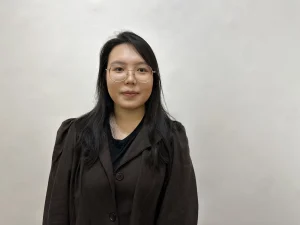
The reduction ofNüshuReducing characters to mere symbols reveals, at its essence, a lack of respect for culture; those who truly respect it seek to understand its origin and evolution – Pan Shengwen, founder of the Nüshu Art Development Project
Pan also emphasizes a concept proposed by Professor Zhao Liming from Tsinghua University: we are currently living in the “Post-era”, and the correct development and transmission of this culture in the new era constitute a challenge of extreme importance: “The goal is not to allow the culture to become distorted, a task that requires the joint effort of all of us,” she states.
So, Nüshu is not just an accessory, but rather “the record of the authentic feelings of people who actually existed at that time.” And “the reduction of “Nüshu” to characters as mere symbols reveals, at its essence, a lack of respect for culture; those who truly respect it seek to understand its origin and evolution,” says Pan to PLATAFORMA.
Read also: Macau returns to Festas de Lisboa to promote Chinese culture
However, it reiterates that it does not oppose artistically inspired creations based on Nüshu. She gave the work of renowned Chinese composer Tan Dun as an example: “Creators expand cultural boundaries, promoting the intersection between music, dance, and Nüshu “resulting in something totally new”.
Society and the era are constantly advancing, and it cannot be demanded that Intangible Cultural Heritage remain strictly in its original environment: “Master Tan Dun said that, in the safeguarding of Intangible Cultural Heritage, innovation is the most important – innovating based on tradition.”
“When we adopt a co-creation approach in the workshop, we also hope to inspire innovative ideas in the participants in order to protect and better transmit this culture,” she says.
“At this year’s Spring Festival Gala, a verse by the poetess Li Qingzhao was quoted:”‘It does not need light shades of green or dark shades of red, as it is, by nature, a first-class flower.’“The flowers appear in multiple states; it doesn’t matter if it’s a peony, a lily, or a lotus flower, each one can bloom with its own beauty,” Pan concludes.
