

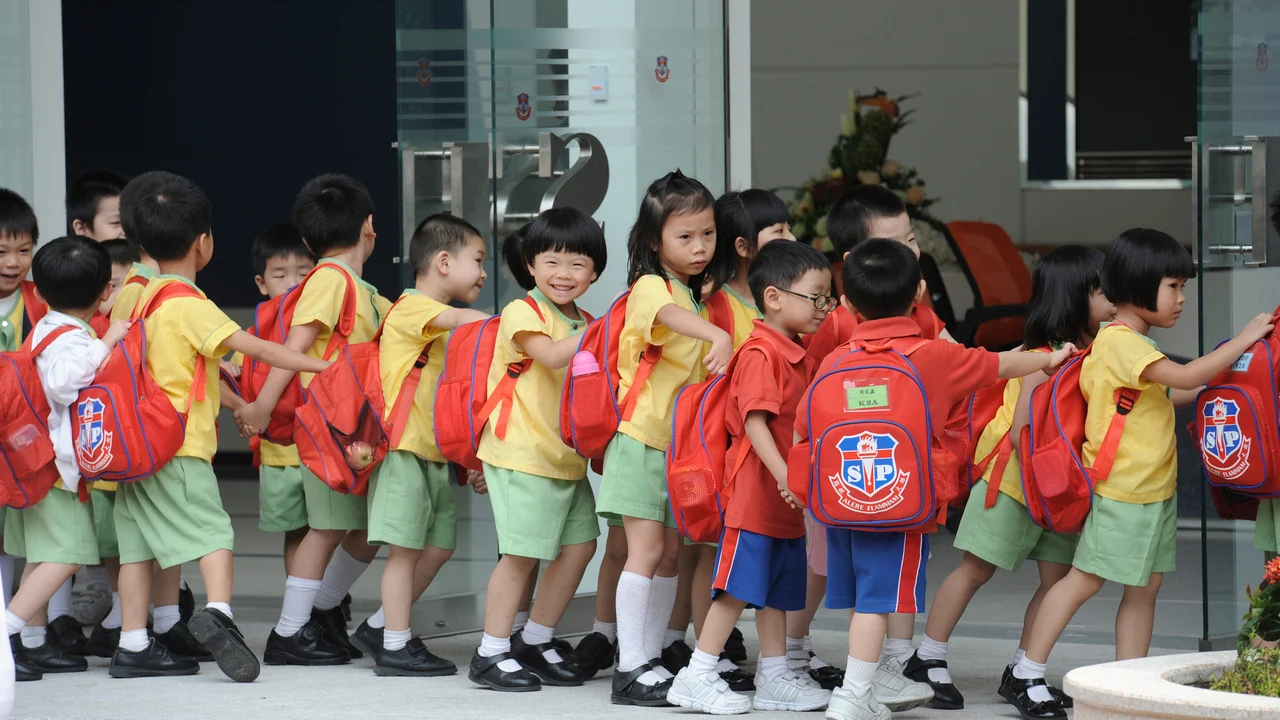
The decline in the number of students in early childhood education is already affecting school organization and is expected to worsen in the next academic year. According to legislator Loi I Weng, more than 60% of schools will have, in 2025/2026, an average of fewer than 25 students per class in the first year of kindergarten.
“According to information from the authorities, the number of children entering early childhood education for the first time in the 2026/2027 academic year is expected to decrease even further, by more than 500. Based on 25 students per class, it is estimated that there will be a reduction of at least 20 classes in the first year of kindergarten, representing an overall drop of more than 12%,” she told PLATAFORMA.
The funding model adds to the pressure. The free education subsidy is based on a standard of between 25 and 35 students per class, excluding classes below that threshold. For schools with chronic shortages of students—particularly smaller ones—a difficult cycle takes hold, the legislator warns: “fewer students mean fewer resources, lower competitiveness, and further loss of students.”
In addition, the lack of resources has a direct impact on the quality of education, as “maintenance of equipment,” “technological upgrades,” and the “hiring of specialized teachers” are “compromised.”
Read also: Macau highlights the historical legacy of the Chinese Army and reinforces patriotic education
“If a school has only a few classes, it may not be able to implement ‘subject-based specialized teaching’, leading to situations where ‘one teacher teaches multiple subjects’, which affects the quality of education,” says Loi I Weng.
Despite this, the legislator acknowledges recent government adjustments, such as proportional allocation of subsidies and the creation of the “School Development Promotion Subsidy,” which reflects “an active response from the Government.”
Beyond professional skills training, it is necessary to confront the psychological pressure and the crisis of professional identity that teachers face during the transition” – Chan Lai Kei, legislator
Even so, demographic trends point to a worsening of the problem, with a foreseeable impact on primary education.
“The authorities should carry out forward-looking studies and planning, and continue to gather opinions from society to reach a consensus; at the same time, they can continuously optimize the teacher-student ratio by implementing the model of ‘two teachers and one teaching assistant’ for kindergarten classes that reach a certain number of students, ensuring that each student receives greater attention.”
Difficult transition
The Government is preparing measures for the 2026/2027 academic year, including transitional support for early childhood education, incentives for school transformation, mergers and inter-school cooperation, and the creation of a teacher-sharing platform.
However, difficulties in implementation persist. Legislator Chan Lai Kei highlights obstacles in the “physical restructuring of schools” and the “transformation of the teaching workforce.”
“If, in the future, there are schools intending to develop elderly education, adapting facilities for this purpose is not something that education departments or schools can accomplish independently.”
He adds: “Beyond professional skills training, it is necessary to confront the psychological pressure and the crisis of professional identity that teachers face during the transition.”
For a successful transition, teachers need to obtain new professional qualifications or receive in-service training, which may pose challenges for older and more experienced teachers – Loi I Weng, legislator
Another issue lies in the limited timeframe of the measures. Loi I Weng cautions that “two years may be insufficient for schools with lower adaptive capacity or those requiring construction and teacher retraining.” School mergers also depend on the “compatibility between educational contexts.”
Teacher transition is another critical point. While early childhood and primary education favor “generalist training,” secondary education requires “specialization.” Adapting teachers to new levels implies “investment in training and institutional support.”
In addition, many kindergartens lack the structure to diversify their offerings, particularly in continuing education or adult training, which “limits reconversion alternatives.”
Read also: High-quality education to consolidate the talent base
In this context, Chan Lai Kei advocates stronger coordination with the Social Welfare Institute (IAS) for “technical support in adapting facilities,” as well as partnerships with “private continuing education entities.”
“This measure not only increases the number of places in continuing education courses popular among residents in the area, but also effectively compensates for the immediate shortage of qualified teachers in certain professional fields in schools.”
For her part, Loi I Weng proposes extending “transitional support” and introducing “phased evaluations.” She also suggests “feasibility studies for schools wishing to convert into continuing education centers,” including support for “independent consultancy.”
The legislator also advocates strengthening inclusive education, with “certified teacher training” and the creation of a “start-up subsidy for inclusive education,” aimed at hiring “support teachers,” “acquiring equipment,” and “adapting infrastructure.”
