

“People always join in whenever there are performances,” explains Ricardo Pinto, founder and director of the Festival: “The idea is to be essentially a literary festival, but to have other ways of bringing literature to broader audiences, particularly through music, film, and theater.”
In a world in turmoil, in Macau or any part of the world, it is particularly relevant today to bring together artists and authors from so many different countries and cultures. “It illustrates the idea that it doesn’t have to be this way; people don’t have to be in constant conflict; there are many things that bring us closer together and are much more valuable than what is at stake in most of these conflicts,” comments Ricardo Pinto.
The program for this year is very ambitious, including Portuguese music and theater stars. What led to this bet?
Ricardo Pinto –In fact, it is ambitious to bring together in a single edition performances with the scale of the concert’s event, Rodrigo Leão and from the theater piece that provides the return to Macau of Margarida Vila-Nova. It is unprecedented in the Festival; and, from a production standpoint, it’s a bit more demanding. But these 15 years of the Festival have shown me that people always get very involved whenever there are performances; whether they be music or theater. That’s also why we decided this year to have at the Macau Cultural Center these two very important moments within the context of the event: Rodrigo Leão on the 11th; and the play “At First Sight“, on 14th and 15th.
– The performative side was since the beginning an insistence, even when there were doubts about its financial weight. Now that experience confirms there is an audience for this, the Script Road positions itself as a festival much more than literary?
R.P. –It will always be a literary festival; and, obviously, all the performances we bring always have a strong connection to literature. Whether it’s because they feature Portuguese authors and poets; or because the original themes have notable composers. For example, this play is an excellent text by the Australian playwright Suzy Miller, which has been performed around the world. It is now in over 30 languages; it has arrived in Portugal… and now also in Macau. It would be very difficult for there to ever be a pop music concert as part of the Festival.
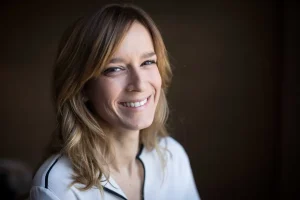
Margarida Vila-Nova returns to Macau with the play At First Sight
– It is this also the logic for choosing movies?
R.P. –This year, we bring a Swiss author of Korean origin—Elisa Choa Dusapin—who wrote “Winter in Seokchon,” which is a Korean spa town. The novel has been adapted into a film by a Korean director; therefore, we will have the author here and show the movie. The idea is somewhat like this: essentially a literary festival, but with many other ways to bring literature to broader audiences, particularly through music, cinema, and theater.
– In pure literature… tribute to Camilo Pessanha; more or less obvious choice…, given the centenary of his death…
R.P. –Yes, we opened the Festival even before the opening ceremony, with a session on the centenary of Camilo Pessanha’s death. And, during the first weekend, we will have city tours; following in the footsteps of Pessanha in Macau. Basically, that’s where the reference ends; although we have two poetry sessions scheduled; where, certainly, some poems by Pessanha will be recited.
Read also: António Lobo Antunes has died; one of Portugal’s greatest writers of all time (with video)
Camilo Pessanha is always a very cherished and present figure in Macau’s cultural events; even this week there was a session organized by IPOR, and throughout the year there will be other moments when he will certainly be remembered. It was important to mark the centennial, but we could not reduce the Festival to that.
European diplomats, particularly those from Francophone countries, are very interested in bringing their authors here.
– What criteria lead to the choices made by the Festival?
R.P. –There are what we can call the festival’s choices; but there is also a set of new opportunities. We had already advanced in some way last year; however, this year the collaboration with the Hong Kong Literary Festival is more obvious. We will have the Argentine-American writer Hernán Diaz here, who won the Pulitzer Prize in 2023, taking advantage of his visit to Hong Kong. The same opportunity criterion that allows us to have the Canadian illustrator Gui Delisle here, or the writer Dusapin.
– New connection, more Anglo-Saxon and Francophone…
R.P. –European diplomats, particularly those from Francophone countries, are very interested in bringing their authors here. Therefore, there is now this space for authors who were present at other cultural events in the region, such as the Francophone Festival and the Hong Kong Literary Festival.
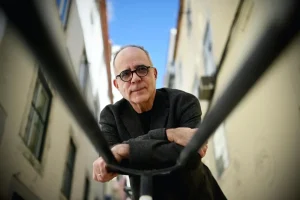
Rodrigo Leão is one of the stars of this edition of the Script Road Festival
– Does the identity of Script Road define itself by its choices? Can we talk about the choices of the Festival?
R.P. –Of course! Amitav Ghosh, for example, is a very prominent name in world literature that we had previously tried to bring in. He has always shown great interest in coming, but he was always prevented by other commitments. This time we spoke to him quite early; he was very pleased with the idea and will be coming here. He is the author of a trilogy of novels centered on the Opium War period; for us, an old goal that we have managed to achieve.
It is also special for Ghosh to be able to speak at the House of Lords, where the British East India Company was headquartered, which had a very direct relationship to the Opium War and the tensions that were felt in this region in the middle of the 19th century.
Ghosh is also famous for his environmental cause. Will he also speak about this?
R.P. –He is indeed a writer with great concern for environmental issues; he has several novels and essays in which the planetary crisis – environment and climate change – is very present. We will have two sessions with him: one focused on the Opium War; another on climate change.
– The Festival also marks International Women’s Day…
R.P. –Ghosh’s moderation will be carried out by Tanja Wessels, an environmental activist herself and author of a documentary about women and the sea which we will show precisely on International Women’s Day: March 8th. On the same day, we will show another very interesting documentary about theNüshu, secret writing invented by women in China to escape male oppression.
We have a staff member from the Nushu Museum in the province of Ju (Hainan) who, among other things, will give aworkshopabout how to write these characters. Nüshu was on the brink of extinction; the last person who knew how to speak and write this unique language died in 2004 or 2005; and since then, there has been a great effort to recover these texts that are now in the museum.
When it seems that this dizziness towards military conflicts cannot be contained; events like these, happening all around the world, have nothing to do with that; they show another way of living; they illustrate a little bit the idea that it does not have to be this way.
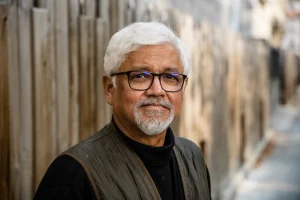
Amitav Ghosh gives two lectures on the themes that made him renowned: one on the Opium War; the other on Climate Change and the environmental crisis
– Is the Casa Garden solidifying its role as the headquarters of the Festival?
R.P. –Last year, the Casa Garden was under construction, so we were at another very interesting location with great potential for this type of event: the old slaughterhouse in Porto Interior. However, the Casa Garden has everything: it allows us to have art exhibitions, such as those we will be doing with photographs by Alfredo Cunha and Liu Zheng; or the work of architect José Maneiras.
Then, there are rooms where more than one session can be held simultaneously; there is an auditorium; a garden… Outside in that space, we will have a band playing at the opening (Sunday, 8th), and the following day, a poet and musician from Shanghai, China, will perform live there. It’s a very special space.
Read also: National security now covers education and culture
– In this world where wars proliferate; Macau today being in deep and accelerated mutation, it has a special meaning to do this Festival?
R.P. –Yes… these meetings between authors from a vast array of countries and different cultures clearly demonstrate that much more brings us together than separates us. We are in a very complicated phase of our History, as humanity; when one expects a war to end, another breaks out instead; we are taking many risks, ignoring what is happening to the Planet, to the climate; and we are exaggerating cultural and political differences.
When it seems that we cannot contain this dizziness towards military conflicts; events like these, happening all around the world, have nothing to do with that; they show another way of living; they illustrate a bit the idea that it doesn’t have to be this way; people don’t have to be in constant conflict; there are many other things that bring us closer together, much more valuable than what is at stake in most of these conflicts.
Here is an example: we have Miguel Carvalho and João Miguel Tavares here, journalists from political-ideological spaces that are very distinct; and I think it’s a good sign that they come to present their books and then have a debate; possibly go to schools and speak with students… It shows that people can have different opinions and this does not prevent them from having a civilized and peaceful relationship.
