

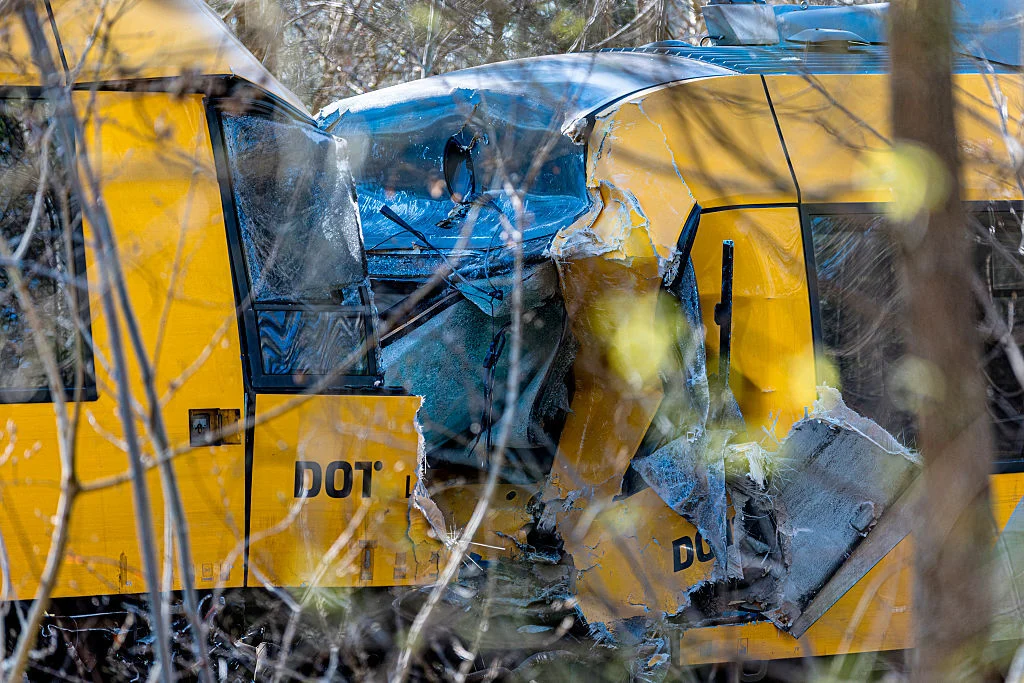
A head-on collision between two commuter trains in northern Denmark on Thursday morning has left at least 18 people injured, including five individuals who are in critical condition, according to reports from The New York Times and Yahoo News.
The crash occurred shortly after 6:30 a.m. local time on a local rail line connecting the towns of Hillerød and Kagerup, located approximately 40 kilometers north of Copenhagen. Emergency services were immediately dispatched to the scene, where first responders found the front ends of the two trains significantly damaged and buckled following the impact.
Local authorities confirmed that 37 passengers were on board the two trains at the time of the collision. A massive emergency response was triggered, with police, fire departments, and ambulance services coordinating the evacuation of the injured.
The scale of the incident necessitated the use of helicopters to transport the most severely wounded passengers to hospitals, while others with less critical injuries were treated at the scene and at a crisis center established in Hillerød for survivors and their families.
Read more: EU: cyclist deaths fall significantly slower than car fatalities
The cause of the crash remains under investigation, and officials have cautioned that it is too early to determine the specific sequence of events that led to the trains occupying the same track.
Police have launched a technical investigation to assess factors such as potential signal errors or other human or mechanical failures. While photos from the scene depicted the trains as remaining upright on the rails, the force of the head-on impact was sufficient to shatter windshields and cause widespread damage to the carriages.
Denmark’s acting Prime Minister, Mette Frederiksen, expressed her profound concern over the incident, stating that her thoughts are with the injured and their relatives.
As rescue operations concluded by mid-morning, authorities focused their efforts on gathering information to explain how such a severe accident occurred on the Gribskov line. Railway experts have noted that the area operates on an older signaling system, though officials have declined to speculate on the cause until the ongoing technical inquiry is completed. Trains in the region remain suspended as the site is cleared and investigators work to reconstruct the morning’s events.
