

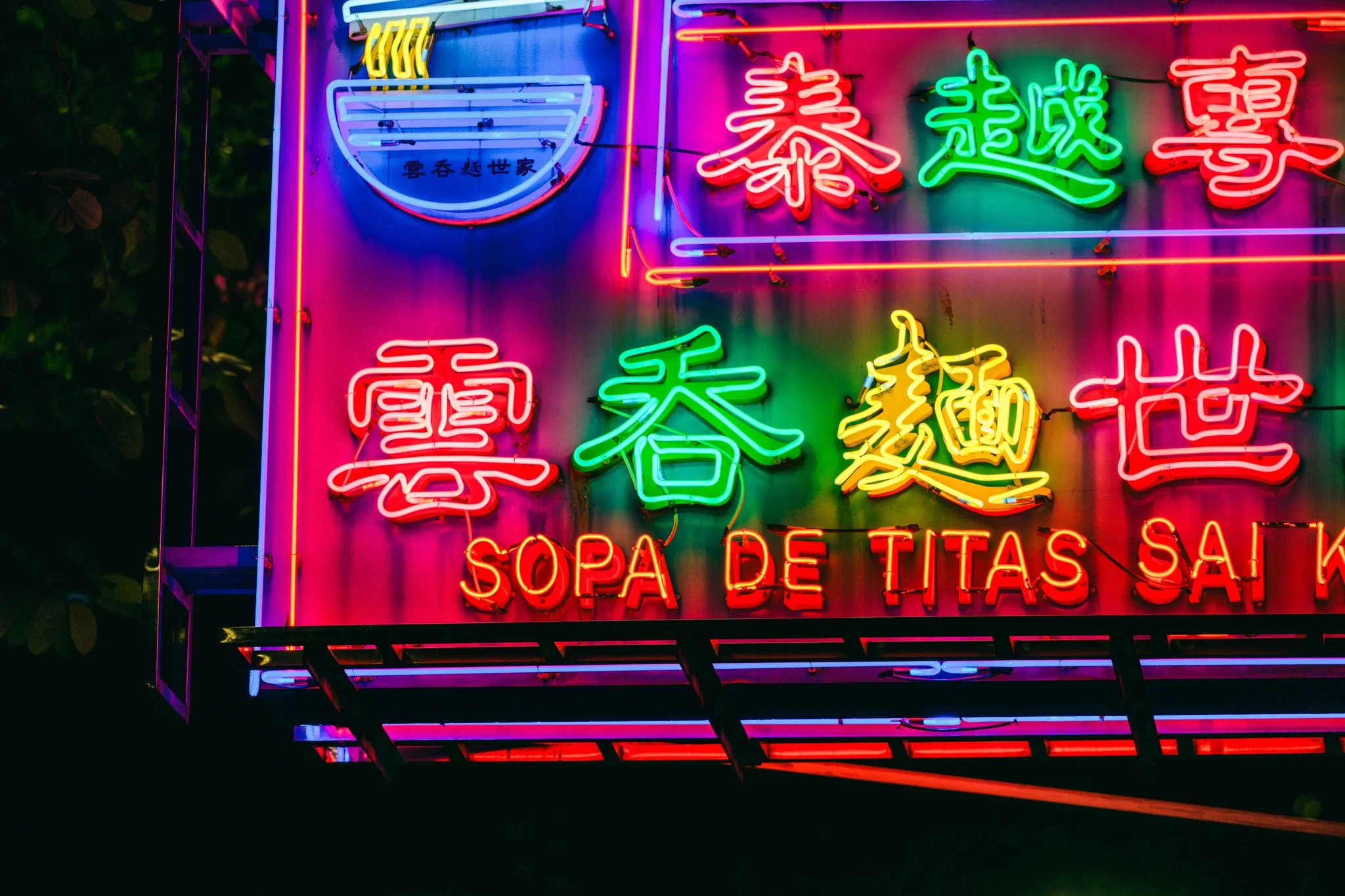
At the end of January, CURB – Center for Architecture and Urbanism released the book Guide to Neon Signs in Macau, the first publication dedicated to comprehensively documenting and celebrating Macau’s neon signs.
Simões told PLATAFORMA that neon is an “intrinsic part of the local visual culture,” stressing that conservation should not focus solely on documentation but also on “selective physical preservation,” recognising the “craft knowledge of neon as intangible heritage.”
Following the 2024 publication of Guide to Macau Street Art, which documented local graffiti, the designer collaborated with Wilson Kam to produce the Guide to Neon Signs in Macau.
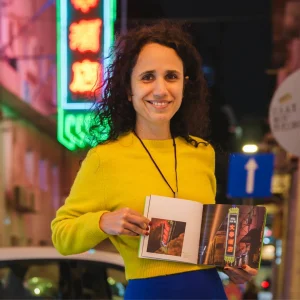
Simões, who has lived in Macau since 2004, has long explored the city’s visual identity, everyday landscapes and the cultural meaning behind its streets. She explains that the publication has three main objectives.
Macao’s neon signs are embedded in a dense and high-density fabric of overlapping streets, where multiple elements compete in a limited space, creating an immersive environment.– Filipa Simões, author and designer
First, the book documents Macau’s neon signs at a “moment when they are disappearing rapidly,” as LED technology replaces neon and traditional craftsmen retire.
Second, it functions as a “navigation guide,” allowing residents and visitors to locate and directly engage with surviving signs, “raising public awareness and encouraging exploration” of different areas of the city.
Finally, it “seeks to reinforce recognition of neon as urban heritage, contributing to broader discussions about what should be preserved as cities evolve and maintaining the visibility not only of the signs themselves but also of the cultural dimension they represent.”
Also read: Cultural Affairs Bureau opens applications for the Macao International Parade
Currently a PhD candidate in Design at the School of Architecture of the University of Lisbon, Simões sees similarities between Macau and Las Vegas, particularly as both are gaming cities that use urban graphics and lighting to generate visibility and spectacle. However, she notes that Macau’s urban condition is very different.
“Unlike Las Vegas’s car-oriented expansion, Macau’s neon signs are embedded in a compact, high-density fabric of overlapping streets, designed to be seen at walking distance rather than highway speed, resulting in a more intimate experience for the observer,” she explains.
Neon proliferated in Macau during the second half of the 20th century, when the local gaming industry expanded and the city positioned itself within regional entertainment circuits.
Cultural neon
The craft skills involved, together with the formal constraints of the technology—requiring continuous lines formed by curved glass tubes—shaped neon’s distinctive aesthetic, making it a “fundamental instrument of commercial visibility and urban presence,” says Simões.
“In Macau, as in Hong Kong, this distinctiveness also lies in its cultural hybridity, particularly in bilingual compositions combining Portuguese and Chinese typographic systems. The city’s spatial limitations, characterised by dense, compact and multilayered streets, further gave Macau’s neon a unique visual character.”
Spatial limitations of the city, characterized by dense, compact, and multi-layered streets, contributed even more to giving Macau’s neon lights a unique visual character.– Filipa Simões, author, designer, and photographer
Regarding conservation, Simões explains that LED technology offers practical advantages: “it is cheaper, more flexible and easier to maintain.” From a commercial perspective the shift is understandable. However, “the value of neon signs is cultural, not merely functional.”
“Street art is often ephemeral and operates at the margins, reclaiming residual or unassigned spaces and adding an artistic perspective to the walls it inhabits. Neon signs originated from commercial needs but ultimately transcended their function, becoming rooted in the collective imagination.”
“They are an intrinsic part of the city’s visual culture, embodying craft knowledge and representing a significant phase of Macau’s history. They possess material qualities that cannot be reproduced in LED without becoming pastiche: the vibrant glow, the irregularities of hand-bent tubes and the visible trace of craftsmanship.”
She also believes conservation should focus not only on documentation but on “selective preservation,” recognising “neon craftsmanship as intangible heritage.”
“The goal is not to resist change, but to ensure this rapid transformation does not completely erase this important layer of Macau’s visual history,” she concludes.
