

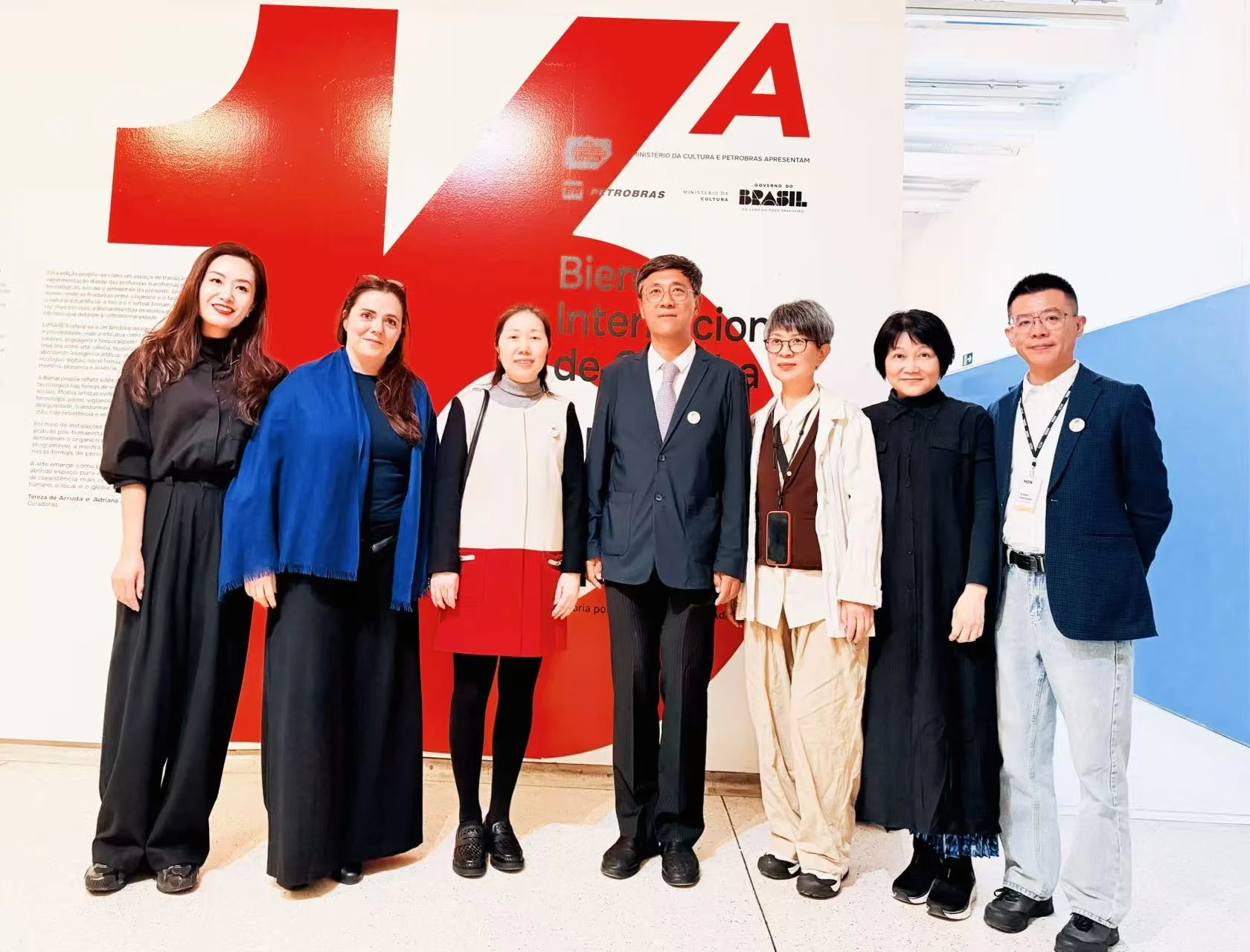
For the first time, Macau is taking part in the International Biennial of Curitiba, one of Latin America’s oldest and largest contemporary art events, with its own pavilion and works that seek to place the city’s identity, memory and cultural diversity in dialogue with Brazilian audiences.
First held in 1993, the biennial is now in its 16th edition. Under the theme “Thresholds,” the exhibition explores contemporary issues surrounding borders, transition and transformation, including the increasingly blurred boundary between humanity and technology.
This year’s edition brings together more than 300 artists from 38 countries, with works displayed across multiple venues throughout the city. Opened on June 14, the exhibition runs until November 15 and forms part of the 2026 China-Brazil Cultural Year.
The invitation also marks Macau’s entry into the Latin American biennial circuit. The Macau Pavilion features the exhibition Matter, Body and Language, curated by the Macao Museum of Art, under the Cultural Affairs Bureau, showcasing works by Peng Yun, Bianca Lei and Chinese artist Gao Fuyan.
Read more: Patuá for everyone
The three artists’ works were originally commissioned for the exhibition I Am Here – Helena Almeida: Presence and Resonance in 2026 and for the main exhibition of Art Macao – Macao International Art Biennale in 2025. In Curitiba, they have been reconfigured around the biennial’s theme, Thresholds.
Macau’s Five Languages
Bianca Lei’s installation, A Hodgepodge of “Cinco Língu-Língu”, was originally created for the 2025 edition of Art Macao, whose main exhibition was titled Hello, What Brought You Here?
The artist says she used that everyday greeting as the starting point for a reflection on Macau’s linguistic and cultural identity. “A large part of my work is related to the environment and the city where I live, so I wanted to create something about Macau,” she told PLATFORM. “The theme was framed as a question, so I started with Macau’s language.”
Since the 16th century, Macau has served as a meeting point between Eastern and Western cultures. That coexistence has shaped a society defined by overlapping cultural references, identities and traditions, reflected in both daily life and the languages spoken by its population.
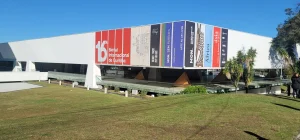
The exhibition “Matter, Body, and Language,” organized by the Macao Cultural Institute and curated by the Macao Art Museum, opened to great acclaim at the Macao Pavilion in the Oscar Niemeyer Museum, the main venue of the 16th Curitiba International Biennial. (Photo: Bianca Lei)
For Bianca Lei, this “linguistic plurality” is one of the clearest expressions of that history. Most of the city’s Chinese population speaks Cantonese, while Mandarin has gained increasing prominence. “Portuguese” remains closely linked to Macau’s “history and administrative system,” alongside “Macanese Patuá and, naturally, English.”
Drawing on this reality, the artist created a multimedia installation made up of five screens, each representing one of the languages present in Macau.
“Macau combines five languages, and each of these languages represents certain communities, such as the Chinese, Portuguese, Macanese and some foreign residents. They also reflect Macau’s historical context. The work explores the relationship between language and our identity,” she explains.
Resonance in Brazil
Presenting the work in Curitiba brings together two cities separated by geography but connected through the Portuguese language and historical experiences shaped by cultural encounters.
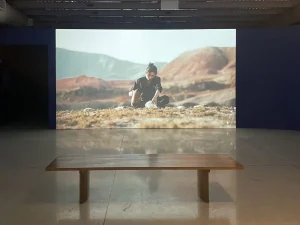
Peng Yun’s work, “Matter, Stone, Sardaban Village”, was originally commissioned for the exhibition “I Am Here – Helena Almeida: Presence and Resonance” in Macau in 2026. In the accompanying video, the artist picks up an ordinary stone, washes it and covers it with gold leaf. According to the Macao Art Museum, “the ‘threshold’ quietly emerges: the answer lies not in speed, but in pause; not in efficiency, but in that silent stone.” The museum also notes that presenting the work in Latin America further highlights the tensions and possibilities of intercultural dialogue. (Photo: Macao Art Museum)
“Part of my work is in Portuguese. Brazil was a Portuguese colony, and there are Portuguese people and even Macanese living there, so I think they will be interested in these themes,” Bianca Lei says to PLATFORM.
However, she believes the connection with Brazilian audiences goes beyond the Portuguese language. The installation also incorporates forms of communication associated with internet culture and increasingly digital societies, creating a visual and conceptual language that extends beyond Macau’s specific historical context.
“This work also addresses the interference and impact of internet language on our environment. The whole world has become digitalized, so beyond the historical context, there are things happening everywhere, and I think people will feel a certain resonance.”
This is the first time Bianca Lei has exhibited in Brazil. The experience also allowed her to engage with Latin American artists and cultural practices, a region she says she had previously had little contact with. “I rarely have contact with Latin American artists. They incorporate Afro-descendant cultural elements into their work, which is something I haven’t had much exposure to,” she says.
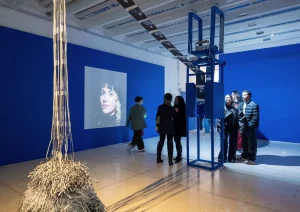
Another featured work, Gao Fuyan’s Fragments of Time – Theater of Faces, is among the biennial’s most interactive installations. It was also previously exhibited in I Am Here – Helena Almeida: Presence and Resonance in Macau. According to the Macao Art Museum, the installation now asks Brazilian audiences “a shared global question: in an era where facial recognition is everywhere, do our faces still belong to us?” (Photo: Macao Art Museum)
Beyond the exhibition itself, the organizers arranged visits to museums and cultural institutions across Curitiba. Bianca Lei highlights how these institutions combine contemporary artistic practice with reflections on colonial history and Indigenous cultures, avoiding a purely historical perspective.
“They don’t just want to preserve history. They really want to revisit history through new perspectives, re-examining colonialism and Indigenous culture. Personally, I think their context has some similarities with Macau’s, and that’s something that really stood out to me.”
In her view, this willingness to reinterpret history brings the Brazilian experience closer to many of the issues that continue to shape artistic creation in Macau, including “identity”, “colonialism”, “memory” and “cultural coexistence”.
Limited International Reach
Despite Macau’s role as a platform between China and Portuguese-speaking countries, local artists continue to have only a limited presence in Brazil and other Lusophone markets.
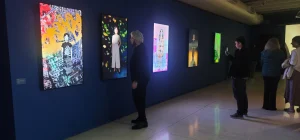
Bianca Lei’s “A Hodgepodge of ‘Cinco Língu- Língu'” (Photo: Bianca Lei)
Bianca Lei believes this is largely due to the structure of Macau’s art sector. Many artists do not work full-time in the arts, and the city lacks “a well-established gallery system” capable of consistently representing and promoting local artists overseas.
Without that support network, international opportunities often depend on government-backed projects or occasional invitations. As a result, she says, local artists highly value every opportunity to exhibit abroad, regardless of whether the destination is a Portuguese-speaking country.
In recent years, many of those opportunities have come through government-supported initiatives such as Art Macao and Macau’s participation in the Venice Biennale. The city’s debut at the International Biennial of Curitiba now adds another important destination to that growing international presence.
The artist hopes Macau’s participation in Curitiba will not be a one-off and that the city will return for the next edition:””I think having this opportunity is something very positive. If Macau artists are able to come here, they will truly value it.”
She also believes there is genuine interest on the Brazilian side in strengthening cultural and institutional ties with Asia, with Macau well positioned to serve as a bridge. “I think Macau is also one of their priorities because of its role as a platform between China and the Portuguese-speaking world.”
More than simply presenting her work in Brazil, Bianca Lei says the experience allowed her to discover new ways of exploring memory, identity and cultural context through contemporary art.
“The artists here are outstanding. You can see their cultural context reflected in the colors they use. I think this experience has been wonderful – a truly enriching journey,” she concludes.
