

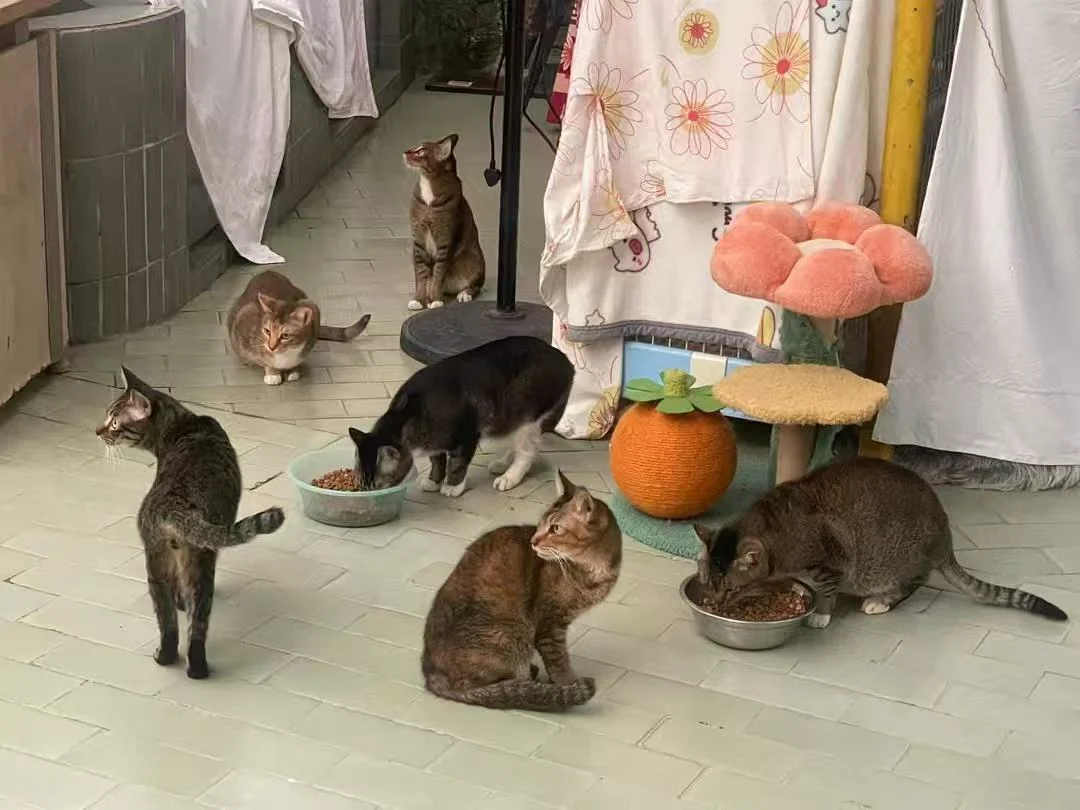
Under Macau’s current Animal Protection Law, returning stray animals to their original environment is considered abandonment. In practice, the association says, this prevents the implementation of the TNR model, which is widely used internationally to manage stray animal populations.
According to Macau Animal Protection Association (ANIMA) president Zoe Tang, “the ban on returning animals means that if we catch a stray dog on the street, we have to put it in a shelter, which directly leads to overcrowding,” she told PLATAFORMA.
In November 2025, the president of the Municipal Affairs Bureau (IAM), Chao Wai Ieng, responded to a question from lawmaker Loi I Weng by stating that the bureau is implementing the Trap-Neuter-Adopt (TNA) approach. He also said that, given Macau’s high population density, public health considerations, and the experience of neighboring regions, conditions are not yet suitable for applying the TNR method across all districts.
Tang believes the government’s TNA policy “produced results in its early stages,” but is unable to “solve the problem” at its source once the stray animal population has become “out of control and has gone through several generations of reproduction.”
Read more: Chula Students Lead Community-Driven Model for Stray Animal Welfare
She hopes the government will recognize the need to move toward TNR. “I have only one wish: I hope that before I die I will see Macau truly implement the TNR method, allowing these lives to coexist with the community in dignity.”
Given the current legal framework, the association has adopted compromise solutions. In the case of dogs living on construction sites with identifiable caretakers, ANIMA provides free sterilization services and allows the animals to recover on-site. According to the association, this practice helps “control reproduction” while ensuring that “the animals remain under supervision,” avoiding a breach of the legal prohibition against abandoning animals.
No Room for Everyone
“In the past, as long as we had space, we took in every animal. But after the pandemic, with expenses exceeding income, we simply no longer have the capacity to do so,” Tang warned.
Founded in 2003, ANIMA established its shelter in Coloane with support from the Macau government and the Macau Foundation. In 2017, it expanded its “Cat Paradise” facility in response to the growing number of stray cats. However, increasing abandonment and the continued breeding of unsterilized animals have placed mounting pressure on the organization. Its dog shelter, “originally designed for around 200 animals,” now houses 350 – nearly “double its intended capacity.”
At the heart of the overcrowding problem is an increasingly unbalanced “intake-to-adoption ratio.” Tang estimates that the association rescues “around 50 dogs and cats” each year, after which it remains responsible for their care for the rest of their lives.
“Then the following year there may be another group of rescued animals, and the numbers just keep growing. Among dogs, perhaps only one will be adopted. Adoption rates for cats are somewhat better, and some may find homes within a month.”
The pressure is financial as well. According to Tang, the association’s monthly operating costs amount to around MOP600,000. Food and veterinary care each account for approximately MOP150,000 per month, in addition to the salaries of 25 full-time employees.
“Although the government subsidizes half of our budget, we still have to raise the remaining MOP4 million ourselves. After the pandemic, donations from the five gaming operators dropped dramatically. Without government support, we wouldn’t survive even ten days.” According to Tang, the organization is currently “surviving on debt.”
Animal Abuse Difficult to Prove
Beyond the growing number of stray animals, Tang identifies “hidden cases of abuse and abandonment” as another major concern. According to her, abandonment—often driven by “changes in family circumstances or other factors”—“has never declined,” while suspected abuse cases are “frequently difficult to prove due to a lack of evidence,” she told PLATAFORMA.
Overpopulation also fuels conflicts among the animals themselves. Tang describes cases in which stray dogs, driven by “competition for resources, bite one another, suffer infected wounds, and lose their trust in humans.”
Faced with what she describes as “an endless task,” the ANIMA president stresses that the existence of stray animals is largely the result of abandonment and human irresponsibility.
“This is a problem created by humans, and we must take responsibility for it. That responsibility should not fall solely on animal welfare groups or individual citizens—it also requires the cooperation of the government.”
