

– What led you to dedicate yourself to the study, preservation, and promotion of Macanese culture, and how has this connection evolved over the years?
Elisabela Larrea: I was fortunate to have several mentors who shaped my dedication to preserving Macanese culture. My grandfather, Vicente Eusébio, was the first person to awaken in me a love for reading and for the stories of Macau. He also enjoyed recording knowledge and preserving family archives, through which I learned from an early age the importance of documentation in any field. In 1994, I came across an article by Cecília Jorge about Patuá theatre, entitled “Récita e Língu Maquista” – a text I kept, without knowing why, for three decades, and which I now feel was a calling I did not yet recognize.
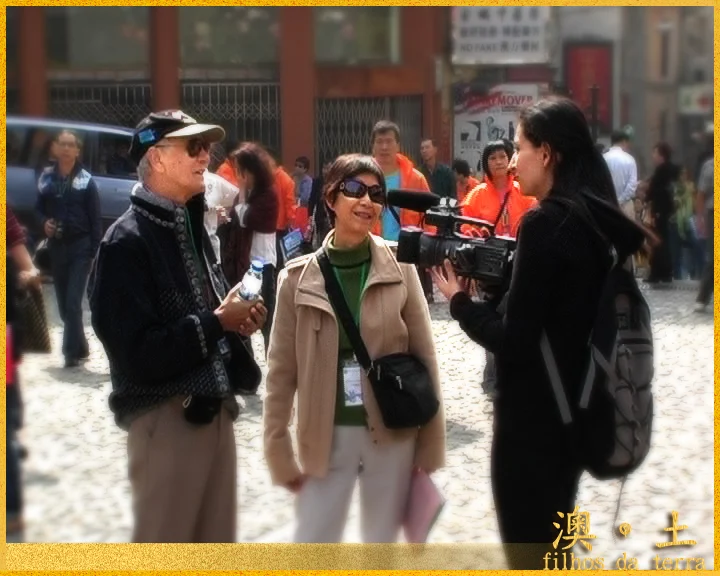
In 2000, my mother, Laura Eusébio, took me for the first time to see a performance by Dóci Papiaçám di Macau. She insisted that I should watch it, telling me that Patuá was our language – a language that had been pushed aside as a matter of survival, but that it was now our responsibility to recover. Her words stayed with me. I began attending every year, and in 2006, I decided to take part in the first edition of Local View Power 2007, during which I made my first documentary, “Filhos da Terra” (Children of the Land), hoping it could serve as a megaphone to help promote and preserve Macanese culture. It was during the production of the documentary that I joined the group as a backstage volunteer, following an invitation from Isa Manhão.
As my interest in cultural studies deepened, I began to understand that the importance of Patuá theatre went beyond the community itself, becoming part of Macau’s broader history. Given the almost complete lack of academic research on the subject, I consulted my mentor, Timothy A. Simpson, and began my doctoral research in 2011.
I quickly realized that I needed to learn Patuá itself in order to analyze its context and the messages conveyed through it. I therefore immersed myself in Adé’s works and recordings of theatre performances. Although some health issues delayed my research, I received tremendous support from Dóci Papiaçám di Macau and from many of the people I interviewed, eventually completing the work after a decade. I am currently writing a book on Patuá theatre, with the encouragement of Miguel de Senna Fernandes and the Cultural Institute.
In 2022, I co-founded the Macanese Culture Research Association, MACRA, together with others who share an interest in this field. If my health allows, I hope to continue collaborating with different sectors on cultural preservation initiatives.
I believe cultures evolve. It was precisely because of the mixing of languages, traditions, and influences that Macanese culture came into existence
– In your research on Patuá theatre, what conclusions did you draw about the role of this artistic expression in building and maintaining Macanese identity?
E.L.: I argued that Patuá theatre began as community theatre, providing Macanese people with a “third space” where they could freely express their opinions in their own language — a language that was then undervalued and considered a “corrupted language.” As Patuá gradually disappeared from everyday use, it acquired a new existence. I argued that it transitioned from a domestic language into a language of performance, not only because it became the main language used in Patuá theatre, but also because Macanese identity itself began to be “performed” through the occasional introduction of Patuá words into conversations.
Read more: Macau recognizes 8 promoters of intangible cultural heritage
Patuá theatre serves multiple functions, with language preservation being the most important. Although literature and songs also contribute to preservation, theatre revitalizes the language in a unique way through live dialogue and interaction with audiences. The group has recruited younger actors, ensuring intergenerational transmission, and has enriched Patuá vocabulary by adapting it to contemporary times. It has also incorporated short films in order to expand its reach.
The language and community spirit of the group reinforce Macanese identity in a way that no other artistic expression can match. In 2021, Patuá theatre was included in China’s National List of Intangible Cultural Heritage, sparking growing interest from schools, communities, and international researchers. Since then, I have received interview requests from all over the world.
Although it was once abandoned and undervalued, Patuá is now appreciated and cherished. I have followed revitalization efforts not only among Macanese people, but also among groups from different cultures around the world, with most participants being in their 20s. Without Patuá theatre, I believe none of this would have been possible.
– What are today the main obstacles to transmitting Macanese culture to younger generations, both in Macau and among diaspora communities?
E.L.: I think one of the challenges faced by any cultural group around the world is the generational gap, at a time when younger people prioritize digital innovations and global popular culture.
It is therefore our responsibility to find ways of communicating that spark the interest of younger generations, using their preferred communication methods and incorporating what is currently popular among them.
MACRA has tried to do this through informational videos, such as “MACRA Express,” and the “MACRA Podcast,” where we share content related to Macanese culture in a more informal and conversational format.
The idea is also to break down the barriers separating cultural groups and geographical borders. Our content is trilingual, and we try not to prioritize a single language, but rather showcase the multilingualism and multicultural “style” that we possess. We hope that, over time, we can generate greater interest among younger generations and diaspora communities.
– Macanese culture is the result of the encounter between different languages, traditions, and influences. How can this hybrid nature be preserved without turning culture into something static or merely folkloric?
E.L.: I believe cultures evolve. It was precisely because of the mixing of languages, traditions, and influences that Macanese culture came into existence. I do not see Macanese culture as something fixed or immutable. Throughout its evolution, it has never been static or unchanged.
Take Patuá as an example. It was once used by Macanese families as an everyday household language. Then it went through a period of decline. Today, it has become a language of representation, and the interest and passion it generates are no longer limited to the Macanese community, having crossed borders and reached other cultural groups.
Another example is Macanese cuisine. In the past, it was limited to Macanese families. Today, we see public Macanese chá gordo events and Macanese culinary projects appreciated not only by Macanese people, but also by other cultural communities.
I do not agree that it has become a performance for tourists, because it continues to exist within Macanese families. Furthermore, there are non-Macanese people who are not merely observers or spectators of our culture: they have immersed themselves in it, learned to love it, and also work towards its preservation.
– You have used writing, cinema, photography, audiovisual installations, and digital platforms. Which methods do you consider most effective in bringing new audiences closer to Macanese culture?
E.L.: We have to work in every direction and through different means, because each medium reaches different people. That is why I have never limited myself to working through a single platform.
Cinema has its own appeal and impact, providing a unique experience. Writing also has its strength, and in academia it is the format with the greatest authority because it creates permanent records that can be cited, verified, and preserved over time.
Photography and audiovisual installations encourage analytical thinking and lead people to reflect more deeply on what Macanese culture truly represents, beyond its superficial appearance.
Digital platforms allow us to reach a broader audience and enable people to interact with culture. Instead of simply watching from the sidelines, they can ask questions, share their own perspectives, and become part of the conversation.
Patuá theatre serves multiple functions, with language preservation being the most important. Although literature and songs also contribute to preservation, theatre revitalizes the language in a unique way through live dialogue and interaction with audiences
– The Unchinho di Língu Maquista project presents Patuá through trilingual cards and audio content. What impact has this initiative had, and what potential do you see in digital tools for teaching and promoting the language?
E.L.: I learned Patuá by immersing myself in Adé’s literary works and watching videos of Patuá theatre. Although this method worked for me, it was not an easy path.
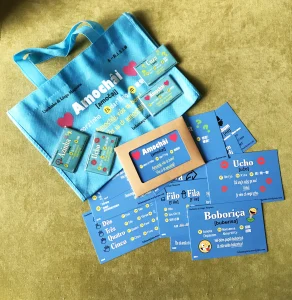
To provide an accessible way for anyone interested to learn this beautiful language, I decided to create educational Patuá cards and share them online. Presenting the cards in three languages allowed anyone to learn, without geographical limitations or other restrictions.
In addition to the cards, I created short videos with explanations and pronunciation guides. I think this helped Patuá move beyond being learned only among Macanese people, allowing non-Macanese people to study it as well.
Macanese culture is part of Macau’s culture, and Patuá is an important component of Macanese culture. Therefore, I believe it should be appreciated by anyone interested in discovering it. Just as I learned Macau Chinese narrative songs, I believe other people can also learn Patuá.
Read more: Macao: A Cultural Kaleidoscope of Languages
In 2019, I created a page called Macanese Culture for Everyone, an extension of Belamaquista, because I firmly believe that a culture should be loved and shared with everyone who is interested in it.
By sharing cultures, we avoid stereotypes and misunderstandings. Our narratives prevent inaccurate representations and interpretations. We can even create partnerships in preservation projects.
After publishing the second book, Patuá for Everyone – A Self-Study Guide, I realized that older generations of Macanese people were eager to use this tool to pass their knowledge on to their descendants. Non-Macanese people also finally had access to a structured way of learning the language.
My main motivation in sharing Patuá was not only to promote it as a language, but to use it as a tool for others to understand and appreciate the beauty of Macanese culture and community.
– What measures should public institutions, schools, and local associations adopt to ensure that Macanese culture continues to be known, practiced, and transmitted?
E.L.: I have participated in several extracurricular activities organized by schools and universities, including seminars and workshops on Patuá theatre. Most of these sessions last between 15 minutes and two hours.
Although they provide students with a useful point of contact — a brief introduction to the culture — they can only address the surface. Macanese heritage is too rich and complex to be meaningfully transmitted through a two-hour lecture.
Another challenge is the limited availability of members of the Macanese community to conduct these sessions during school hours.
Given this situation, I believe it would be highly beneficial to develop a structured teacher training program. Such a program could bring together cultural associations, specialists in different fields, and academics to jointly develop comprehensive educational resources on Macanese culture.
With proper training and support, teachers would be prepared to integrate this knowledge into their own curricula and transmit it to students in a continuous and thoughtful way.
In the long term, I see this as a viable approach that could be implemented on a larger scale because it creates institutional capacity rather than relying exclusively on the occasional availability of community volunteers.
By integrating Macanese culture into teacher training and, subsequently, classroom learning, we can promote greater awareness and understanding among future generations.
