


What is your assessment of the delegation’s visit to São Paulo, and what were the main results of the meetings with Brazilian legal and academic institutions?
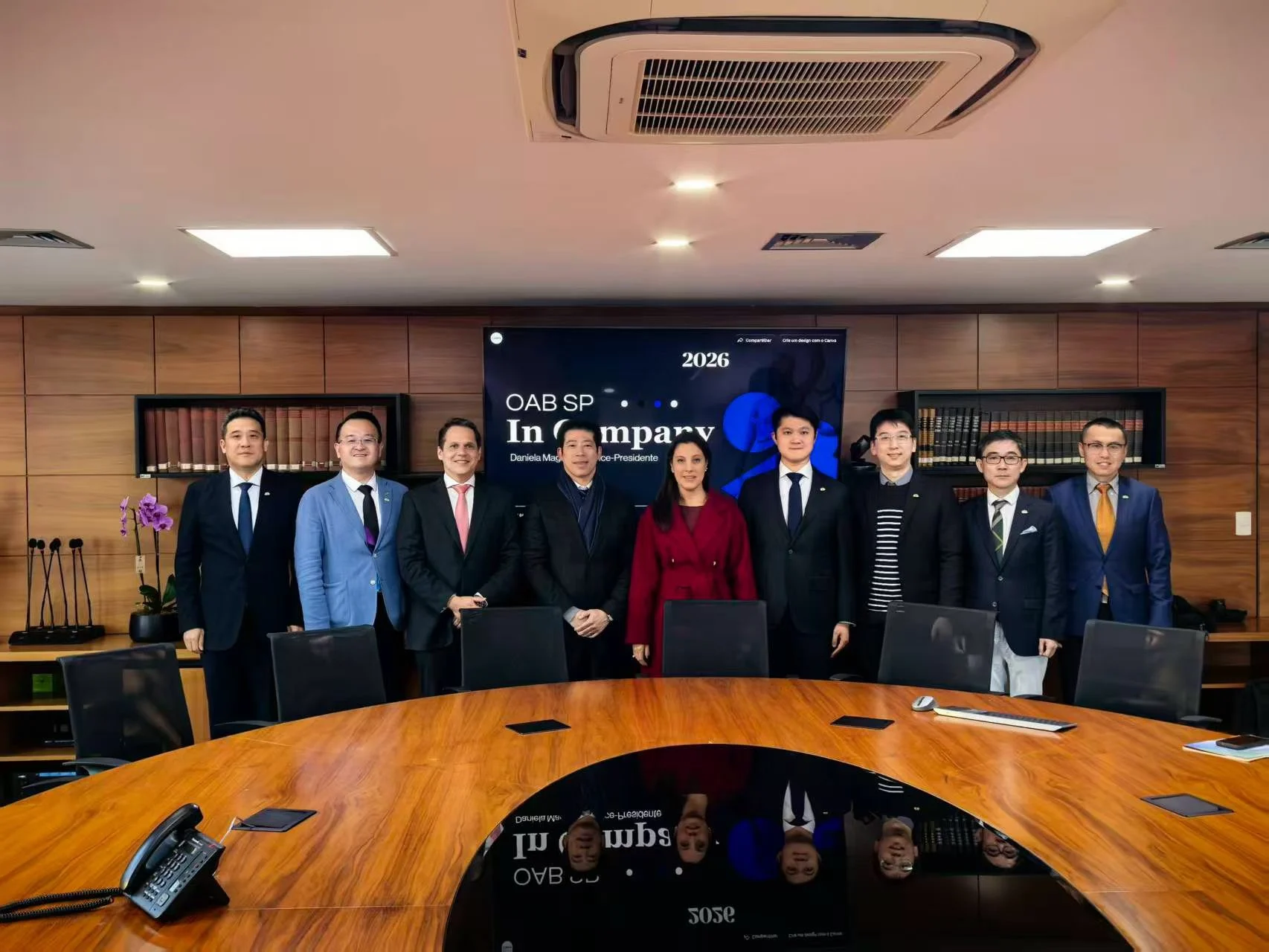
Vong Keng Hei — The visit to São Paulo represented the first practical and systematic working mission by Macau’s legal sector into Brazil’s legal ecosystem, and was not merely ceremonial. The results exceeded our initial expectations.
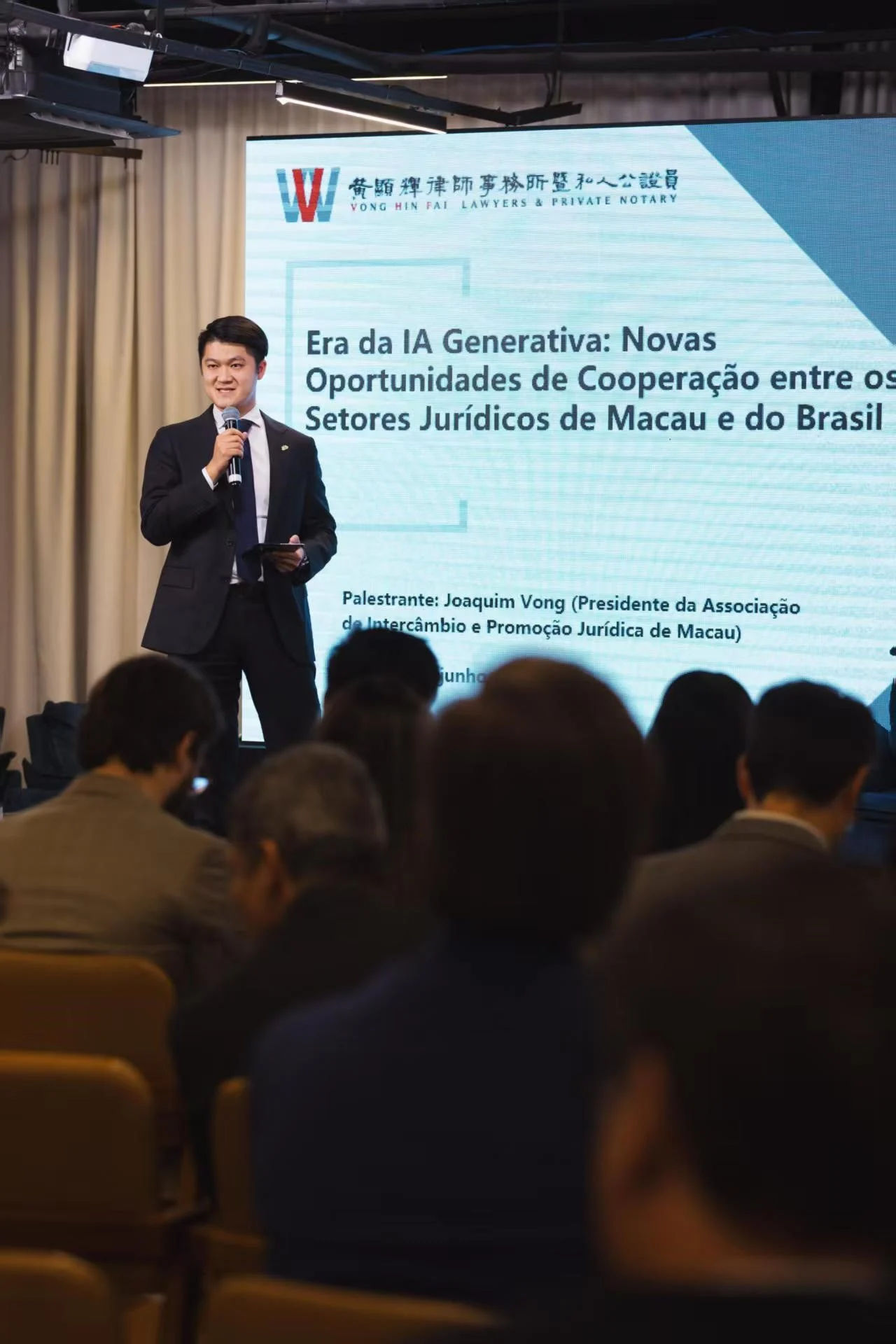
The main achievements are concentrated along three lines. First, we achieved broad coverage across the institutional landscape, engaging with nine types of entities — judicial and legislative bodies, the bar association, leading law firms, law schools, arbitration and mediation platforms, business associations, Chinese communities and legal think tanks — opening channels between official and private spheres, and between practice and academia. Second, seven cooperation memoranda were signed, each linked to concrete operational scenarios and implementation timelines, rather than being generic frameworks. Third, we opened a new area of cooperation in emerging fields, co-organizing the first Sino-Brazilian International Academic Forum on Law and Generative Artificial Intelligence and inaugurating the Legal Innovation and Artificial Intelligence Center (NIDIA), filling a gap in joint research on digital governance.
We extend special thanks to Ibrachina and to the law firm Thomas Law Advogados, central partners in the mission. From the prior coordination with institutions and program preparation to the co-organization of the forum and the inauguration of NIDIA, both entities provided professional support and mobilized resources decisively. This mutual trust forms a solid foundation for long-term cooperation.
What concrete opportunities have you identified to deepen legal cooperation between China and Brazil, particularly in the areas of investment, trade and dispute resolution?
V.K.H. — The volume of Sino-Brazilian economic and trade exchanges is already very high, but follow-up legal services remain far short of actual needs, so there is broad scope for cooperation. There are three urgent areas.
In investment, focusing on sectors with a strong presence of Chinese companies — mining, renewable energy, agriculture, manufacturing, traditional Chinese medicine and cross-border e-commerce — we can develop standardized due diligence and risk-alert products, as well as a legal risk database for investments in Brazil. We will also promote collaboration between law firms from both sides, to provide legal support to companies from registration through operational management, including access to the local market for traditional Chinese medicine products.
In trade, given the frequent difficulties faced by small and medium-sized enterprises — such as documentary compliance, intellectual property protection and cross-border payments — we will draft practical, accessible compliance guides, reducing the costs of error and adaptation.
In dispute resolution, we will promote a mechanism linking mediation and arbitration, systematize the practical pathways and obstacles to enforcing the New York Convention in Brazil, and offer companies a clear, applicable framework for defending their rights. Data compliance and digital governance are also areas with significant growth potential, for which the forum has already laid the groundwork.
Macau’s core advantage lies in the institutional dynamism afforded by the “One Country, Two Systems” principle and the fact that it is the only region in the world where Chinese and Portuguese are both official languages
How can Macau strengthen its role as a legal platform between China and Portuguese-speaking countries, beyond its traditional function as an economic and trade link?
V.K.H. — Macau’s core advantage lies in the institutional dynamism afforded by the “One Country, Two Systems” principle and the fact that it is the only region in the world where Chinese and Portuguese are both official languages. This status gives it a dual foundation of trust: mainland China places institutional trust in Macau and grants it preferential policy support, while Brazil and the other Portuguese-speaking countries maintain historical and cultural ties with the region, in addition to the closeness stemming from the shared origins of their legal systems.
Macau must convert these advantages into concrete platform value, by building an economic and legal corridor linking “mainland China — the Guangdong-Macau In-Depth Cooperation Zone in Hengqin — Macau — Brazil.” Macau would function as the hub for regulatory coordination, and Hengqin as the link to the mainland, connecting China’s vast market and industrial resources to the commercial networks and legal systems of Portuguese-speaking countries. Companies could thus benefit from an integrated coordination of rules, services and dispute resolution along this corridor.
Within this framework, Macau can strengthen its role across four dimensions: creating a research center and database on the law of Portuguese-speaking countries, compiling rules on investment, labor, taxation and data; training bilingual legal talent, in partnership with universities, law firms and associations from the mainland and Portuguese-speaking countries; establishing itself as the preferred destination for resolving commercial disputes with Portuguese-speaking countries, drawing on its arbitration system and the “Macau Capital, Macau Law, Macau Arbitration” policy; and creating a Sino-Lusophone network of legal think tanks for joint research on topics such as the Belt and Road Initiative and regional trade rules.
What are currently the main legal obstacles faced by Chinese companies seeking to invest in Portuguese-speaking countries, and by companies from those countries interested in the Chinese market?
V.K.H. — For Chinese companies investing in Portuguese-speaking countries, there are four central difficulties. First, local regulatory barriers are high. In Brazil, for example, labor protections are strict and the tax regime is complex, with rules very different from those on the mainland, creating compliance risks. Second, the costs of dispute resolution are high, due to the length and bureaucracy of proceedings and the obstacles to recognizing and enforcing cross-border judgments. Third, compliance pressure in emerging areas is significant. Brazil’s General Data Protection Law imposes strict requirements on cross-border data transfer and governance, affecting digital economy companies in particular. Fourth, there is an information and language asymmetry: the legal services market lacks transparency and documents are mostly in Portuguese, making it difficult to identify quality professional resources.
Read more: Macau’s economic recovery remains “uneven”
For Portuguese-speaking companies entering the Chinese market, access rules are complex. The negative list for foreign investment, sector-specific supervisory requirements and business registration processes differ substantially from those in Portuguese-speaking countries. Compliance rules are also evolving rapidly in areas such as intellectual property, competition, data security and cybersecurity. There are also strict rules governing cross-border capital management, including foreign exchange provisions applicable to investment and profit repatriation. Finally, many companies are unfamiliar with Chinese judicial and arbitration processes and with the judicial assistance mechanisms between the mainland and the special administrative regions, making it difficult to choose the most appropriate solution for their disputes.
Macau’s lawyers are not merely legal service providers, but also participants in the national opening-up strategy
What specific advantages can Macau’s lawyers offer in transactions between China and Portuguese-speaking countries, given the legal system, language and experience in cross-border cooperation?
V.K.H. — The core advantage of Macau’s lawyers stems from the resources granted by national policies and the region’s positioning as a Sino-Lusophone platform. The State has designated Macau as a platform for commercial cooperation services between China and Portuguese-speaking countries, supported by the Hengqin Zone and the “3M” framework — Macau Capital, Macau Law, Macau Arbitration. Macau’s lawyers are thus not merely legal service providers, but also participants in the national opening-up strategy, able to carry out cross-border activities based on a systematized network of resources — a structural advantage difficult for professionals from other regions to match.
They also hold three professional advantages. The first is regulatory: Macau belongs to the civil law family, sharing the same roots as Brazil and the other Portuguese-speaking countries, and its lawyers are also familiar with the mainland’s legal system and Greater Bay Area policies, allowing them to translate norms between jurisdictions with precision. The second is linguistic and cultural: they typically practice in Chinese, Portuguese and English, and are familiar with the commercial and legal practices of both sides. The third lies in dispute resolution and resource integration: Macau is a party to the New York Convention, so its arbitral awards are enforceable in more than 170 countries and regions. Local lawyers have experience in cross-border commercial litigation, international arbitration rules and judicial assistance mechanisms, and can mobilize networks both on the mainland and in Portuguese-speaking countries.
Following this mission to Brazil, what initiatives or cooperation mechanisms does the Macau Legal Exchange and Promotion Association intend to develop to build on the contacts established?
V.K.H. — This visit is the starting point for lasting legal cooperation between Macau and Brazil. The Association will move forward with five initiatives.
The first is following up on the seven cooperation memoranda, through regular monthly contacts, designated persons responsible and deadlines for each project, in order to ensure the agreements are carried out. The second involves regularly organizing lectures on Sino-Brazilian investment compliance, in both online and in-person formats, with institutions from the mainland and Brazilian partners. The third involves establishing, through Macau, a liaison channel to legal and business professionals familiar with Brazilian rules, to support the internationalization of Chinese companies.
The fourth initiative is to establish a permanent channel with Brazilian arbitration and mediation institutions, promoting efficient solutions for cross-border commercial disputes. Finally, a legal handbook titled “One Question, Three Answers” will be produced with entities from Macau and Brazil, covering mainland China, Macau and the State of São Paulo, offering clear and accessible compliance guidance for companies on both sides.
