

“Put simply, it is a service platform for overseas expansion,” says the deputy director of the Legal Affairs Bureau of the Guangdong-Macau In-Depth Cooperation Zone and vice chair of the centre’s board. She says mainland Chinese companies face various obstacles when they try to expand abroad and assures that “our platform will help them solve these problems,” she told PLATAFORMA.
She argues that the focus on Portuguese- and Spanish-speaking markets stems from Macau’s own advantages. “We chose to focus on Portuguese- and Spanish-speaking markets because Macau has a natural advantage.” Hence the ambition: “Macau, together with Hengqin, will become the best bridge for businesses seeking to expand overseas.”
Ng In Cheong summarises the centre’s mission in three areas: supporting mainland Chinese companies that want to expand into Portuguese- and Spanish-speaking countries; helping companies from those markets attract investment and cooperate with China; and establishing itself as a broader hub of cooperation, “not only in trade and the economy, but in all areas, including culture and sport.”
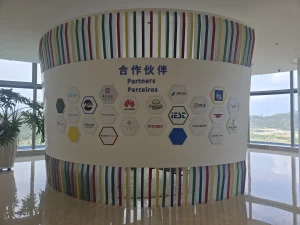
In distinguishing the Centre from the Forum Macao, the official insists on the different nature of the two structures: “The China–Portuguese-speaking Countries Economic and Trade Centre is a service platform for overseas expansion,” while the Forum for Economic and Trade Co-operation between China and Portuguese-speaking Countries “is a national-level intergovernmental international organisation.” The centre, she stresses, “is a practical platform geared towards the needs of businesses” and provides “tailored services.”
Our goal for next year is to become a national-level social organisation and a national-level overseas service platform by the end of 2027” — Ng In Cheong, vice chair of the China–Portuguese-speaking Countries Economic and Trade Centre
Read more: O Lam wants to promote the mobility of talent in the cultural sector between Macau and Hengqin
Its installation in Hengqin, she adds, is the result of a joint effort. “We are currently provisionally based in Hengqin, but this is not only because of the Hengqin Executive Committee; it is a joint effort by the Macao SAR Government and the Hengqin Government.” With support from several central government ministries, the target is clear: “our goal for next year is to become a national-level social organisation and a national-level overseas service platform by the end of 2027,” she told PLATAFORMA.
Fund, visas and expansion
Among the advantages highlighted by Ng In Cheong is a specific fund to support international expansion. “The Executive Committee created a guiding fund of 30 billion yuan. Under this fund, we created a 1 billion yuan fund specifically aimed at supporting Chinese companies and companies from Portuguese-speaking Countries in their international expansion.” She also stresses that the network is growing: “offices in Shenzhen and Shanghai are under construction”; overseas, “we have already established an office in Hong Kong and, subsequently, will set up branches in Brazil, Portugal, Spain and Mexico.”
On services, visas emerge as one of the key areas. “Because of our government background, we have established links with the embassies of many Portuguese- and Spanish-speaking countries.” In the case of Brazil, she said, the embassy in Beijing promised that companies recommended by the centre would be able to obtain visas “through a green channel, more quickly.”
Read more: Macau’s chief executive points to economic diversification and Hengqin as priorities
Ng In Cheong also points to work in outbound investment approval, legal support, translation, exhibitions and training. On the latter, she refers to contacts with universities in Macau and mainland China to train professionals with knowledge of Portuguese and Spanish, adding that the talent pool already includes “more than 600 people.”
The official also uses the case of WGL to illustrate regional synergies. The company, she said, “is a leading logistics company in cross-border e-commerce in Latin America, holding more than 40% of the Mexican market,” and has received financial backing from the centre. She also highlights a decisive logistical advantage: “Macau has independent traffic rights, which allow planes to fly directly to Latin America, Brazil and Mexico.”
The centre began preparatory work in April last year and, according to the official, “officially obtained legal person status as a non-profit social organisation in Hengqin in early December.” In March this year, “we established contact with more than 200 companies involved in export business to Portuguese- and Spanish-speaking Countries,” with more than 80 service or cooperation agreements already signed. “We serve companies from all over the country,” Ng In Cheong said.
