

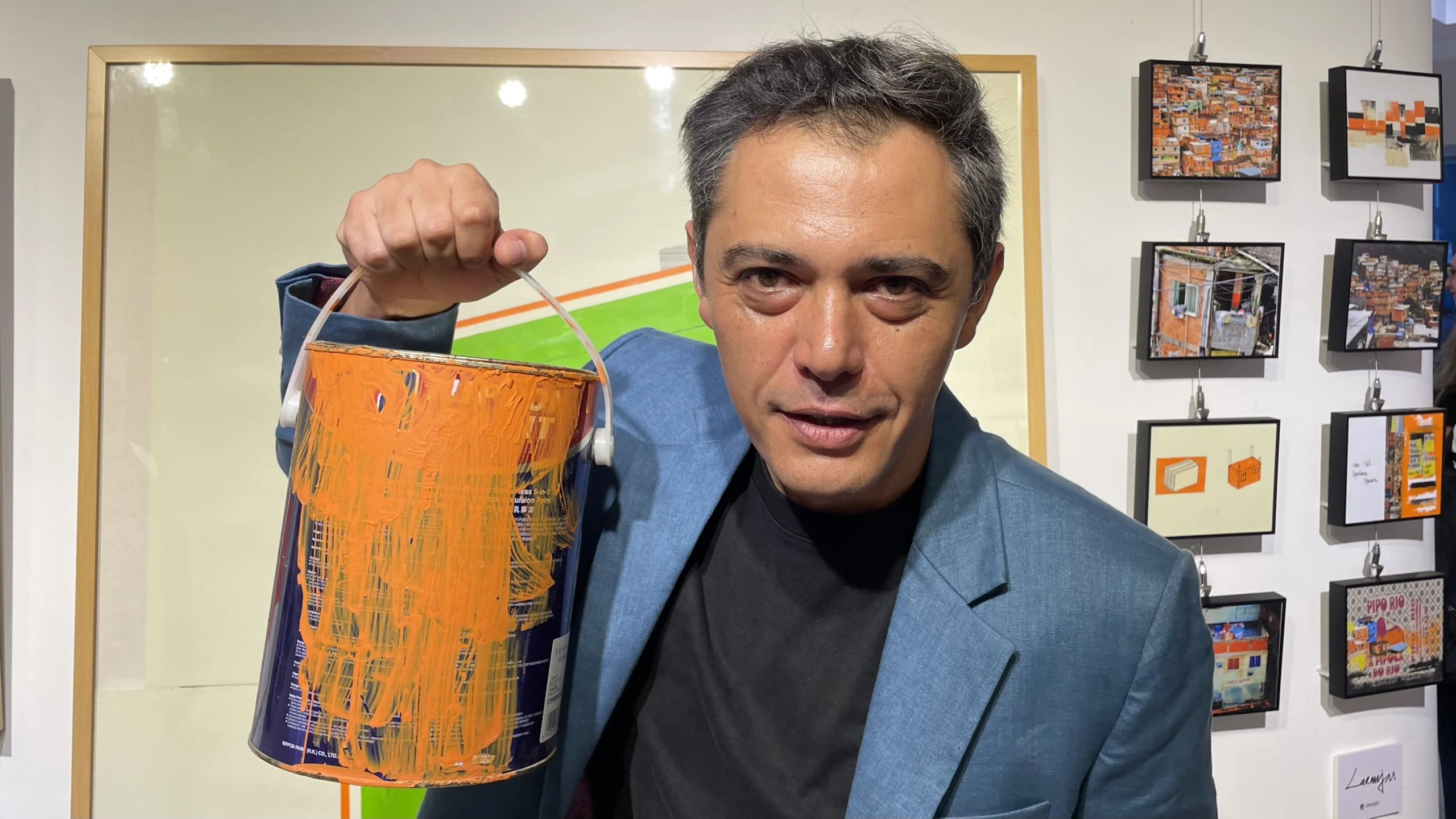
Alexandre Marreiros’s studio is not just a room where work is done. It is a physical place, but also a mental one; a workshop, but also a space of waiting, memory and observation. In “The Studio of Alexandre Marreiros – Drawing and Painting”, on show at the Rui Cunha Foundation until 20 June, the Macao architect and artist starts from this idea to present not only finished works, but also what usually comes before an exhibition: the “sketches”, “the objects”, “the images”, the references and the traces of a process under construction.
“The studio is, for me, a multiple space, a spiritual place, a place of work, meditation and contemplation,” he tells PLATAFORMA. It is, he adds, “permanence and passage”, a “keeper of memories that organise themselves and reveal themselves when necessary”.
The intention was direct: “I decided to take my studio into the gallery to share not only final works, but also to show the process, the first sketches and records of an idea, the objects that surround me, the images behind a finished work.” For Alexandre Marreiros, the proposal is to “teleport” the studio into the gallery, avoiding any separation between process and final work.
Macao’s cultural vitality “must be accompanied by an industry capable of sustaining and projecting that artistic creation, placing it on a platform that not only exhibits local artists, but also brings in major international artists”
The idea of the studio has accompanied Alexandre Marreiros since before he had a space of his own. “I also remember not having what is understood as a studio, being very young and creating in my bedroom at my mother’s house in Monte Estoril,” he says. Later, he had a studio alone and with friends in Portugal. In Macao, the family dining room served two purposes: during the day it was a domestic space; at night it became a studio; before going to sleep, it became a dining room again.
That experience seems to have broadened his notion of a place of creation. The studio may be in Macao, but also “10,000 kilometres away in Brazil, Portugal, China or Japan”, whenever there is “a moment of reflection, critical thinking or contemplation”. In those moments, he says, “drawing, writing or photography are the immediate tools for recording thought”.
Read also: Macau: More Culture, Less ‘Decoration’
For that reason, he also calls it the “mothership”. The Macao studio keeps ideas, objects and memories, but creation does not depend solely on that space. It may begin in a landscape, on a journey, in a prolonged gaze at nature. Returning to the studio then allows those images to be worked on with “the necessary time”.
Drawing before everything
As an architect and artist, Alexandre Marreiros does not completely separate architecture and painting in his creative process. There is a common territory: drawing. “Whether in artistic creation, architecture or most of the things I do, without exception everything is born from thought, from the idea, and immediately afterwards is translated and recorded in a sketch,” he explains.
For the artist, “drawing is the extension and first, immediate record of thought”. Paper therefore occupies a decisive place. Unlike canvas, which allows concealment, correction or overlaying, paper exposes risk. “It leaves a mark in the process; it does not allow me to make mistakes in the generous way that canvas does,” he says.
It is in that fragility that Marreiros finds part of the strength of the work. Error is not merely an accident: it can become part of the work. “The fundamental error during the process of the work thus becomes a primordial part of the final work,” he says. The exhibition shows precisely this relationship between thought, gesture and support, rejecting the idea of perfection as the only destination. The artist prefers to speak of an “order of searching”, in which the work assumes the truth of the process and the marks that are not hidden “behind paint or a mask”.
Architecture enters this field naturally. Alexandre Marreiros says he is sensitive “to space and light, to places, cities, buildings and the nature that surrounds construction made by human beings”. That relationship with space is present in his artistic work, even when it does not appear literally. “I would say that architecture is naturally more present in my artistic work than the other way around, but they are interconnected.”
Macao, root and identity
Macao runs through Alexandre Marreiros’s work even when it is not represented directly. The city appears as memory, identity and context. “Macao has a natural presence in my work, sometimes in a figurative way but also in a less evident manner,” he says.
Read also: Macau: “A Glimpse of Chinese Culture” in Lisbon
The relationship is also familial. “My parents are Macanese, I have Portuguese grandfathers, a Chinese grandmother and a Macanese grandmother. I live and work in Macao, and this is the context that shapes my practice.” For that reason, he adds, “Macao is not just a backdrop, it is root, it is identity, it is territory that inevitably inscribes itself in what I create”.
The exhibition comes at a particular moment: ten years have passed since Alexandre Marreiros’s first solo exhibition in Macao, at the Museum of Modern Art. Even so, the artist rejects the idea of a retrospective. What he wanted to do was to look at works kept in his archive, produced over the past decade, and understand how they relate to one another.
“I believe human beings have a natural tendency to make comparisons. I did that exercise with my own work, with a critical eye, raising questions, deviations, behaviours and references in a free state of mind (…) I deconstructed and rebuilt, in search of a result that pleases me from the process through to the final work”
“Not a chronological relationship, but an attempt to understand how a work from 2010 relates to another from 2026,” he explains. He is interested in observing “traces”, “distances” and “approximations”, allowing works from different moments to meet in the same space.
Opening the studio to the gallery also brings a reflection on the place of art in Macao. Alexandre Marreiros explains that artistic creation is always an “instrument and record of the context and time in which it exists”. And Macao, he argues, has the cultural substance to sustain a stronger artistic presence.
“Macao has always been a land of great poets; Camões and Bocage passed through here, Camilo Pessanha lived here. There have always been great artists. This land is inspiring, it has a culture of its own like no other,” he says.
In the end, Alexandre Marreiros prefers to leave space for the public. He does not want to impose a reading. He wants each visitor to find their own relationships between works, objects and references. “I want to share and offer visitors complete freedom of interpretation,” he says. The studio that arrives in the gallery is, after all, this open place: between work and process, between Macao and the world, between memory and creation.
