

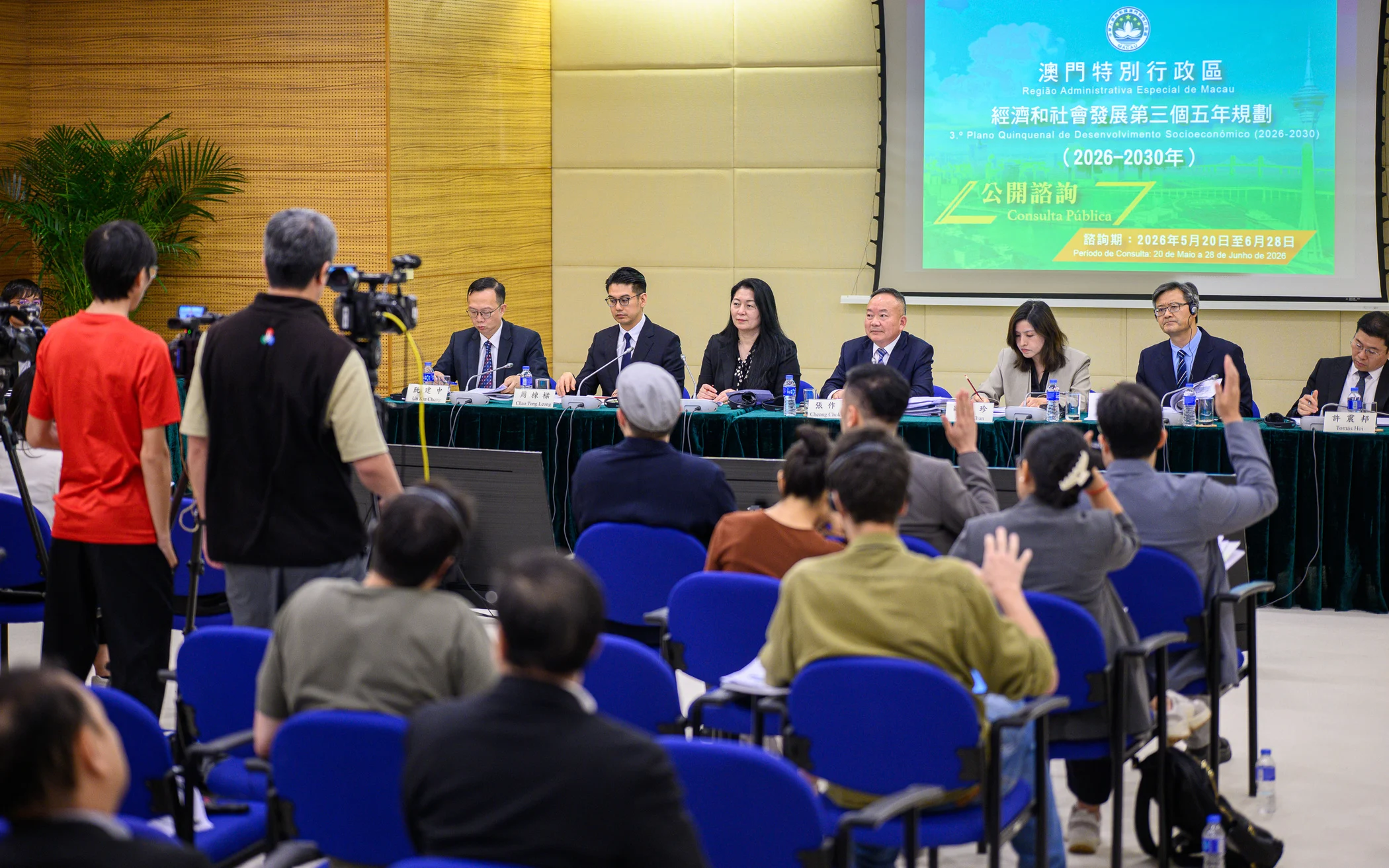
The public consultation for the 3rd Five-Year Plan runs until June 28 and includes areas such as national security, economic diversification, Hengqin, governance, technological innovation and integration into national development.
The plan is aligned with the national 15th Five-Year Plan and with President Xi Jinping’s recent speeches on Macau, reinforcing the priority given to national security, regional integration and economic diversification.
Lou Shenghua, professor of Social Sciences at the Macau Polytechnic University, believes the document establishes “eight core objectives” and will serve as a “guiding principle for governance over the next five years”. Among the priorities identified are the “strengthening of national security”, “rule-of-law governance”, “integration between Macau and Hengqin” and the “development of emerging industries”.
Still, the academic argues that the greatest challenges lie precisely in the ability to implement these objectives. The first risk he points to is Macau’s “growing external vulnerability”.
Read also: Sam Hou Fai calls on associations to provide more support for Macau’s government
But it is above all in economic diversification that Lou Shenghua identifies structural weaknesses. The document sets the target of non-gaming sectors accounting for around 60% of the economy by 2030. However, the academic believes the path remains unclear. “The new industries lack leading enterprises and the industrial chains remain incomplete,” he tells PLATAFORMA.
Despite the various policies aimed at sectors such as traditional Chinese medicine, high technology and specialised finance, Lou Shenghua believes the concrete results remain “limited”.
The governance mechanisms, benefit-sharing arrangements and division of responsibilities between Macau and Hengqin remain incomplete – Lou Shenghua, university professor
Integration with Hengqin also continues to fall short of expectations. Although the plan insists on coordination between Macau and the Guangdong-Macau In-Depth Cooperation Zone, Lou Shenghua believes obstacles persist in areas such as cross-border mobility, legal compatibility, mutual recognition of qualifications and institutional coordination. “The governance mechanisms, benefit-sharing arrangements and division of responsibilities between Macau and Hengqin remain incomplete,” he observed.
“Territorial and demographic limitations” also emerge as “significant obstacles”. Macau faces a “shortage of physical space, an ageing population and a lack of qualified professionals in areas such as technology, healthcare and finance”, factors that could “hinder economic diversification”.
Read also: Hengqin launches an exclusive recruitment drive for Macau residents
At the political level, Lou Shenghua rejects the idea that deeper national integration could reduce Macau’s autonomy. The academic stresses that the plan maintains the principles of “One Country, Two Systems”, a “high degree of autonomy” and “Macau governed by its own people”, while preserving the SAR’s distinctive characteristics as a “world centre of tourism and leisure, a China-Portuguese-speaking platform, a free port and a low-tax system”.
“Macau’s development should fully integrate into the national strategy while simultaneously maintaining its institutional system, economic characteristics and socio-cultural specificities,” he argues. For Lou Shenghua, integration into national needs and the preservation of Macau’s uniqueness are “not contradictory, but complementary”.
