

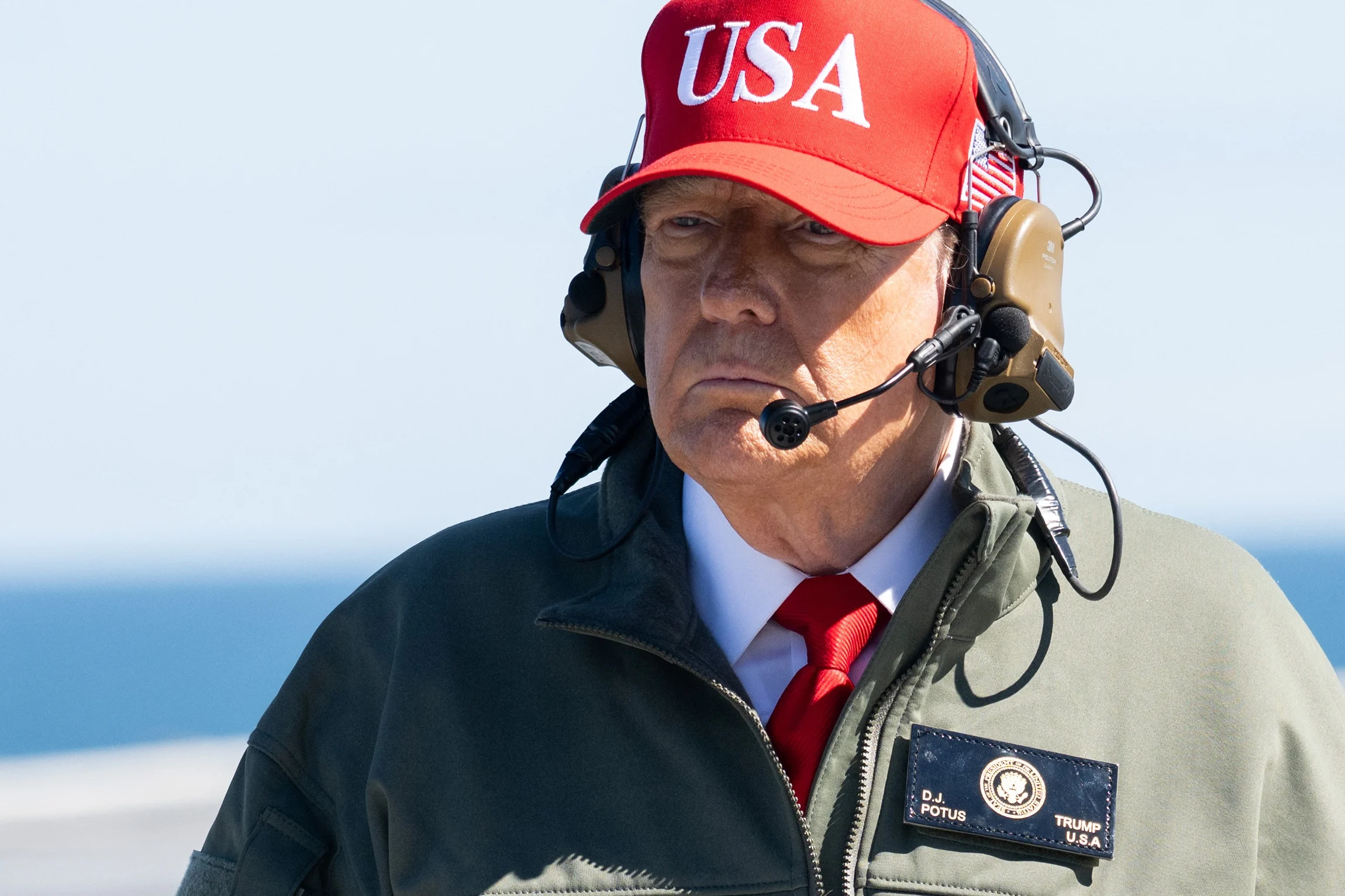
Donald Trump has never had a simple relationship with war. The US President avoided military service — receiving five draft deferments during the Vietnam War — yet has spoken with total confidence about how every American conflict should have been fought, and won.
Mr. Trump’s worldview on war is built around a few pillars: scorn for long, unresolved conflicts; belief in overwhelming force as the fastest path to peace; and, perhaps more importantly and characteristically, a deep conviction that America’s military power has been squandered by weak, foolish leaders.
Across two presidential terms and decades of public statements, here is how Trump has positioned himself on each of the major wars that shaped modern America.
Vietnam: “We would have won easy”
Trump was never in Vietnam — he avoided the draft five times, the last time on a medical deferment for bone spurs in 1968. Publicly called himself “never a fan” of the war, once describing it as a conflict in “a country that nobody had ever heard of.” Yet he has also said he would have been “honoured” to serve, telling British broadcaster Piers Morgan in 2019: “I would not have minded that at all.”
As early as 1984, at the height of the Cold War arms race, Trump told The Washington Post he wanted to be put in charge of U.S.-Russia nuclear negotiations. “It would take an hour-and-a-half to learn everything there is to learn about missiles,” he said. “I think I know most of it anyway.”
His revisionism about the outcome of the Vietnam War has been more pointed. In 2025, Trump argued the problem with Vietnam was political restraint, not military failure. “We would have won Vietnam, very quickly,” he said.
His retrospective take on why Vietnam was lost has been blunt. Speaking aboard the USS Harry S. Truman in 2025, he put it plainly:
“Problem with Vietnam, we stopped fighting to win. We would have won easy. We would have won Afghanistan easy, would have won every war easy. But we got politically correct,” Trump noted.
The 45th and 47th US President of the United States of America has also produced charts comparing war durations — World War One: four years. World War Two: six years. Korea: three years. Vietnam: nineteen years — as evidence not of a conflict’s complexity, but of a failure of will.

Trump’s comments about the duration of several US military involvements. Photo: Screenshot of @realDonaldTrump on Truth Social
The Gulf War: The one Trump largely endorsed
Trump’s relationship with the Gulf War — the U.S.-led coalition operation to expel Iraq from Kuwait — has been more complicated than his rhetoric suggests. In 1991, when a broad international coalition under President George H.W. Bush drove Saddam Hussein out of Kuwait, Trump was broadly supportive.
His main criticism, repeated often over the years, was that the U.S. stopped too soon. “I wished the first time (Desert Storm) was done correctly” — is how he described the Gulf War in a 2002 radio interview with Howard Stern, contrasting it with the incomplete job he felt had been left by not finishing Saddam off.
Years later, pressed on what “correctly” meant, Trump explained on Meet the Press: President George H.W. Bush had “taught them a lesson,” but allowed Saddam Hussein to survive and claim a propaganda victory — taunting that he had driven back “the ugly Americans.” The failure to finish the job in 1991, in Trump’s telling, made everything that followed — the sanctions era, the 9/11 attacks, the 2003 invasion — effectively inevitable.
Iraq War: The one Trump claims he always opposed
No conflict has featured more prominently in Trump’s political identity than the 2003 invasion of Iraq — and no claim of his has been more thoroughly disputed. Trump has insisted, repeatedly and categorically, that he opposed the invasion from the beginning. “I strongly disagreed with it,” he said in 2019.
“There were no weapons of mass destruction. It turned out I was right.” The Iraq War became central to his 2016 campaign as a way to separate himself from establishment Republicans and to attack Hillary Clinton, who had voted for it in the Senate.
The problem is that the record does not support his account. When asked on the Howard Stern Show on September 11, 2002 whether he supported invading Iraq, Trump said: “Yeah, I guess so.” Trump quickly added that he wished the first Gulf War “had been done correctly,” but his early, lukewarm public support for the invasion contradicts his later insistence on principled, early opposition.
That inconsistency aside, his post-invasion critique became consistent and sharp. The US President has called the Iraq War a “disaster,” blamed it for destabilising the entire Middle East, and argued that withdrawing from Iraq in 2011 — a decision made under Obama — created the vacuum that gave rise to ISIS. “We should have kept the oil when we got out,” he said in 2017. “Had we taken the oil, you wouldn’t have ISIS, because they fuel themselves with the oil.”
Afghanistan: From “terrible mistake” to the Doha deal
Trump’s position on Afghanistan has shifted more than almost any other foreign policy issue. In 2011, he was categorical: “When will we stop wasting our money on rebuilding Afghanistan? We must rebuild our country first.”
By 2012 he called it “a total disaster” and questioned why the U.S. was “continuing to train these Afghanis who then shoot our soldiers in the back.” By 2013: “Let’s get out of Afghanistan. Our troops are being killed by the Afghanis we train and we waste billions there. Nonsense!”
In 2015, as a presidential candidate, he told CNN: “We made a terrible mistake getting involved there in the first place.” A few weeks later, he reversed himself, saying: “I never said that. Afghanistan is different — it’s next to Pakistan, which has nuclear weapons.”
After taking office, his instincts again pulled toward withdrawal — but his first speech on Afghanistan strategy in 2017 acknowledged that his generals had persuaded him otherwise. “My original instinct was to pull out, and historically I like following my instincts,” Trump said.
“But all my life I’ve heard that decisions are much different when you sit behind the desk in the Oval Office.” Donald J. Trump instead announced a conditions-based strategy, expanding military authority without specifying troop numbers or timelines.
By his final year in office, however, Trump had fully committed to ending the war. The 2020 Doha Agreement with the Taliban — negotiated without the Afghan government at the table — committed the U.S. to full withdrawal within 14 months in exchange for vague Taliban assurances about al-Qaeda.
By January 2021, he had drawn troop levels down to 2,500, the lowest since 2001. When the Taliban retook Kabul in August 2021, during Biden’s presidency, Trump blamed the outcome entirely on his successor — calling it “the most embarrassing moment in the history of our country” — while claiming he would have managed the exit differently.
Ukraine: Peacemaker, critic, and reluctant ally
Trump’s position on the Russia-Ukraine war has evolved across multiple phases, often within weeks of each other. The former “Apprentice” host has consistently criticized NATO allies for not spending enough on their own defense, and has questioned U.S. financial commitments to Ukraine, framing the conflict as a problem Europe should solve for itself.
In his second term, his administration produced a 28-point peace framework that included a halt to NATO expansion — a key Russian demand — while simultaneously insisting the deal must include full security guarantees for Ukraine. Trump has claimed personal credit for preventing a Russian victory:
“Without my involvement, Russia would have all of Ukraine right now,” he said in early 2026. In one shift that surprised everyone, he told a UN General Assembly gathering that Ukraine — with NATO support — could win back all of its territory.
As a 2024 candidate, he promised to end the war before even taking office: “I’ll get that war settled before I even become president.” Once back in the White House, he grew sharply critical of President Zelensky, questioned the legitimacy of Ukrainian wartime governance, and distributed blame broadly: “You have millions of people dead because of three people — Putin number one, Biden number two, and Zelensky.”
Iran: Maximum pressure, then War
Iran is the conflict that has most dramatically tested Trump’s stated aversion to long foreign entanglements. In his first term, he withdrew from the 2015 nuclear deal — the Joint Comprehensive Plan of Action — and imposed sweeping sanctions under the banner of “maximum pressure.” Mr. Trump defended the move as correcting what he called “the worst deal ever,” but critics argued it eliminated diplomatic leverage without replacing it with a sustainable strategy.
In his second term, the pressure escalated into open warfare. On February 28, 2026, the U.S. launched military operations against Iran, with Trump framing it as his doctrine in action: “We’re doing this for the future.”
Read more about this topic: Iran War: Trump says “nothing will be left” if Tehran rejects deal (with video)
The stated objectives multiplied rapidly — destroying Iran’s missile program, neutralizing its navy, degrading proxy forces, preventing a nuclear weapon, and encouraging regime change — making a clear endgame difficult to define. Trump threatened to bring Iran “back to the Stone Ages” if strikes continued, a phrase echoed by Defense Secretary Pete Hegseth.
The conflict closed the Strait of Hormuz, killed thirteen U.S. service members, and disrupted global energy markets before a ceasefire was announced in early April 2026.
Trump compared its duration favorably to previous conflicts, calling it an “excursion” — framing short military action as proof of decisive leadership rather than a sign of limited objectives.
The through-line
Across Vietnam, the Gulf War, Iraq, Afghanistan, Ukraine, and Iran, a consistent worldview runs through Trump’s statements: America’s wars have been too long, too indecisive, and too managed by people who lacked the will to win.
Trump’s prescription — overwhelming force, no telegraphing of intentions, no nation-building, no apologies — has driven both his rhetoric and, when in office, his decisions. Whether that doctrine produces the shorter, cleaner outcomes he promises, or whether it generates new and different complications, remains the defining question of his foreign policy legacy.
