


“The Government must address the root of the problem and work with the sector to create clear guidelines. Only then will it be possible to balance the optimisation of the tourism experience with the protection of local employment,” argues Lei Leong Wong.
Unlike illegal labour traditionally associated with construction or the restaurant sector, this new model depends heavily on digital platforms. Lei Leong Wong says it is enough to “open apps such as Xiaohongshu or WeChat Channels to find ‘Macau Travel Photography’ advertisements”, with payments processed “directly” through WeChat, making the activity “more difficult to detect”.
Local photographer Jason Wong describes a sharp drop in income since the new border facilitation policies came into force. “Before 2025, after deducting costs such as equipment and advertising, my monthly net income remained above MOP20,000. After 2025, I have almost never been able to reach that level again,” he tells PLATAFORMA.
If a major photography event in Macau is being advertised online for a certain date, why don’t the police act preventively? – Lei Leong Wong, member of the Legislative Assembly
According to the photographer, teams from Mainland China are now able to travel to Macau far more easily and at lower cost, offering photography and makeup services at cheaper prices.
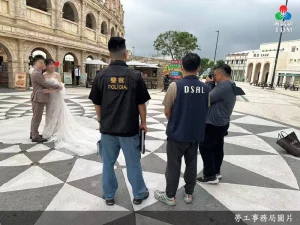
The phenomenon ranges from tourist photo sessions near the Ruins of St. Paul’s to commercial work and events. “Because the cost of living in Mainland China is lower, they can offer technically mature services at lower prices, severely squeezing the survival space of local professionals,” he explained to PLATAFORMA.
Read also: Macau lawmaker: Tai Kin Ip’s resignation will help tackle “youth unemployment”
Data from the Office of the Secretary for Security indicate that the number of illegal workers intercepted in 2025 increased by around 27 per cent year-on-year. Among them, there is a growing number of freelancers entering Macau on tourist visas to provide travel photography, wedding photography and makeup services.
Jason Wong also criticises the lack of targeted enforcement. Although the authorities announced more than one thousand inspections over the past year, the photographer says most focused on “illegal construction workers or illegal money changers, while leaving these freelancers aside”. “Some officers simply let them go because they claim they are photographing friends,” he laments.
The photographer even recalls reporting a “team wearing uniforms from a Zhuhai company”. Nevertheless, the suspects were released after claiming they were merely taking photographs of friends. “Does anyone carry ten kilograms of photography equipment just to photograph a friend?” Jason asks.
“More active” enforcement
The current Illegal Employment Prohibition Regulation, in force for more than 20 years, “no longer keeps pace with the reality of ‘Internet+’ and cross-border promotion on social media”, says Lei Leong Wong, who advocates a “legal revision” and a policing approach more focused on “online intelligence and monitoring”.
“If a major photography event in Macau is being advertised online for a certain date, why don’t the police act preventively?”
Before 2025, after deducting costs such as equipment and advertising, my monthly net income remained above MOP20,000. After 2025, I have almost never been able to reach that level again – Jason Wong, photographer
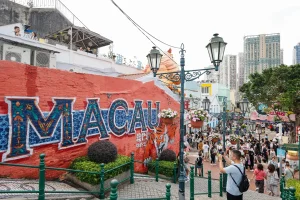
The legislator also suggests that the Labour Affairs Bureau and the Public Security Police create “instant communication groups with representatives from the sector”, similar to what already exists in the tourism industry. “Professionals are able to quickly identify who is a legal operator and who is an illegal worker.”
Read also: Sam Hou Fai pledges to strengthen labor rights and employment in Macau
Lei Leong Wong adds that, as Macau is an international tourism and leisure city, the Government should encourage “legal cooperation models between Mainland Chinese companies and local operators”, including the “hiring of residents” or “formal applications for non-resident workers”, instead of allowing the “expansion of the illegal market”. “Demand cannot serve as an excuse for illegality,” he concludes.
Illegal labour and criminal liability
At present, illegal labour carried out by non-residents is generally punished only through administrative sanctions. However, lawyer Lao Chi U warns that “companies or agencies that systematically organise teams to provide services in Macau using tourist visas may incur the crime of irregular employment under Law No. 16/2021”.
The lawyer also recommends that residents “do not independently collect images or videos” as evidence, instead advising “immediate contact with the police” or “labour authorities”, providing detailed information regarding locations, schedules and the characteristics of the suspects.
