

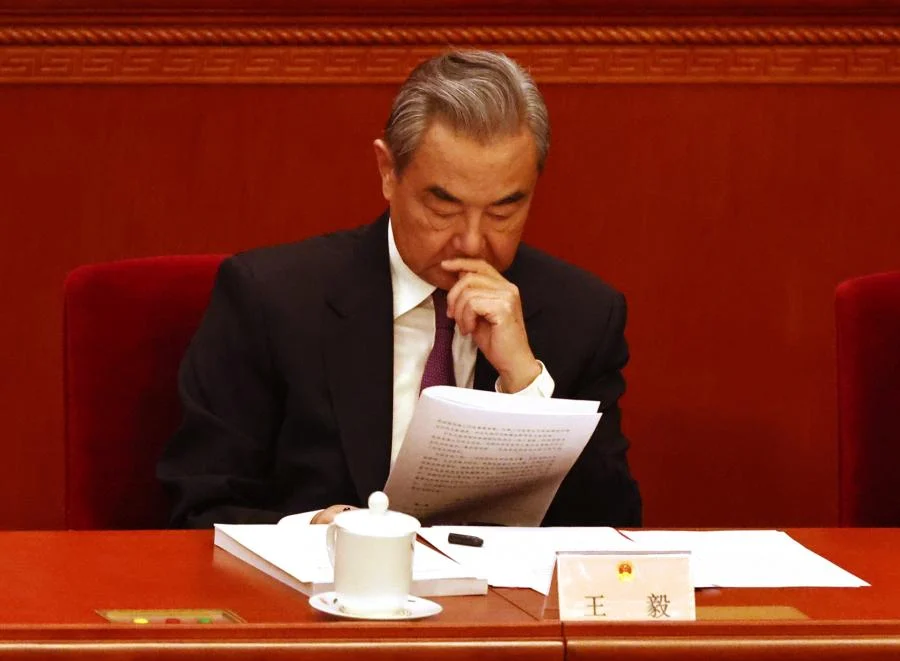
The negotiations “are in the fundamental interest of the Iranian people,” and China is willing to continue playing “a constructive role” for peace in the Middle East, Wang Yi said during a phone call with his Iranian counterpart, Abbas Araghchi, according to a statement. China is Iran’s main trading partner and one of its most influential allies.
Wang Yi stated that “Iran’s sovereign security, as well as its legitimate rights and interests, must be respected and protected” as a strategic country in the Strait of Hormuz, emphasizing that “at the same time, (…) freedom of navigation and security must be guaranteed.”
Iranian Foreign Minister Abbas Araghchi, for his part, indicated that Tehran “counted on China to play a positive role in promoting peace and ending the conflict,” according to the Chinese Foreign Ministry’s statement.
Araghchi also expressed “Iran’s willingness to continue seeking a rational and realistic solution through peaceful negotiations,” according to the same press release.
Read also: Iran War: U.S. denies agreement to extend ceasefire (with video)
Iran today received a Pakistani delegation led by the influential army chief, Asim Munir, after stating that it would continue its talks with the United States through Pakistan, state television reported.
The delegation is carrying a new message from Washington to Tehran and is expected to discuss future negotiations with Iranian officials, following the failure of the first round of talks between the two countries, according to Iranian state television.
Tehran and Washington failed to reach an agreement last weekend in Islamabad, but Pakistani authorities announced they are working toward new negotiations. U.S. President Donald Trump said in an interview with Fox Business that the war in Iran could end “very soon.”
In an attempt to pressure Iran and force the reopening of the Strait of Hormuz, Trump announced on Monday a blockade on maritime traffic in Iranian ports.
Read also: Iran War: Xi Jinping calls for a “comprehensive and lasting” ceasefire
In response, the head of Iran’s armed forces, General Ali Abdollahi, stated that Iran will not allow “any exports or imports in the Persian Gulf, the Sea of Oman, or the Red Sea.”
On the diplomatic front, Pakistani Prime Minister Shehbaz Sharif traveled to Saudi Arabia today to meet with Crown Prince Mohammed bin Salman. Sharif and his accompanying delegation are also expected to visit Qatar and Turkey.
The Pakistani leader is traveling with Foreign Minister Ishaq Dar on a mission that his government has officially described as “bilateral in nature.”
However, the visit is taking place within the timeframe indicated by the U.S. president and by diplomatic sources cited by the Spanish news agency EFE, who suggested that talks would resume late this week or early next week.
The same sources added that the proposal for a second meeting has already been sent to the U.S. and Iranian delegations to break the deadlock in negotiations over uranium enrichment.
Meanwhile, The Washington Post reported today that the Pentagon (U.S. Department of Defense) is preparing to deploy an additional 4,200 troops to the Middle East.
A two-week ceasefire went into effect on April 8 to allow for negotiations between the United States and Iran, mediated by Pakistan.
