

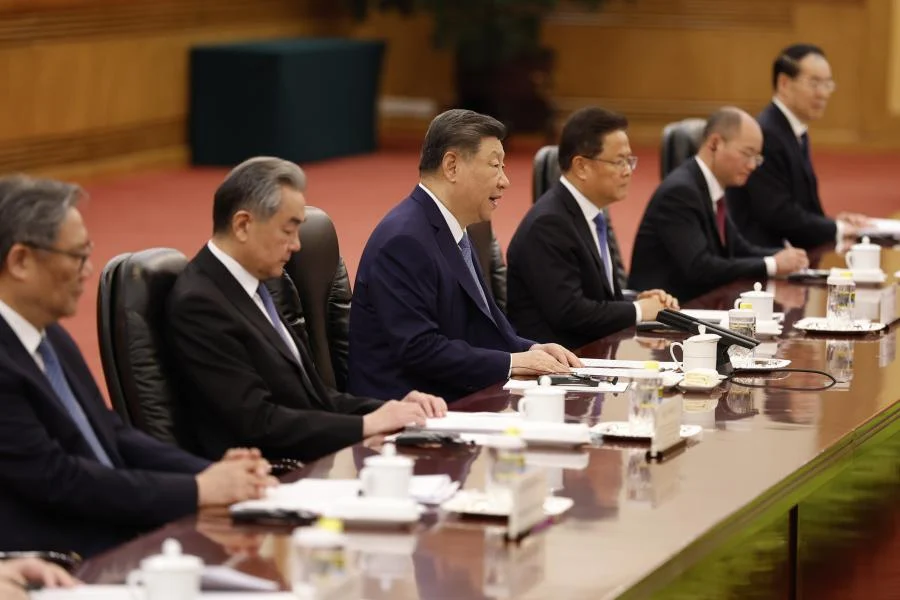
Chinese President Xi Jinping has called for a “comprehensive and lasting” ceasefire in the Middle East amid escalating tensions in the Strait of Hormuz, one of the world’s key energy shipping routes.
Xi made the remarks during a meeting in Beijing with Abu Dhabi Crown Prince Khaled bin Mohamed bin Zayed Al Nahyan at the Great Hall of the People.
According to a statement from the official Xinhua News Agency, Xi stressed that the crisis should be resolved through political and diplomatic means, pledging that China will continue to play a “constructive role” and actively work to promote peace.
The Chinese leader also urged respect for the sovereignty, security, and territorial integrity of Middle Eastern and Gulf countries, warning against the selective application of international law, which he said should not be used “when convenient and discarded when not.”
Read more about this topic: Iran War: Trump threatens 50% tariffs on China over potential military support (with video)
Xi outlined four principles for regional stability, including peaceful coexistence among regional states, respect for international law, and coordination between development and security. He noted that growing instability is increasing uncertainty over global trade and energy routes.
He also called for stronger coordination within multilateral frameworks such as the United Nations and BRICS, adding that stable China–UAE relations could help ease global uncertainty.
Both sides exchanged views on the situation in the Middle East and the Gulf, where maritime traffic through the Strait of Hormuz has been disrupted following heightened tensions involving the United States and Iran.
Xi warned against a return to a “law of the jungle” in international relations — an expression he also used earlier in a meeting with Spanish Prime Minister Pedro Sánchez.
According to Xinhua, the UAE Crown Prince described China’s role as “responsible and constructive” and expressed readiness to strengthen coordination with Beijing to promote a ceasefire, ensure safe navigation, and reduce the impact on the global economy and energy markets.
The visit comes amid heightened instability in the region, with Iran imposing restrictions on shipping through Hormuz following escalating tensions with the United States and Israel.
