

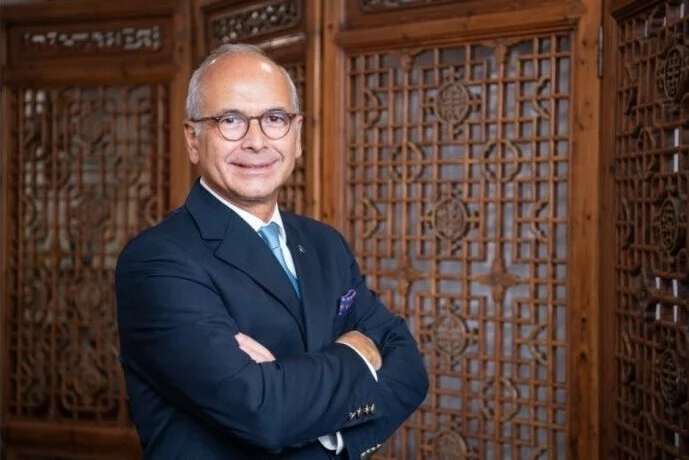
The president of the Luso-Chinese Chamber of Commerce (CCILC) in Macau said on Monday that he expects the upcoming visit of Macau’s Chief Executive to Portugal to help resolve restrictions on residency rights for Portuguese nationals.
The Chief Executive of Macau is set to visit Portugal and Spain between 17 and 23 April, marking his first overseas trip since taking office in December 2024.
According to the chamber, the most important issue on the agenda is the ability for Portuguese citizens to move to Macau to work “in a less bureaucratic and less uncertain way,” said Carlos Cid Álvares.
He recalled that such arrangements used to exist in a relatively simple form but are no longer available.
Read more: China willing to expand cooperation with Portugal using Macau as platform
Since August 2023, Macau has stopped accepting new residency applications from Portuguese nationals based on “highly qualified technical roles,” only allowing applications based on family reunification or prior ties to the territory.
The previous framework, in place after Macau’s handover in 1999, has effectively been dismantled, leaving most Portuguese workers with only a “blue card” tied to employment contracts, without full residency rights such as access to healthcare and education.
The only remaining route to residency is through talent recruitment schemes introduced more recently.
“I believe this is an issue being worked on, perhaps behind the scenes, and will certainly find a solution,” said Cid Álvares, who is also chairman of Banco Nacional Ultramarino, owned by Caixa Geral de Depósitos.
Read more: Macau points to Portugal as a priority to attract more tourists
Macau’s Chief Executive, Sam Hou Fai, met Portuguese Prime Minister Luís Montenegro in Macau on 10 September. At the time, Montenegro said that “things are moving in the right direction” regarding a possible resolution to residency restrictions.
Cid Álvares also stressed the need for reciprocity, noting that Portugal has granted citizenship to around 120,000 to 130,000 people from Macau and Hong Kong.
“The Portuguese influence cannot be sustained here under the current situation. It is one thing for Chinese citizens to speak Portuguese, but quite another for Portuguese nationals to actually live in Macau,” he said.
Macau continues to promote Portuguese language education as part of its role as a platform for financial and business links between China and Portuguese-speaking countries, aiming to diversify its casino-dependent economy.
Read more: Pereira Coutinho hopes that António José Seguro will strengthen relations between Portugal, China, and Macau
However, Cid Álvares warned that language education alone is not enough, arguing that real influence requires the physical presence of Portuguese professionals.
Separately, Macao lawmaker José Pereira Coutinho said he hopes the Chief Executive’s visit to Portugal will produce “positive results” for Macau’s future development, particularly in human resources.
He highlighted shortages in healthcare, legal services, public administration, and digital modernisation.
At the end of 2025, Macau’s public administration employed 33,856 people, though official data does not specify how many are Portuguese nationals, only noting that 226 were born in Portugal.
