

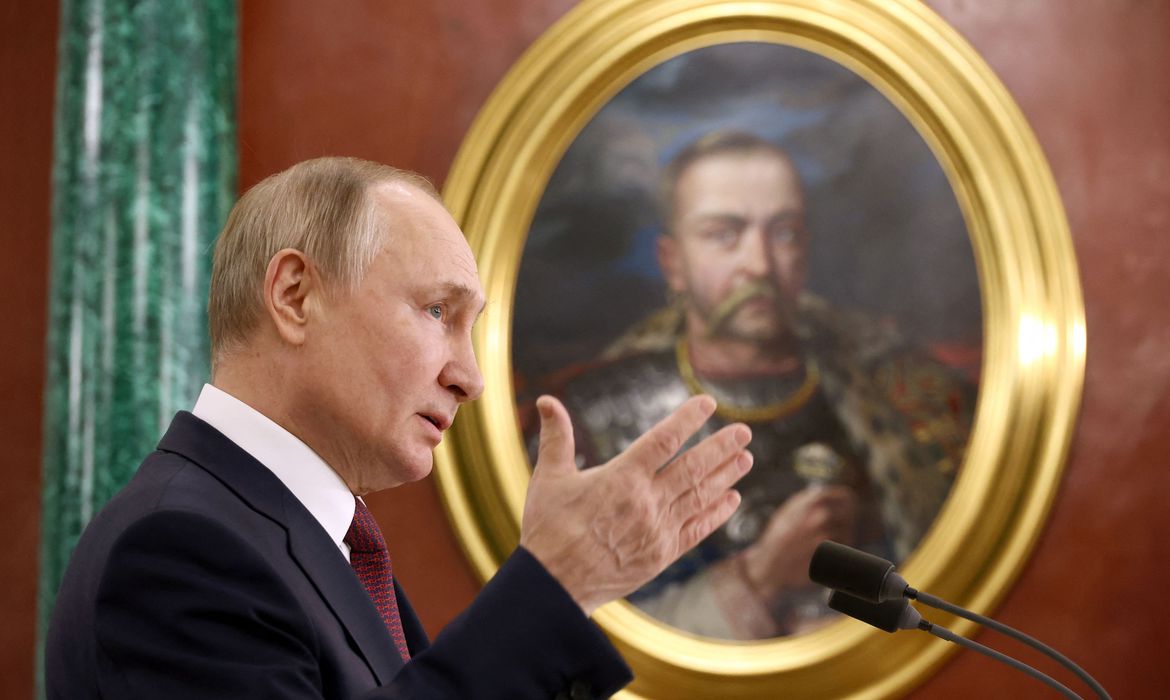
President Vladimir Putin reaffirmed Russia’s commitment to expanding its nuclear arsenal today, declaring that the nation will develop strategic weapons specifically designed to bypass any current or future Western missile defense systems.
Speaking during a visit to the Moscow Institute of Thermal Technology (MITT), the legendary design bureau responsible for the Topol, Bulava, and Yars intercontinental ballistic missiles (ICBMs), Putin emphasized that Russia’s nuclear modernization remains the cornerstone of its national security.
Mr. Putin asserted that the Kremlin is creating missile systems with enhanced combat power capable of overcoming any “antimissile shields” deployed by the United States or its NATO allies.
The Russian leader used the occasion of MITT’s 80th anniversary to personally decorate the institution’s chief designer, Yuri Solomonov, with the “Hero of Russia” medal. During the ceremony, Putin noted that the expertise developed at the institute has been instrumental not only in strategic deterrence but also in the “special military operation” in Ukraine, where he claimed conventional variants of ballistic systems are being used with high efficiency.
Read more: Ukraine: Putin drone strikes are “no serious threats”
This rhetoric serves as a direct warning to the West, reinforcing Moscow’s stance that its military-industrial complex remains robust despite years of heavy international sanctions and battlefield losses in Eastern Europe.
A central piece of Putin’s modern nuclear strategy is the Sarmat intercontinental missile, which he recently lauded as the most powerful system in the world. According to Russian claims, the Sarmat possesses four times the power of Western equivalents and features a “virtually unlimited” range.
While Putin announced that these missiles would enter active service by the end of 2026, the project has been marred by setbacks. Independent reports indicate that the deployment schedule was previously delayed following two failed tests, and the manufacturer, Krasmash, recently saw its director arrested on suspicion of bribery, highlighting internal struggles within the Russian defense sector.
Despite these domestic challenges and the arrest of key industrial figures, the Kremlin continues to project an image of technological invincibility. Having already stationed tactical nuclear weapons in neighboring Belarus, Putin’s latest statements signal a shift toward long-term strategic competition.
Read more: Ukraine: Putin declares a unilateral ceasefire for May 8-9 (with video)
By focusing on the development of projectiles that render current interceptor technologies “useless,” the Russian President is attempting to balance the geopolitical scales at a time when tensions with the West have reached their highest point since the Cold War.
