

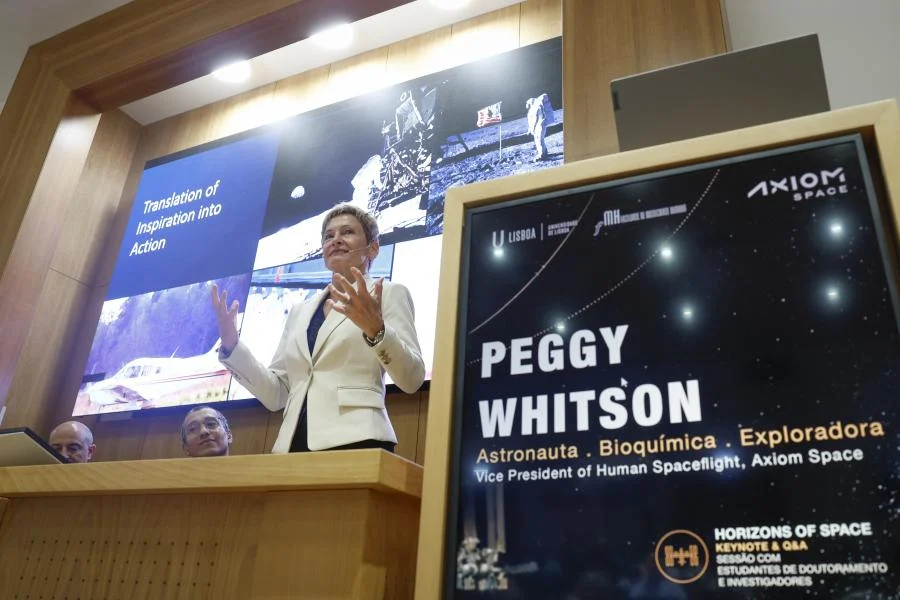
American astronaut Peggy Whitson admitted today that returning to planet Earth is much harder than traveling into space, emphasizing the critical role of physiology in how the body recovers and readapts to gravity upon its return. “Gravity sucks,” she joked before an audience of students and professors at the Faculty of Human Kinetics (FMH) of the University of Lisbon.
The astronaut, biochemist, and Vice President of Axiom Space visited the university to sign a memorandum of understanding integrating the faculty into the Axiom Space University Alliance.
During a session dedicated to the “horizons of space,” Whitson shared her career trajectory and stories from her numerous space flights with NASA and Axiom Space. She also discussed lessons learned during the ten years she worked at NASA being rejected from the space program year after year before finally being selected.
Given the audience of human kinetics specialists, many questions centered on how the human body prepares for and experiences the extreme conditions and physiological shifts caused by prolonged exposure to outer space.
Read more: SpaceX completes 12th starship V3 test flight (with video)
“Being in space is the best part of being in space,” she stated, explaining that microgravity forces the body and brain to operate entirely differently than they do on Earth. However, after spending nearly two years of her life in orbit across various missions—including a continuous stint of nearly 300 days aboard the International Space Station (ISS)—Whitson admits that returning home is the hardest part.
While aboard the ISS, astronauts exercise daily to combat muscle atrophy, bone density loss, and neuromotor deterioration.
Despite these efforts, the physical impact remains significant even during shorter space flights. Whitson noted that the return to Earth’s gravity has the greatest toll on the neurovestibular system and overall motor coordination.
She highlighted the work of physiologists as essential, recalling that during her 2025 Axiom mission, which lasted 16 days, updated protocols made her return much smoother. One of the training experts preparing her for that mission was Portuguese physiologist and FMH alumnus Emiliano Ventura.
Read more: US-China rivalry extends to space with focus on orbital warfare
Ventura explained that the human response to space is highly individual, meaning preparation must mirror the tailored approaches used for elite individual athletes.
FMH President Pedro Passos stated that joining the Axiom Space Alliance opens doors to deep research into space adaptation, with plans already underway for a dedicated research project and potential future graduate programs. Hugo Costa from the Portuguese Space Agency also praised the partnership, identifying space medicine as an expanding frontier with vast growth potential for students.
