

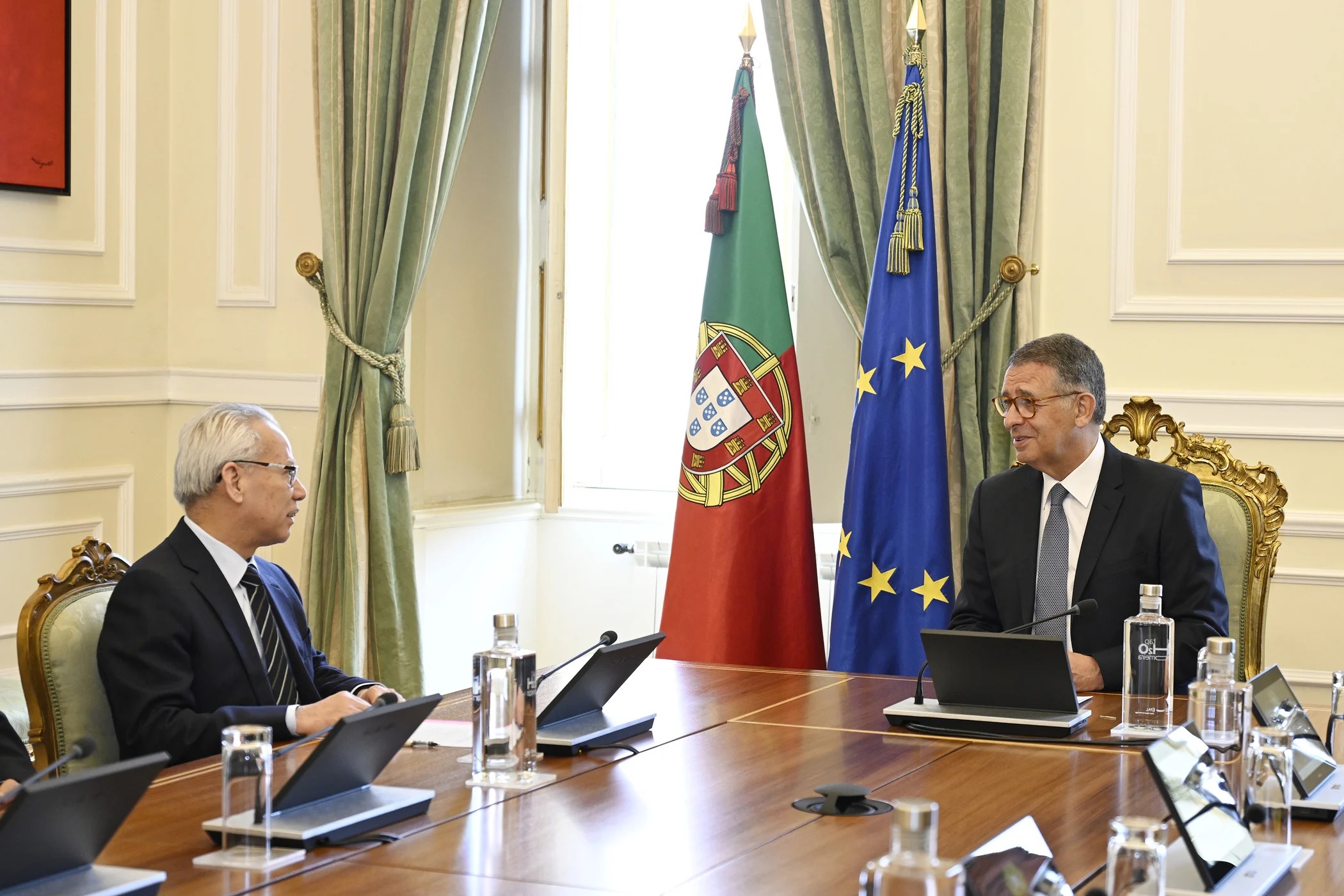
Sam Hou Fai’s first official trip abroad includes Madrid, and will conclude in Geneva and Brussels; however, its political epicentre and economic weight are defined from the outset in Lisbon, where a dense and demanding agenda ensures the institutional dimension of the visit. It also reinforces a consistent and repeated message: to “strengthen cooperation” with Portugal; to “project the platform”; to offer Macau’s “advantages”; and to present diversification and investment in Hengqin as “opportunities.”
In a dual sense, the Chief Executive stressed in his press briefing before departing for Madrid: “Portuguese companies that wish to enter China”; and “Chinese companies that wish to come to Portugal.”
The message circulates behind the scenes; Sam Hou Fai projects the support of the Portuguese government in the media. In his account, the President, prime minister and ministers all “agree” on using Macau as a platform for China and want to “strengthen relations.”
It is Sam Hou Fai himself who conveys this to the Macau press – the only media following the visit step by step over three days: 22 events, 17 attended by him, and he even finds time to praise the reporters’ endurance: “I could see that you are more tired than I am.”
Read also: Sam Hou Fai outlines five expectations for local business sector
The Portuguese press pays little or no attention to the presence of the Macau government; closed-door official meetings, with no statements, also escape traditional media visibility; and no Portuguese journalists are present at the press conference where Sam Hou Fai sums up the trip: a long speech, many messages, few questions – three in total.
Pillars of the platform
The visit to Portugal establishes the three pillars underpinning the narrative of internationalisation as a driver of diversification: the China–Portuguese-speaking platform as a competitive “advantage”; Hengqin as an economic “opportunity”; and diversification as a “political priority.” But what Sam Hou Fai himself calls “the most comprehensive institutional agenda ever” also carries its own political weight.
First, because there were doubts and scheduling difficulties – only days before the trip, it was far from certain: the President, prime minister, Parliament, two ministers, even the highest magistrate in the nation… the full spectrum of power.
Second, because the weight of Chinese diplomacy is evident, insisting on the institutional dimension of the visit. The Chief Executive explicitly thanks Chinese diplomacy, adopts a strategy aligned with the national plan of opening and growth, and confirms China’s support for Macau’s platform role.
It is a pragmatic discourse; seen by some as a weakness, in the sense of limited autonomy and reduced representativeness, but one that demonstrates strength in the institutional arena. With Beijing’s backing in play, and with emphasis on the “high-level” nature of the visit, Macau secures a mediating role without needing to impose itself.
In his meeting with the Minister of Economy, Manuel Castro Almeida, Sam Hou Fai presents Macau as a link between China and the Portuguese-speaking world, highlighting the advantages of bilingualism and the legal system for Lusophone businesses. He aims to channel bilateral cooperation towards economic diversification, focusing on areas such as scientific innovation, education and training, tourism, and conventions and exhibitions. The ultimate goal: investment – inviting Portuguese companies to invest in the Macau/Hengqin axis.
Stability and progress
Castro Almeida praises Macau’s stability and progress since its return to China, and acknowledges the interest of Portuguese companies in Macau, the Greater Bay Area, and mainland China. This business dimension is central to the message.
At the official reception, attended by around 400 guests, Sam Hou Fai projects an economy of “high quality,” in an “international” business environment grounded in the rule of law and predictability. At the MEO Arena, he calls on Portuguese companies to “explore opportunities” in Macau, Hengqin, and mainland China, pointing to sectors such as the digital economy, marine economy, financial technology, environmental sustainability, and cross-border e-commerce.
Read also: Sam Hou Fai highlights strategic partnership with Portugal during official visit
Trade, technology, tourism, education, healthcare, exhibitions, and culture are among the areas where the Chief Executive seeks to strengthen institutional and business ties. The visit is also marked by “61 agreements and protocols,” which Sam Hou Fai pledges to “implement and develop.”
In a meeting with representatives of the Association of Chinese Societies in Portugal, he underscores the choice of Portugal as the first destination, reflecting “the importance attached to strengthening economic cooperation.” He encourages Macau companies to deepen ties with Portugal and highlights the presence, within the delegation, of representatives from Macau, Hengqin, and several Chinese provinces.
A pointed remark
In a statement, the Presidency of the Republic calls for the “strengthening” and “deepening” of the “relationship of trust,” following a meeting that highlighted Macanese culture, the importance of the Portuguese School, and the preservation of the language. However, António Seguro offers the only politically sharper note: “It is essential that full compliance with the legal framework arising from the transfer of administration continues,” particularly regarding the protection of rights, freedoms, and guarantees.
In his meeting with Justice Minister Rita Alarcão Júdice, Sam Hou Fai explains the legal framework in the context of integration into China and calls for stronger judicial cooperation, particularly in supporting bilateral trade and the movement of people. The Portuguese minister acknowledges Macau’s progress, the preservation of the Portuguese language and culture, and its role as a platform for China.
Other moments of the visit
When inaugurating in Lisbon an exhibition dedicated to the principle of “One Country, Two Systems,” Sam Hou Fai stresses that the model, more than a political concept, is proof of the “progress” achieved over recent decades. The ceremony is attended by MP José Cesário, who highlights the “friendship” between Portugal, China, and Macau.
In his meeting with China’s ambassador to Portugal, Yang Yirui, Sam Hou Fai focuses on cooperation between Macau and Portugal and on the Lusophone platform, thanking the Ministry of Foreign Affairs and the embassy for their “commitment” and “support.” The ambassador, in turn, highlights the “scale” and “high standard” of the official programme and reaffirms China’s support for Macau’s development and the Greater Bay Area.
There was also time to meet more than a hundred Macau students in Portugal, studying fields such as law, translation, Portuguese studies, medicine, artificial intelligence, engineering, economics, and architecture.
The “most moving” moment of the visit, Sam Hou Fai admits, as it reminded him of his own time as a student, and because these are the “young people who will help develop Macau and the country.” Hence, he concludes, the importance of investing in “education and intercultural communication” – ultimately, in Macau’s capacity to competently act as a bridge between China and the Portuguese-speaking world.
