

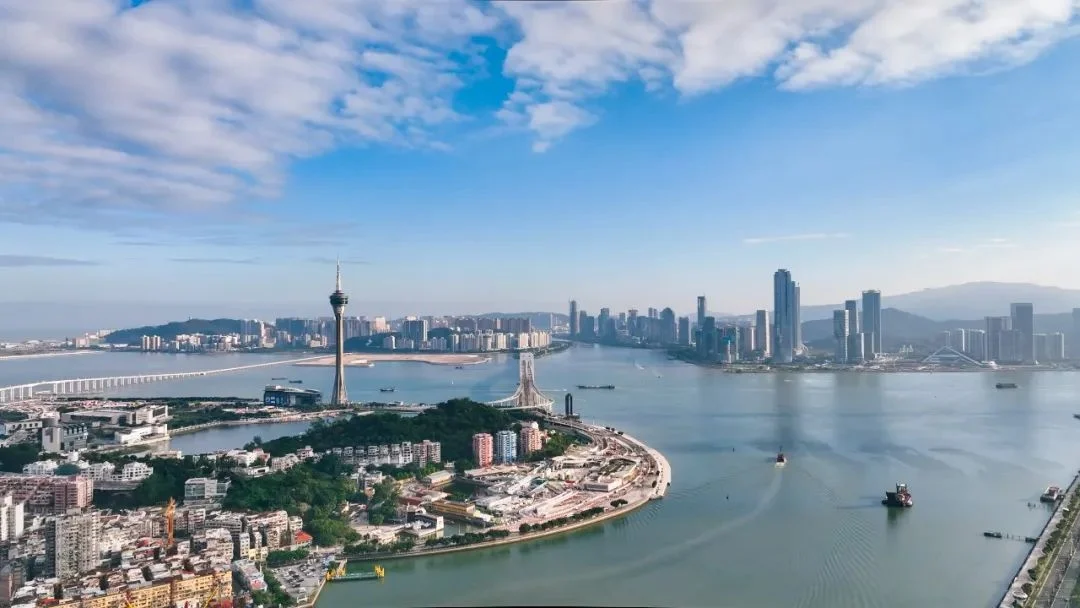
“With just over 30 square kilometers and a population of about 600,000 people, the market is far too small. Macau lacks the space, resources, and conditions to support a complete industrial chain,” says Samuel Tong, president of the Macau Association for the Study of Political Economy.
The General Administration of Customs of China announced a package of 20 measures to accelerate cross-border trade and deepen the integration of the Guangdong-Hong Kong-Macau Greater Bay Area. The initiatives include customs simplification, logistics integration, support for technological innovation, expansion of e-commerce, and new mechanisms for the movement of goods between Macau, Hong Kong, and mainland China.
For Samuel Tong, the measures should be viewed in the context of the 15th Five-Year Plan. “The General Administration of Customs’ 20 measures are aligned with the objectives of the 15th Five-Year Plan,” he states, adding that the goal is to “promote the alignment of rules and mechanisms” and strengthen “market integration in the Greater Bay Area.”
Tong believes that Macau and Hong Kong are now entering a new phase in China’s opening-up process. The analyst first recalls the role of the two regions in the Special Economic Zones initiative and then the deepening of economic cooperation following China’s accession to the World Trade Organization and the establishment of CEPA.
Macau lacks the space, resources, and conditions to host a complete industrial chain – Samuel Tong, president of the Macau Association for the Study of Political Economy
“In this new context of unilateralism and protectionism, if China wants to deepen economic opening, it can use Hong Kong and Macau, as separate customs regions, as pilot zones,” he tells PLATFORM.
Read more: Hengqin launches an exclusive recruitment drive for Macau residents
Tong also argues that the “1+4” strategy depends on regional integration and coordination with Hengqin to develop industrial chains in the Greater Bay Area. According to the analyst, the new measures aim to reduce costs and transit times between the three customs territories through mechanisms such as “one document, dual declaration,” the expansion of electronic customs seals, and new multimodal transport systems.
“These measures reduce costs and transit times between the three customs territories, allowing the ‘1+4’ industrial chain to improve in quality and efficiency,” he tells PLATFORM.
The package also includes the expansion of the “single-lock” system, which is expected to reduce customs clearance times by about 30%, as well as new inspection models for sensitive technological goods and specific measures for Hengqin, Nansha, and Qianhai.
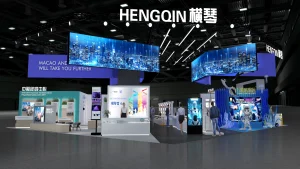
Made in Macau
Kin Sun Chan, a professor at the University of Macau, highlights the expansion of the “Produced under Macau Supervision” model and the coordination between Macau and Hengqin. The academic also states that Macau can act as a “super connector” between China and international markets. “Macau can leverage policy differences with Guangdong to act as a ‘super connector’ between the country and the world,” he tells PLATFORM.
Macau can leverage policy differences with Guangdong to act as a ‘super connector’ between the country and the world – Kin Sun Chan, professor at the University of Macau
The academic also highlights the expansion of the “Produced under Macau Supervision” model, which allows products registered in Macau to be manufactured in Hengqin and exported while retaining the Macau brand identity.
“This allows Macau’s SMEs to utilize Hengqin’s production facilities while simultaneously preserving the value of the ‘Macau brand’ and reducing production costs,” he says.
According to Kin Sun Chan, the model helps unlock the “Registration in Macau + Production in Hengqin + International Sales” chain. The academic adds that mechanisms such as the AEO system, the 9610 and 1210 regulatory models for cross-border e-commerce, and the “Cross-boundary One Lock” can significantly reduce logistics costs for local companies.
“The 20 measures were specifically designed to support the Hengqin-Macau Cooperation Zone and sectors linked to Macau’s economic diversification,” he concludes.
