

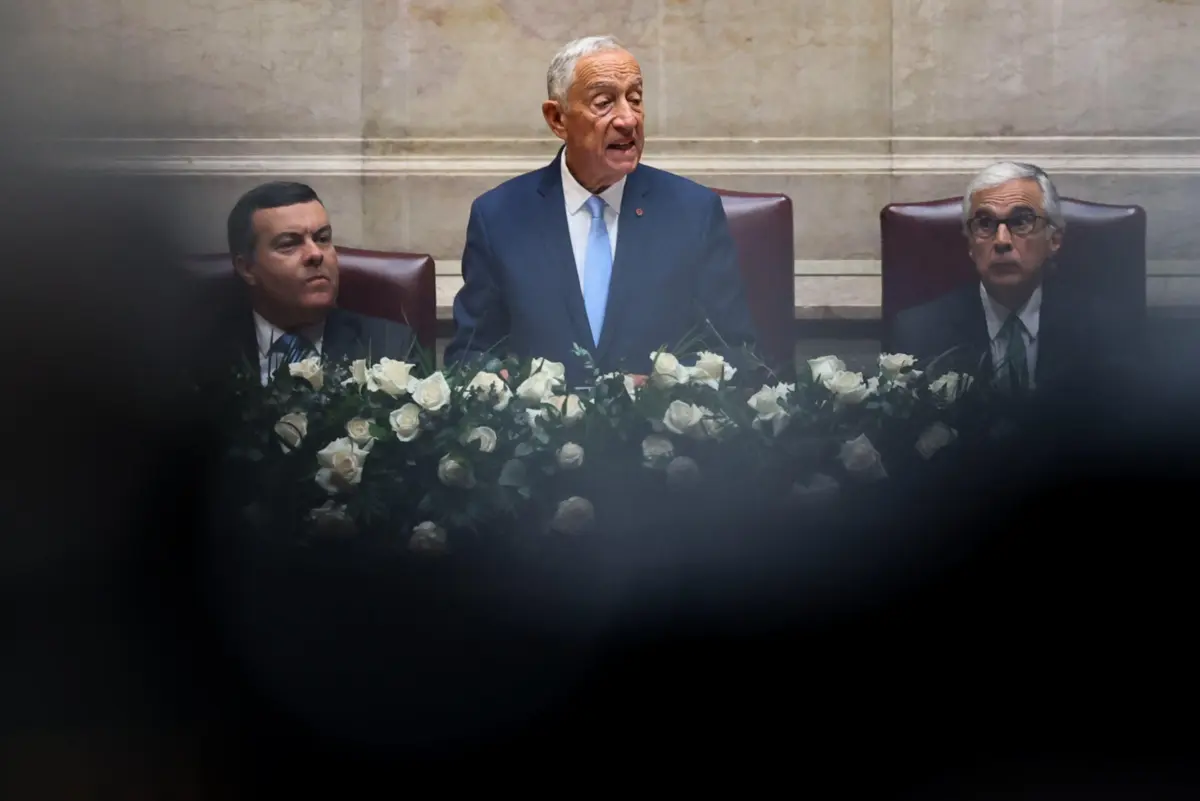
Former Portuguese President Marcelo Rebelo de Sousa stated that it is currently “harder to govern” and called for widespread education on the importance of institutional stability, urging public figures “not to contribute to the noise.”
“I make it a point, in relation to the organs of power—because I know the difficulty of these positions—to the President of the Republic, the Prime Minister, the Government, and political leaders in general, to appeal for people to understand that today it is harder to govern than it was five, 10, 15, 20, or 25 years ago,” Rebelo de Sousa said in Madrid.
“And understanding that means not just avoiding contributing to the noise, but actively teaching what is truly important: institutional stability and personal stability. The Portuguese people want that,” added the former head of state, who spoke Sunday night at a June 10th (Portugal Day) celebration dinner organized by the Fórum dos Portugueses, a Portuguese community association in Madrid.
Reflecting on the heightened challenges of holding political office today, Rebelo de Sousa recalled that “even before finishing my mandate,” he did “something unusual” when, during his “farewell to the Armed Forces,” he urged them “to unite around the new President who was about to take office.”
Read more: Portugal pledges to support Mozambique in AI
The former president explained that today’s “world is more global” and “what happens on one side of the planet shakes the stock markets and directly impacts everyone’s pockets across all nations,” noting that “it wasn’t like this” years ago. Furthermore, “time has accelerated,” meaning that “a decision that once seemed enduring or long-lasting” can now be thrown into question on the exact same day or the next.
Governing “in this accelerated era, with an increasingly complicated world where everyone depends on everything, is more difficult than it used to be.”
Marcelo Rebelo de Sousa reiterated that he does not intend to return to active politics, participate in “party or electoral activities,” or resume political commentary in the media, stating that this hands-off approach defines the role he believes a former president should maintain.
“I chose to return to what I could return to without causing issues,” he stated, highlighting his current visits to primary and secondary schools. He added that he remains “available for cultural activities and conferences,” though these will be “very few and highly selective, strictly avoiding topics connected to current domestic political realities.”
Read more: Macau: Minister admits difficulties in hiring Portuguese teachers
“Politics has an addictive side,” he recognized, “and the great risk of starting to make exceptions is falling back into that addiction.”
Rebelo de Sousa stressed that “when a former President of the Republic comments on anything, they are no longer President, but once you have worn that suit, it stays on.” He added that a former leader “cannot simply forget what they decided,” how, why, or “what they did and didn’t do,” and then suddenly comment on party politics, elections, policies, or presidential vetoes.
“These matters call into question one’s entire legacy as President of the Republic. That legacy stays with me for the rest of my life,” he added.
Insisting that “once you are President of the Republic, you remain a former president forever,” he shared a lighthearted recent anecdote from a traditional Queima das Fitas (burning of the ribbons) university graduation ritual in Coimbra, which involved hitting top hats with walking sticks, three kisses, and a playful kick.
Read more: Ursula von der Leyen thanks Portugal’s Marcelo Rebelo de Sousa for decade of leadership
“I did something that I’ve regretted several times over,” he shared, explaining that while it was completely harmless and something he would have done before his presidency, it now sat “right on the boundary” of acceptable post-presidential conduct. “And I have to be very careful with that boundary,” he concluded.
Marcelo Rebelo de Sousa served as President of Portugal for ten years until last March, when he was succeeded in office by António José Seguro.
SEO Description: Former Portuguese President Marcelo Rebelo de Sousa speaks in Madrid about why modern governing is harder and details his life after the presidency.
Slug: marcelo-rebelo-de-sousa-madrid-governing-institutional-stability
