

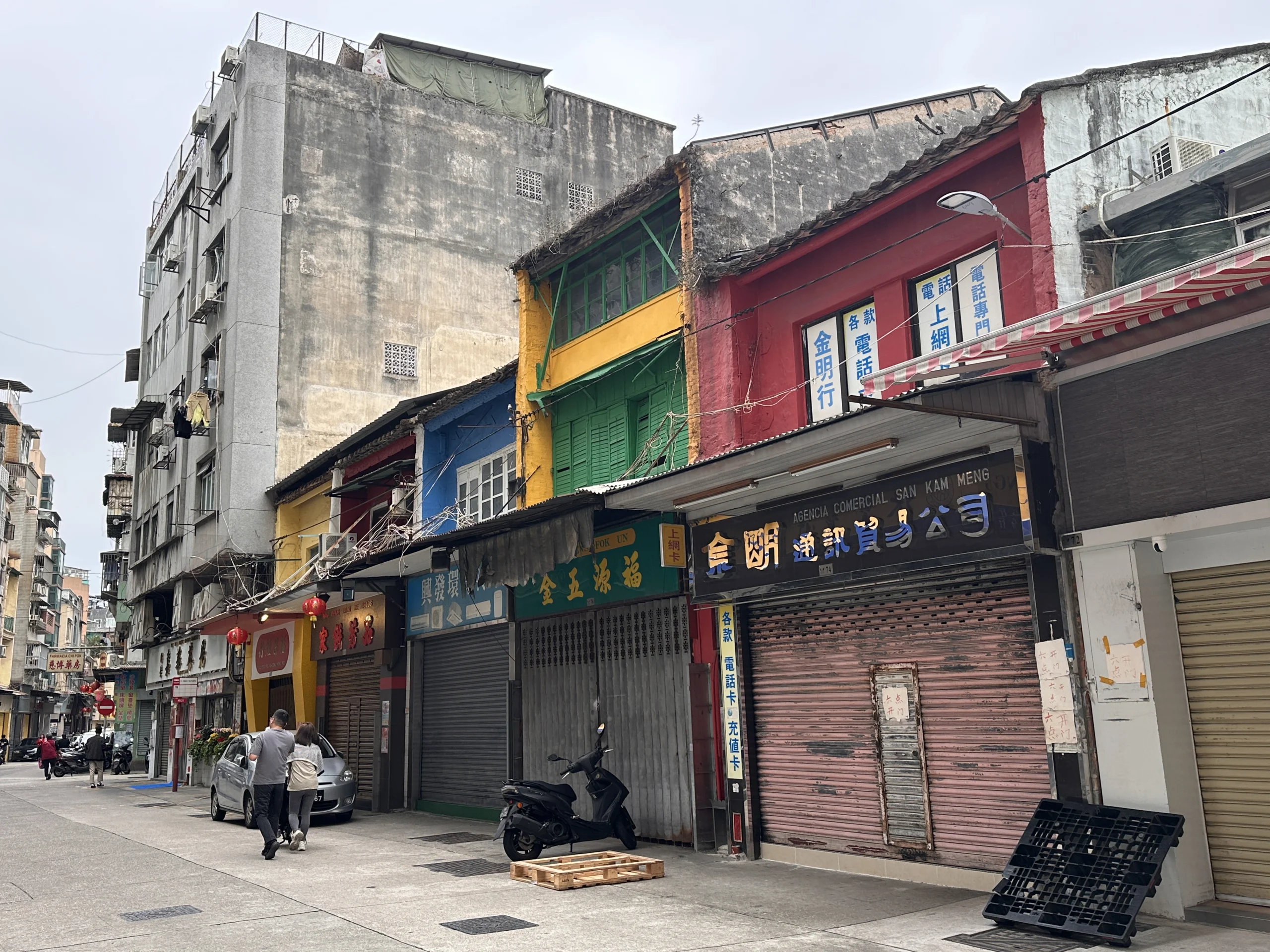
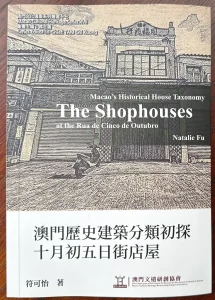
Natalie Fu has published the book Macau’s Historical House Taxonomy – The Shophouses at the Rua de Cinco de Outubro, a work organised into six parts that brings together a detailed analysis of Macau’s shophouses, interviews with academics, and a vast photographic archive, including the location and technical cross-sections of the buildings, thus constituting an important record for future memory.
The original manuscript was written in English; the edition now published has been translated into Chinese: “I want it to reach more local readers. The bilingual publication is intended to stimulate debate and interest among a wider audience,” she told PLATAFORMA.
A Macau native, Natalie is currently pursuing a PhD in History, focused on the study of cultural fusion in architecture and built heritage conservation. The content now published is based on her master’s dissertation, revised and expanded: “I sought to present the historical value and cultural significance of Macau’s old shophouses.”
Read more: National security now covers education and culture
In the book, Natalie stresses that shophouses are an essential type of multifunctional dwelling, adapted to various uses, which once formed the predominant structure along Macau’s streets, and which hold significant historical, social, cultural, architectural and aesthetic value.
She also highlights how Chinese and Western architecture “mutually influence each other” and how this is particularly reflected in the appearance of the shophouses, citing, for example, the “Art Nouveau-style” façades introduced in the 1920s.
Forgotten by the law
“Unfortunately, because they are small and scattered structures, and are not sufficiently protected by heritage law, they have been disappearing in the face of the city’s rapid development.”
To PLATAFORMA, Natalie explains that urban growth always implies the “loss and renewal of buildings”, and that deciding what to preserve and how to preserve it “is a complex and ongoing issue”, admitting that she herself is still learning about and exploring the subject. She nevertheless stresses that “preservation, protection, restoration and revitalisation should not be approached in a uniform way”.
The active use of shophouses highlights their social value (…) By keeping shophouses in operation, there is constant monitoring and maintenance, which is the most direct form of safeguarding them — Natalie Fu, architect
For the shophouses that still remain, the best strategy for now is maintenance, ensuring their continued use and carrying out annual inspections: “The active use of shophouses highlights their social value. For example, the presence of century-old shops on Rua de Cinco de Outubro further underscores the cultural and human value of the shophouses. By keeping the shophouses in operation, there is constant monitoring and maintenance, which is the most direct way of safeguarding them.”
Read more: Macau: More Culture, Less ‘Decoration’
To prevent serious damage to the shophouses before long-term planning is in place, provisional protection measures are urgently needed, as well as a comprehensive survey and thorough research to uncover the full value inherent in these buildings.
Disappeared shophouses
The book also documents several shophouses that have already disappeared. However, for some of these, which were lost before they could be properly studied, it was only possible to record their exteriors in photographs.
Asked about the main difficulty of the research, Natalie admits that it was access to information: there is a growing lack of data in Macau, especially adequate architectural records, which are scattered across public archives that are difficult to access or were never even catalogued by the authorities.
“Architectural plans are not accessible for academic research, and the private nature of these buildings makes fieldwork difficult,” she says.
She also stresses that “the classification of shophouses is the first step towards their protection”. The collection, cataloguing and dedicated study of data on Macau’s shophouses are “urgent and indispensable” tasks.
With the passage of time and the evolution of the urban fabric, “these ways of life and these buildings combining commerce and residence are disappearing”. These records are therefore “fundamental for the history of Macau’s architecture, for the study of mixed-use housing and for other related fields”.
Through the book, Natalie Fu hopes to raise public awareness and gather contributions from other professionals, encouraging the participation of more researchers: “In this way, it will be possible to involve more people in the preservation and development of Macau’s shophouses, providing important references for exploring better methods, directions and foundations for their conservation.”
Some of Macau’s shophouses have already been incorporated into the city’s historic centre zone, and are mainly located within the protection area of Avenida de Almeida Ribeiro, with some of them classified as buildings of public interest. Among the buildings recognised for their architectural value are the Tak Seng Pawnshop and the Moosa Houses; the classified cluster on Rua da Felicidade and Beco da Felicidade; as well as the former Sino-Western dispensary of the Old Chong Sai Pharmacy, at No. 80 Rua das Estalagens, the latter classified as a monument.
