

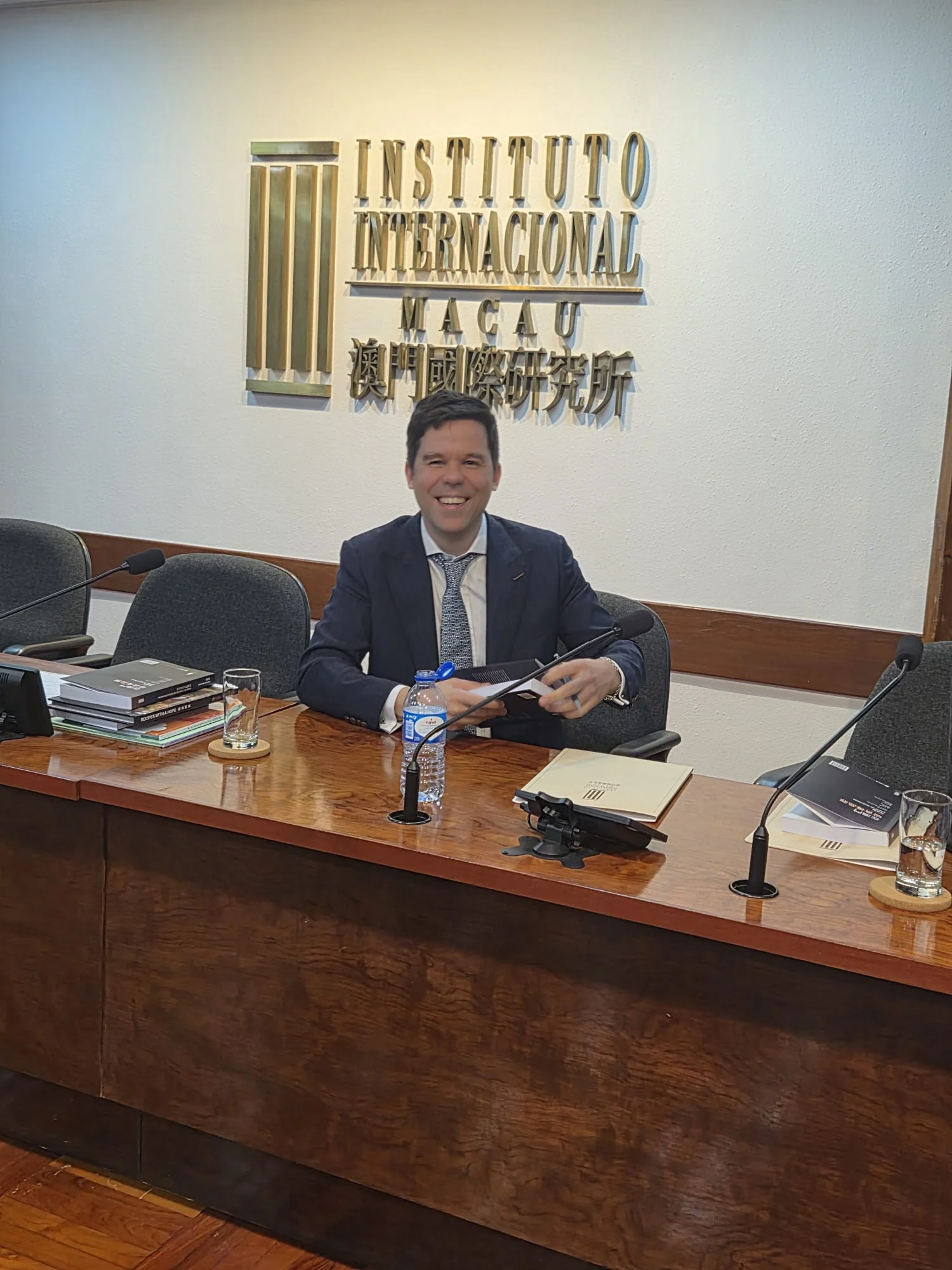
– What was the idea behind creating the Macau–Portugal Association for Legal Studies?
David Sá Machado – The Association had a single objective: the future publication of an Annotated Code of Civil Procedure, a project I conceived three years ago. For now, it is the only project on the table. But that does not mean others will not follow, because although it was an accident, it was a happy one. The Association can effectively promote Macau law, which is a field deserving our full attention. At least in terms of scientific publications, there has not been much development. Being able to bring figures from the Lusophone world, from Portugal and elsewhere, to join projects would, I think, be interesting.
– A bit like a legal think tank?
D.S.M. – The idea first came from several lawyers at MdME, particularly my colleague Dr. Rui Oliveira, one of the authors of the Code, who showed great availability and patience. He then helped me gather other members to form the association’s governing bodies and move the project forward. Dr. Teresa Leong is currently the project coordinator. She and Dr. Maria José Capelo, an associate professor at the Faculty of Law of the University of Coimbra, who already has a reputation in Portugal and dozens of publications in this area. I think she pairs very well with Dr. Teresa Leong, who, as everyone knows, was a magistrate in Macau for more than 20 years. It brings together practical and theoretical minds — theoretical knowledge and practical knowledge, a magistrate and a university professor.
Also read: Analysts warn of constitutionality issues in Macau’s National Security Law Proposal
The book was published in collaboration with the Macau Association for the Rehabilitation of Drug Abusers (ARTM), which has done extensive treatment work over the years…
D.S.M. – Precisely. That is a side that should never be overlooked. ARTM plays a fundamental role in Macau society and has been present for 25 or 30 years. Augusto Nogueira was very patient and willing to help me completely selflessly. He advised me, gave examples, showed me and helped me understand the reality.
Are you thinking of publishing more studies on other legal topics you find interesting?
D.S.M. – I would like to develop something further in the area of civil procedure. There are always very interesting topics. Rights-related matters are all there waiting to be explored. We work with cases every day and various problems arise — in practice, any of them could become an article, a monograph or a book. As there are few people writing about these topics, it is always a possibility. The Association can promote the development of studies on any issue raised in the courts, more modern ones, beyond the usual subjects I mentioned such as mediation, arbitration or the Basic Law.
There has been much discussion about arbitration as part of Greater Bay Area integration. Are these topics the association will try to explore?
D.S.M. – Certainly. Anyone who comes with an idea and wants to move forward, we can serve as a catalyst and promote it — bringing people together, including some of the authors we already have working in those areas, to build publications and projects. There is a lot of potential here; there is much to be done.
The book was published in collaboration with the Macau Association for the Rehabilitation of Drug Abusers (ARTM), which has done extensive treatment work over the years…
D.S.M. – Precisely. That is a side that should never be overlooked. ARTM plays a fundamental role in Macau society and has been present for 25 or 30 years. Augusto Nogueira was very patient and willing to help me completely selflessly. He advised me, gave examples, showed me and helped me understand the reality.
Are you thinking of publishing more studies on other legal topics you find interesting?
D.S.M. – I would like to develop something further in the area of civil procedure. There are always very interesting topics. Rights-related matters are all there waiting to be explored. We work with cases every day and various problems arise — in practice, any of them could become an article, a monograph or a book. As there are few people writing about these topics, it is always a possibility. The Association can promote the development of studies on any issue raised in the courts, more modern ones, beyond the usual subjects I mentioned such as mediation, arbitration or the Basic Law.
There has been much discussion about arbitration as part of Greater Bay Area integration. Are these topics the association will try to explore?
D.S.M. – Certainly. Anyone who comes with an idea and wants to move forward, we can serve as a catalyst and promote it — bringing people together, including some of the authors we already have working in those areas, to build publications and projects. There is a lot of potential here; there is much to be done.
– Are the authors all based in Macau? Do you also have people based in Portugal?
D.S.M. – Many of them are from Portugal, some from Macau, others from different places. We tried to maintain a balance in terms of origins, so that it would not be a Macau code annotated only by people from Portugal.
– Do you believe there is still room for public debate on legal issues in Macau?
D.S.M. – It cannot be otherwise. Law should be a science open to criticism, so to speak, for its own evolution and even its own survival. Otherwise, publishing these works would make little sense.
– You also published a book on the offence of drug consumption in Macau. Was that a joint publication with the Association or a separate project?
D.S.M. – It was a coincidence. It was a project I began three years ago, roughly at the same time, but developed in parallel. By coincidence, the book was published now, at the same time the association was created, but in reality it has nothing to do with the association’s activity. The book was published with the International Institute of Macau and resulted from a personal project I had long wanted to complete. Since I have been in Macau, I had the idea of publishing something related to a local topic with both practical and theoretical relevance. In that sense, I think it fulfilled its purpose. I dedicated this book to my brother and to my father, who worked here as a magistrate in the 1990s.
Law should be a science open to criticism, so to speak, for its own evolution and even its own survival
– How do you assess the way the offence of drug consumption is applied, compared with other jurisdictions such as Portugal?
D.S.M. – The particularity I can highlight, among several issues I raise, concerns the equivalence drawn between the consumer and the trafficker. For aggravated consumption to apply, there must be both a quantitative and a qualitative basis: a certain number of doses to be considered trafficking, but also intent to sell or produce. In practice, however, courts often convict largely on the quantitative aspect alone. A person has more than five doses and is already considered a trafficker. They apply the rule by presumption when in fact a deeper investigation should be carried out. There are other problems too, of course, because it is a complex provision, densely drafted and referring to several other provisions. The law has been amended regarding the schedules.
Also read: Syrups with opiate trafficked from Macau may result from closed borders
– The very substances listed as illegal…
D.S.M. – Yes. The schedules expand as new substances are created. Sometimes two or three times a year the law is amended because a new synthetic drug more commonly used here is discovered. Naturally, under the principle of criminal legality, if the substance is not on the schedule, it is not a crime and the person cannot be charged.
A person has more than five doses and is already considered a trafficker. [The courts] apply the rule by presumption when they should conduct a more thorough investigation
– It has to be added, otherwise it is not a crime…
D.S.M. – Exactly. It has happened, and I even had a client in that situation. He was caught with a substance and detained. But at the time of indictment the Public Prosecutions Office could not proceed because the substance was not yet on the schedule. Days later, the law was amended in a rapid change.
– The book was published in collaboration with the Macau Association for the Rehabilitation of Drug Abusers (ARTM), which has done extensive treatment work over the years…
D.S.M. – Precisely. That is a side that should never be overlooked. ARTM plays a fundamental role in Macau society and has been present for 25 or 30 years. Augusto Nogueira was very patient and willing to help me completely selflessly. He advised me, gave examples, showed me and helped me understand the reality.
– Are you thinking of publishing more studies on other legal topics you find interesting?
D.S.M. – I would like to develop something further in the area of civil procedure. There are always very interesting topics. Rights-related matters are all there waiting to be explored. We work with cases every day and various problems arise — in practice, any of them could become an article, a monograph or a book. As there are few people writing about these topics, it is always a possibility. The Association can promote the development of studies on any issue raised in the courts, more modern ones, beyond the usual subjects I mentioned such as mediation, arbitration or the Basic Law.
– There has been much discussion about arbitration as part of Greater Bay Area integration. Are these topics the association will try to explore?
D.S.M. – Certainly. Anyone who comes with an idea and wants to move forward, we can serve as a catalyst and promote it — bringing people together, including some of the authors we already have working in those areas, to build publications and projects. There is a lot of potential here; there is much to be done.
