

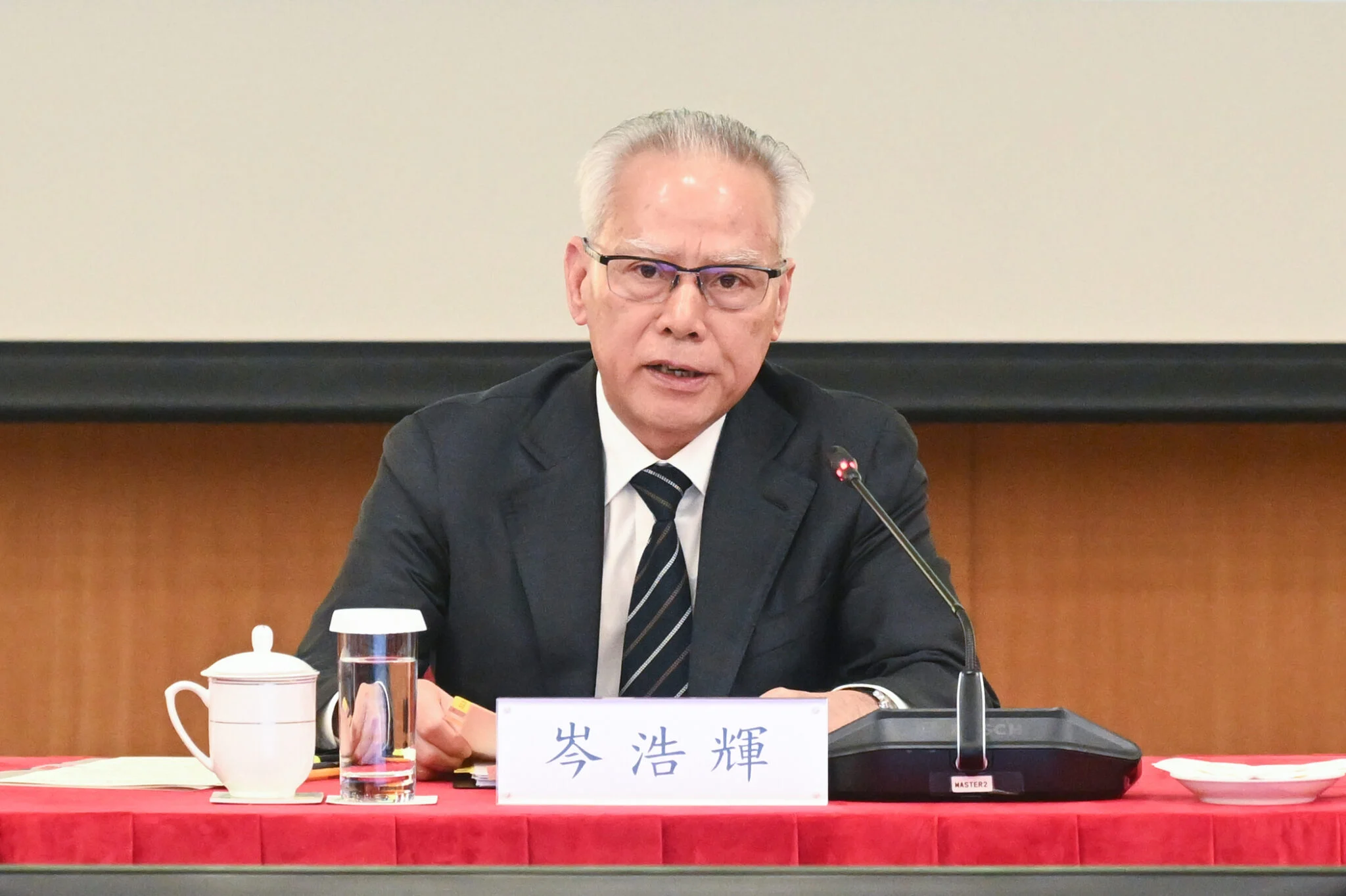
In his National Day speech, Chief Executive Sam Hou Fai announced the creation of a new one-billion-yuan fund aimed at Portuguese-speaking countries, as well as the establishment of a new cooperation center that will also include Spanish-speaking nations. The head of the Macau SAR Government did not provide details on how the fund would operate. PLATAFORMA attempted to obtain further information about the new fund and the center but received no reply before publication. Nevertheless, the announcement was enough to raise expectations about strengthening Macau’s role as a platform between China and the Ibero-American world, expanding a strategy that has been consolidated over the past two decades through the Forum Macau.
According to Lou Shenghua, the new fund could complement the existing Sino-Portuguese cooperation mechanism. “As no details have yet been announced regarding the creation of the said fund, it is speculated that it may serve as a complement to the current China–Portuguese Speaking Countries Cooperation and Development Fund. It is expected that the fund, managed by investors based in Hengqin—including the investment company of the Deep Cooperation Zone and the Investment Fund of the Deep Cooperation Zone—will aim to promote the development of the financial investment industry between China and Portuguese-speaking countries. This initiative could help Macau better fulfill its role as a platform for economic and trade cooperation between China and the Lusophone world.”
“Based on the limited information available, it is speculated that if the fund is established in Hengqin, its purpose will be to promote the development of that region’s modern financial industry, focusing mainly on capital investment, investment management, asset management, and other financial activities. Thus, the creation of this fund will contribute to strengthening financial and investment cooperation between China and Portuguese-speaking countries,” Lou Shenghua explained to PLATAFORMA.
Integration of the Hispanic World
The decision to also include Spanish-speaking countries in the new center announced by Sam Hou Fai was received with cautious enthusiasm by Deputy Consul-General and Senior Trade Commissioner of Spain, Javier Serra.
“The inclusion of Spanish-speaking countries considerably broadens the scope of the center’s activities, allowing for a closer relationship between Macau and nations beyond those with which it has traditionally maintained long-standing partnerships,” said the diplomat.
Serra sees this initiative as an opportunity for Spain and Latin American countries to strengthen their presence in the Chinese market:
“Our brother countries in the Americas each have their own strategies regarding the Chinese market, but we share a common language and culture, as well as a growing interest in this part of the world. I am convinced that this initiative will open in Macau a new gateway for developing relations between each of the Spanish-speaking countries and China. In Spain’s case, diplomatic and business relations with Macau have traditionally been conducted through Hong Kong, so I hope we now have the opportunity for a more direct approach.”
When asked about a possible imbalance of influence between Portugal and Spain, Serra dismissed the idea of competition:
“I don’t see it as rivalry but rather as complementary spaces. The Spanish- and Portuguese-speaking countries of the Americas and Africa—especially the larger ones such as Mexico, Brazil, Peru, Chile, and Colombia—do not belong to any European sphere of influence. Moreover, Spain and Portugal, as Member States of the European Union, share a set of values and interests, so this is not a zero-sum game.”
Synergies, Not Overlap
The objectives of this new center, however, resemble those of Forum Macau—a Central Government initiative coordinated by the Ministry of Commerce and the Macao SAR Government, which aims to deepen economic, trade, and cultural relations between China and Portuguese-speaking countries. There is also the China–Portuguese Speaking Countries Cooperation and Development Fund, which finances investment projects and stimulates trade and industrialization in participating countries. The fund is headquartered in Macau and jointly managed by the China Development Bank and the China–Africa Development Fund.
According to Lou Shenghua, “the new center will neither weaken nor replace the role of the Forum,” which has achieved “remarkable results” since its establishment in 2003. “It is believed that, by complementing the Forum’s functions, the new center will work together to promote economic and trade exchanges between China and Portuguese-speaking countries.”
Javier Serra, meanwhile, notes that “Forum Macau focuses on high-level exchanges, such as Ministerial Conferences.” The Forum regularly gathers ministerial representatives from all member countries—including Portugal, Brazil, Angola, Mozambique, Cape Verde, Guinea-Bissau, Timor-Leste, and São Tomé and Príncipe—and has been one of the main diplomatic and economic channels between the Lusophone world and China. “The future of this new center will depend on the concrete opportunities it can offer businesses from all sides to facilitate trade and business relations beyond existing channels.”
The announcement of the fund and the new center is interpreted as a sign of continuity and expansion in Macau’s economic foreign policy. Lou Shenghua sums up: “It can be said that these measures will help strengthen and consolidate Macau’s role as a platform for economic and trade cooperation between China and Portuguese-speaking countries.”
The move to integrate the Hispanic world into this dynamic could represent a new stage for Macau, consolidating it as a strategic bridge linking China and the Ibero-American space.
PLATAFORMA contacted Forum Macau, which simply replied that “any initiative aimed at fostering synergies toward common goals will always be positive.”
