

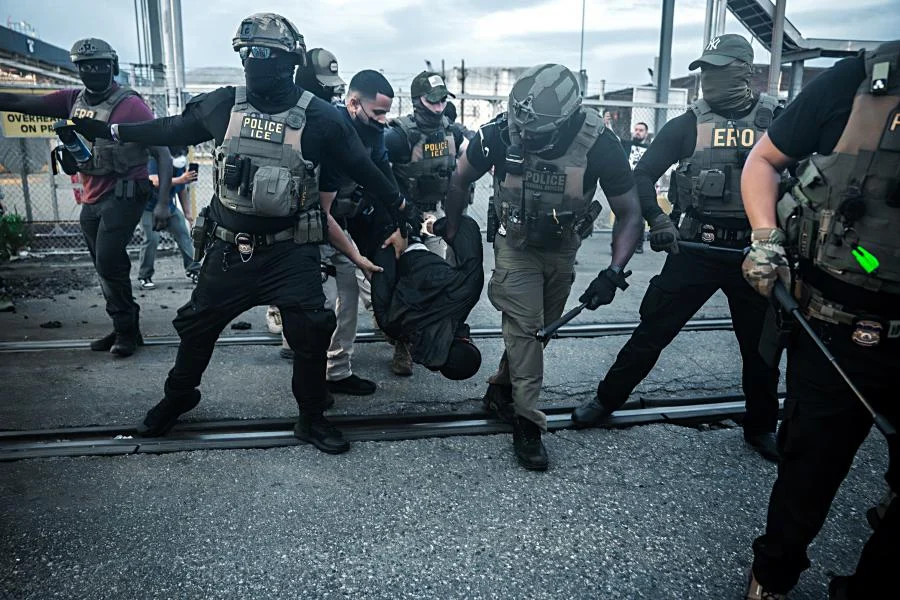
A federal judge has extended a ban nationwide, prohibiting agents from the U.S. Immigration and Customs Enforcement (ICE) from carrying out civil arrests inside or directly outside immigration courthouses.
The ruling announced on Tuesday by Judge P. Casey Pitts of the U.S. District Court for the Northern District of California delivers a major legal setback to the mass deportation policies enacted under Republican President Donald Trump.
Judge Pitts expanded a previous order issued in December to cover the entire country, blocking ICE agents and the Department of Justice from waiting in courtroom hallways to detain undocumented immigrants who lose their cases.
This enforcement practice had become a central yet highly controversial pillar of the Trump administration’s immigration strategy, resulting in the detention of migrants attending routine hearings and sparking fierce condemnation from civil rights groups over its chilling effect on court attendance.
Read more: Macau police arrest seven men over assault on investigator in Cotai
The Department of Homeland Security defended the courthouse tactics as an essential mechanism for executing valid deportation orders, while plaintiffs successfully argued that the threat of arrest induced panic and fundamentally undermined access to due process.
According to judicial records, the aggressive tática caused a sharp decline in overall appearance rates, which frequently resulted in immigration judges issuing mandatory deportation orders in absentia because individuals were too afraid to show up.
The judge stated that the federal authorities failed to provide any reasoned legal justifications for their policy changes, ultimately concluding that the contested enforcement guidelines were entirely “arbitrary and capricious.”
The decision by Pitts, an appointee of former Democratic President Joe Biden, additionally struck down a critical ICE policy waiver that had allowed immigration authorities to hold detainees in short-term holding facilities for prolonged periods extending up to 72 hours.
Read more: Japan and U.S. discuss Yen after currency approaches 40-year lows
As part of its broader mass deportation campaign, the Trump administration had systematically loosened long-standing restrictions in 2025 regarding immigration enforcement actions in designated sensitive locations, which previously shielded hospitals, places of worship, and schools.
According to the most recent official U.S. Census data from 2020, there are approximately 1.45 million individuals of Portuguese descent currently residing across the United States.
The latest annual report issued by U.S. Immigration and Customs Enforcement notes that 69 Portuguese nationals were formally repatriated back to Portugal, representing an increase of nine individuals compared to the previous calendar year.
In February 2025, Portugal’s then-Secretary of State for Portuguese Communities acknowledged during a parliamentary hearing in the Assembly of the Republic that the government lacked an exact statistical count of Portuguese citizens currently facing a direct risk of deportation from the U.S.
Read more: Trump claims sanctions money will be controlled by U.S. for humanitarian aid
José Cesário reminded lawmakers at the time that 360 Portuguese citizens had already exceeded the maximum 90-day temporary stay authorized under the visa waiver program, while broader U.S. Senate assessments had identified roughly four thousand Portuguese nationals as having overstayed their legal periods of admission.
Cesário further noted during that specific parliamentary briefing that there were 24 Portuguese citizens actively held in immigration detention facilities throughout the United States.
