

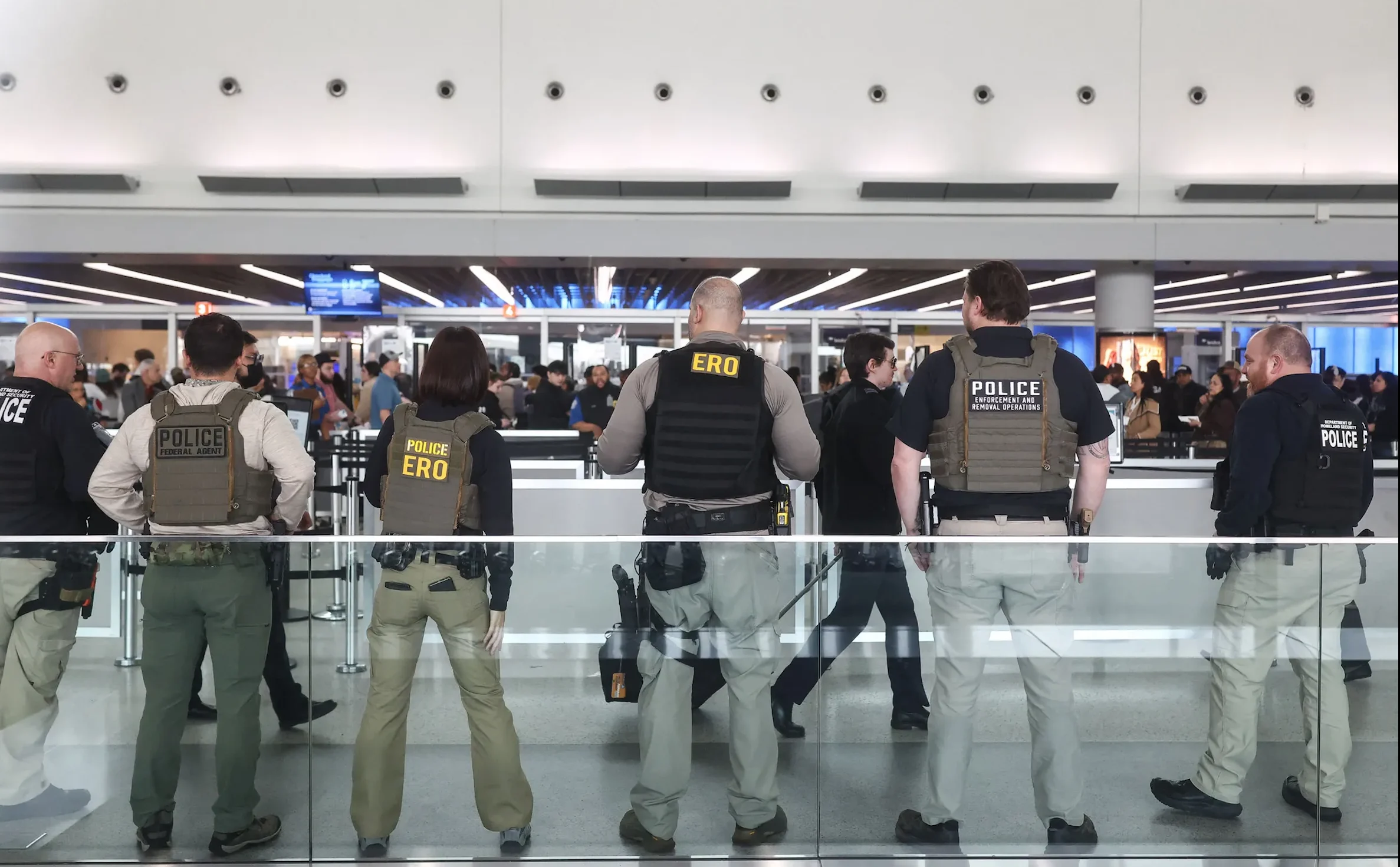
Airports have become an increasingly common site for immigration arrests across the United States, according to CNN, who documented a series of cases in which travelers, including people with pending legal applications, were detained by Immigration and Customs Enforcement agents while checking in or boarding flights.
The shift traces back to an agreement between the Transportation Security Administration and ICE that allows the two agencies to share passenger data.
That arrangement initially focused on people with existing deportation orders, but reporting from The New York Times found that the program has since expanded to include a far larger population: travelers whose visas have simply expired, including spouses of American citizens, tech workers awaiting permit renewals, and people with active applications still pending review.
Because pending immigration paperwork doesn’t grant formal legal status, these travelers occupy a legal gray area that agents have increasingly used as grounds for arrest.
Read more about this topic: Forty US senators demand ICE reforms after fatal shootings (with video)
These airport arrests have taken place across at least nine states, with immigration attorneys now warning clients that domestic air travel carries real risk if their immigration status is still being processed, ABC News confirmed.
A watchdog group’s release of the underlying TSA-ICE data-sharing agreement showed the arrangement was built around aviation security rules originally meant to screen for threats to flight safety, not immigration status.
Former ICE officials have said airports offer clear practical advantages for agents under pressure to increase arrest numbers. Passenger information is already collected in advance, the setting is secure and free of weapons, and agents can be confident of exactly when and where a target will appear, reducing the number of personnel needed for each arrest.
The Department of Homeland Security has defended the strategy, saying its goal is to prevent people in the country illegally from continuing to travel domestically.
Read more about this topic: Trump rejects halt on ICE traffic stops, calling them crucial for crime fighting (with video)
Individual cases have drawn national attention. Video captured a woman being pulled from a jet bridge in Denver as she tried to board a flight, and another set of plainclothes agents left a man partially handcuffed on the ground at a Las Vegas airport before ultimately detaining him a day later in Los Angeles.
Other cases have involved a flight attendant taken into custody while on duty and a Ukrainian woman detained at a gate in San Francisco after screaming for help. Attorneys representing these individuals say many of their clients have no criminal history and were in the process of pursuing lawful immigration status when they were arrested.
ICE’s authority to carry out this kind of enforcement stems from its founding under the Homeland Security Act of 2002, created in the aftermath of the September 11 attacks as part of the broader Department of Homeland Security, BBC reports, examining the agency’s legal powers.
ICE agents are permitted to stop, question, detain and arrest individuals they suspect of being in the country illegally, though entering a private home or similar space still requires a signed judicial warrant.
Read more about this topic: FBI scrutiny of violent ICE incidents rejoined by controversy amid conflicting reports (with video)
Agents can also detain U.S. citizens under narrower circumstances, such as when someone interferes with an arrest, assaults an officer, or is mistakenly suspected of being undocumented, though watchdog groups have documented more than a hundred cases in which citizens were held against their will during such encounters.
Use of force by ICE agents is governed by a combination of constitutional protections, federal law and internal Homeland Security guidelines, which permit deadly force only when an agent reasonably believes a person poses an imminent threat of death or serious injury to themselves or others.
Courts have historically given officers considerable latitude in split-second decisions, a legal standard that has come under renewed scrutiny following fatal shootings involving ICE and Border Patrol agents in other enforcement contexts.
As airport arrests continue, immigration lawyers say they’ve had to rewrite the advice they give clients, moving from reassurances that legal presence in the country was enough to travel safely to now cautioning that any pending change in immigration status may be reason enough to avoid flying until a case is fully resolved.
