

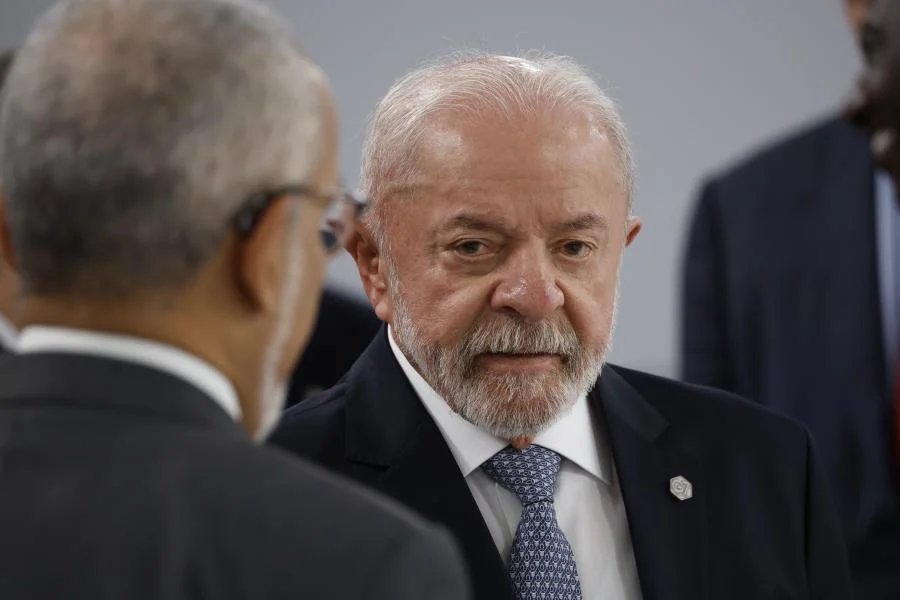
Brazilian President Luiz Inácio Lula da Silva claimed he “was never a leftist” during an informal conversation in France with the Managing Director of the International Monetary Fund (IMF), Kristalina Georgieva, and German Chancellor Friedrich Merz. The candid, backstage exchange occurred on the sidelines of the G7 Summit in Évian-les-Bains, France, and was inadvertently broadcast by the event’s official media transmission feed.
Lula initiated the discussion by outlining how right-wing and conservative administrations, such as the Republicans in the United States and conservatives in France, have historically maintained longer tenures in power compared to left-leaning governments.
“In the United States, the Republicans stayed in government longer than the Democrats. In France, the Socialists also spent much less time governing,” Lula explained through his interpreter. “What does that prove? That the world is not left-wing. The world belongs to the middle path. That is the truth,” the Brazilian president declared, drawing laughs from Chancellor Merz.
Following his remarks, IMF Chief Kristalina Georgieva recalled the global expectations surrounding his initial ascension to power in 2003, noting that everyone expected him to govern as a leftist, but he did not. Lula quickly interrupted Georgieva to firmly repeat twice that he “was never a leftist,” prompting the IMF leader to respond that “this was simply the image of that era.”
Read more about this topic: Trump praises “dynamic” Lula following 3 hour meeting (with videos)
The Brazilian head of state justified his political stance by contextualizing his historical roots within mainstream European union movements rather than ideological socialist frameworks.
“I was a union leader with an excellent relationship with the German trade union movement,” Lula explained. “I had a great relationship with Italian unions, and a very good relationship with the UGT [General Workers’ Union] in Spain.”
Lula also recounted a defining moment from 1980 when he was invited to a political congress in the Soviet Union but chose not to travel because he had been convicted under Brazil’s National Security Law. He noted that after traveling across Europe to gather international solidarity instead, he actually began to be labeled by some contemporary media outlets as an “anti-communist.”
The ideological clarification stands in sharp contrast to Lula’s official domestic legacy as the founding father of the Workers’ Party (PT) in 1980—the largest left-wing political formation in Latin America. After mounting unsuccessful presidential campaigns in 1989, 1994, and 1998, Lula secured consecutive terms in 2002 and 2006, returning to power for a third term in 2023.
Read more: Lula and Macron discuss defense and digital sovereignty cooperation
Since beginning his current mandate, Lula has frequently criticized the modern PT and the broader Brazilian left, arguing that conservative factions have engaged more effectively with working-class citizens over the past decade.
The former metalworker often leverages his background to argue that his original union movement understood the actual clamor of regular workers far better than modern ideological party platforms.
However, domestic polling indicates that the financial sector and agribusiness industry continue to view Lula firmly as a leftist, making his international declarations a highly polarized topic back home.
In Brazil, opposition lawmakers quickly seized upon the leaked G7 audio on social media platforms, accusing the veteran leader of trying to shift his branding away from a damaged political label.
