

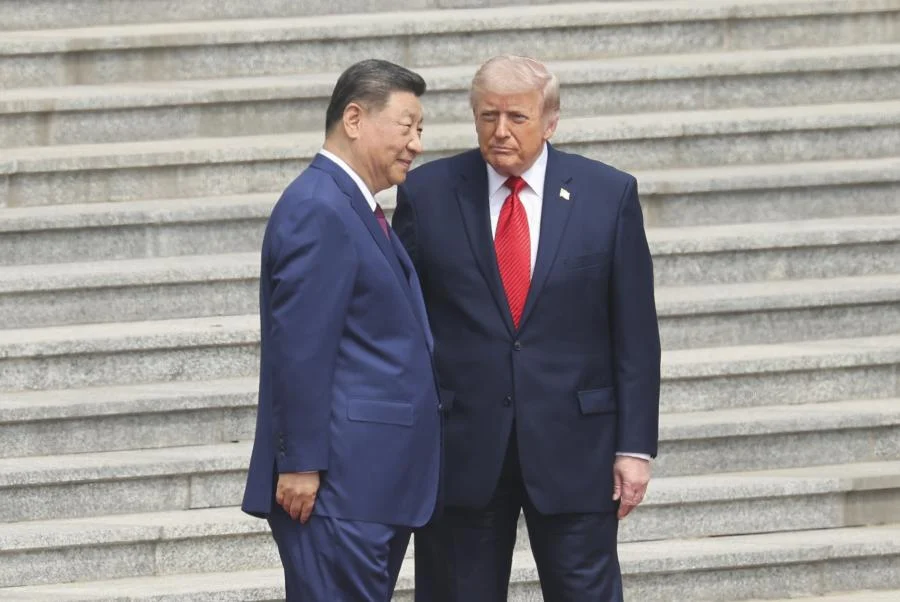
Analysts consider that the succession of visits by foreign leaders to China this year is reinforcing Xi Jinping’s image as a central figure in global diplomacy and Beijing’s narrative of serving as a pillar of multilateralism.
In the first five months of the year, 21 heads of State or Government visited China, including the leaders of Germany, Spain, Canada, and the United Kingdom, according to calculations by the Financial Times based on data from the Chinese Ministry of Foreign Affairs.
U.S. President Donald Trump and his Russian counterpart, Vladimir Putin, held consecutive summits with Xi this month. This week, Pakistani Prime Minister Shehbaz Sharif and Serbian President Aleksandar Vucic also traveled to Beijing.
Analysts cited by the British newspaper consider that the “parade” of foreign leaders helps Beijing present itself as a stable partner and defender of the multilateral order, at a time when the United States faces criticism over the unpredictability of Trump’s foreign policy.
Read more about this topic: “China has become unavoidable”. Merz announces Chinese order of up to 120 aircrafts from Airbus (with video)
For the Chinese domestic public, the phenomenon also evokes the ancient imperial tributary system, in which foreign rulers traveled to the court of the Chinese emperor.
“There is a particular Chinese context to this, especially in how it is perceived by the Chinese public, as a return to the natural state of affairs, where others come to you,” said John Delury, a historian of modern China and senior fellow at the Asia Society.
“The emperor never left China,” he added.
Xi Jinping has significantly reduced his trips abroad. The Chinese leader has not left the country this year and made only six international trips in 2025.
Read more about this topic: Xi Jinping tells Trump: “U.S. and China should be partners, not rivals” (with videos)
According to data compiled by the Asia Society, Xi made 100 trips abroad in the first seven years after assuming the leadership of the Chinese Communist Party in 2012, more than the 90 trips made by U.S. Presidents Barack Obama and Donald Trump during the same period.
Since the lifting of covid-19 pandemic restrictions in 2022, Xi has made only 26 international trips, compared to 56 by U.S. Presidents Joe Biden and Donald Trump.
Neil Thomas, an expert on Chinese politics at the Australian Strategic Policy Institute (ASPI), considered that Xi’s recent travels have focused primarily on neighboring countries and strategic partners in Central Asia and Southeast Asia, regions frequently “neglected” by the United States.
For Damien Ma, director of the Carnegie China center based in Singapore, receiving leaders in bilateral meetings allows Beijing to exert greater influence over less powerful partners and favor direct relationships over multilateral forums.
Read more about this topic: Global Times: Xi, Trump hold talks, agree on new vision for bilateral ties
“For China, the road to Europe goes through Berlin and Paris, not through Brussels,” he stated.
According to analysts, the visits produced mixed results for the foreign leaders.
During British Prime Minister Keir Starmer’s visit, Beijing halved the 10% tariffs on British whisky and authorized visa-free travel for UK citizens, while the pharmaceutical company AstraZeneca announced a 15-billion-dollar (nearly 13-billion-euro) investment in China.
In the case of Canada, Xi agreed to lift tariffs on rapeseed, an important Canadian agricultural export, during Prime Minister Mark Carney’s visit.
Read more about this topic: Putin praises Russia-China alliance ahead of visit to Beijing (with video)
Michael Kovrig, a former Canadian diplomat detained in China for nearly three years, told the FT that the visits of Western leaders “eager” to get closer to Beijing reinforce the narrative promoted by Xi about “the rise of China and the decline of the United States.”
The analyst argued that Western countries should better coordinate their policies regarding China, rather than pursuing isolated bilateral agreements.
Despite the intense diplomatic agenda, some observers consider that Xi will be increasingly focused on domestic politics as the 21st Congress of the Chinese Communist Party approaches, scheduled for 2027, in which he is expected to secure a fourth five-year term in power.
“We are already basically in a campaign period in China,” said Damien Ma. “For Xi Jinping, it is better to be at home than to spend time on a plane.”
