

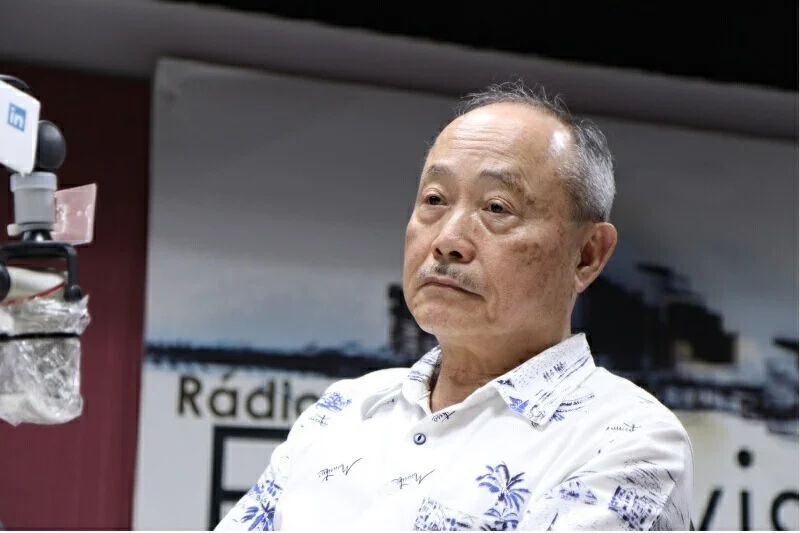
– APOMAC is celebrating its silver jubilee; 25 years alongside the transfer of sovereignty. Is life today easier, or more difficult than it seems?
Jorge Fão — Following the handover, retirees began receiving their pensions from another country. As far as I know, no other former overseas territory had the same outcome. Macau was an exception for two reasons: there was time to negotiate the payment of pensions through the Portuguese State, via Caixa Geral de Aposentações; and, together with some friends and fellow countrymen, we worked very enthusiastically throughout the process. We put pressure on the Portuguese Government during several trips to Portugal; we were also in Beijing, where we spoke with the relevant authorities and realised that the pension issue would have a satisfactory outcome.
– Is that why APOMAC was created?
J.F. — Pensions are paid by Portugal and people receive them in Macau; hence the need to create an association to deal with these matters, especially because of the bureaucracy in Portugal and the language itself. A large part of the pensioners do not understand Portuguese; some do not even understand Chinese — they are people who never went to school.
– Has pensioners’ quality of life met expectations?
J.F. — Over the past 25 years, Macau has gone through golden periods, especially when the Government decided to end the casino monopoly. We have one of the highest GDPs in the world; China also has a very high GDP; therefore Macau is fortunate. We live peacefully, with money, and China is a country with economic power and a voice in world affairs; it has many allies across all latitudes and political spectrums.
The Government’s support, through the Macau Foundation, is increasingly smaller; it is reduced every year and the pressure on our accounts is evident
– A list that keeps growing amid the international decline of the United States…
J.F. — Exactly; the world order may be changing hands. Perhaps that is why the West — particularly America — is afraid. The US dollar still dictates the rules, but less than before; and at this moment BRICS carries more weight than the G7. China is gaining a great deal of strength, and people who speak badly about it simply do not know China well. If we look at history, it was never a country that lived through conquest and hegemony; it never had major colonies.
Read also: “Loyalty” in the Civil Service Seen as Normal
– Does Macau benefit from that?
J.F. — Macau benefits from that. If you ask me whether it is easier to live in Macau today than in the past, honestly, it is not more difficult. As long as people do not do things contrary to national security policy — and we are not going to do that. I have always been quite critical, during the Portuguese administration and now; and if I need to continue criticising, I will. But it has nothing to do with the country’s security; it has to do with the security and well-being of pensioners. We make proposals and suggestions. We can also talk about the Civil Service; my trade union background had some influence in that regard.
– In comments to Tribuna de Macau, you complained about the lack of dialogue with the Government. Are there no communication channels?
J.F. — Right from Ho Iat Seng’s term, we felt a certain distancing from the Chief Executive and his team. When the boss does not move, neither do the others. As far as I remember, he never came to APOMAC, except when he was running for Chief Executive. Incidentally, he had the right to one vote — my vote. He never came back; he disappeared. And Government support through the Macau Foundation is increasingly smaller; it decreases every year and the strain on our accounts is obvious.
– Less support and more bureaucracy?
J.F. — At one point they even asked for receipts for our tips; it is ridiculous, but it happened. With the current Government, I expected some improvement, but so far there has been none. I had a meeting with the current Chief Executive at the Government Headquarters together with other associations. But he never listened to APOMAC, never wanted to know how it works, whether it is doing well or badly. If he had invited me for a meeting, I would have explained in person how this works and how it could improve. And this has consequences for secretaries, department directors and so on. Nowadays, a citizen has access to no one. You call wanting to speak with a director and you cannot; the secretary asks 500 questions. It is very bad.
It is hard to understand why successive governments do not even want to speak with us; it seems they are afraid of us
– What consequences does that have?
J.F. — When there is no communication, the machine jams; the administrative machine is jammed. In the past, we had the possibility of talking to one another; today nobody wants to speak with anyone, because they are afraid of taking responsibility. And that comes from the top; I do not see government departments with initiative or creativity. A civil servant only acts when ordered to do so; if nobody orders it, nothing gets done. They take no initiative because they may even be punished for it. I remember the Chief Executive saying he would visit departments to inspect employees’ punctuality, and he actually did. It was one of the most ridiculous things I have ever seen, but he did not feel ridiculous. The leader’s role is not to clock in on time or leave late; it is to plan, organise and make everything work. At this moment, many department heads spend eight hours in their offices without speaking to anyone.
– Is bureaucracy governing?
J.F. — We have a highly bureaucratised Government. They inherited Portuguese bureaucracy and made it worse; they bureaucratised it even more. The machine is not functioning.
– What can civil society do?
J.F. — Since there is no means of communication, people have to rely on the media or send proposals. Every now and then I send one to the Chief Executive or to the relevant supervisory entity, about things I see and believe could be improved. It is the only way. That is why so many people criticise the Government on that Chinese radio programme; there is no other channel for suggestions, criticism or anything else. It would be good if the Government did not think criticism — which I also make — is meant to destroy. It is not. We are trying to build and improve Macau.
Read also: Macau’s economy under pressure
– Why do you draw a contrast by praising the Liaison Office?
J.F. — Because that is the reality; I find it very strange, but it is not new. Over the past two and a half years, perhaps two deputy directors from the Liaison Office have come here. First, the last lady came with a team to listen to us. It was not for a meal — I invited them to the table out of courtesy. We had an excellent conversation about everything; it was very open. More recently, in March, the deputy director came with a department head and advisers. For about an hour, we talked about every aspect; he asked a series of questions about our philosophy, management and sources of funding. I was very clear and told him everything. We created a channel and, at this moment, a member of our board who speaks Mandarin serves as a liaison between me and the Liaison Office.
– How important is that channel?
J.F. — It is very useful; but the Government has done nothing like that. I am not here to play football matches; in some way APOMAC is also a political association, representing a community that belonged to the Civil Service. I was appointed by the Federation of Trade Unions to join the Chief Executive Election Committee, which shows that this has political weight. It is difficult to understand why successive governments do not even want to speak with us; it seems they are afraid of people. They have nothing to gain from that, only to lose. And we lose as well. I hope this can change.
