

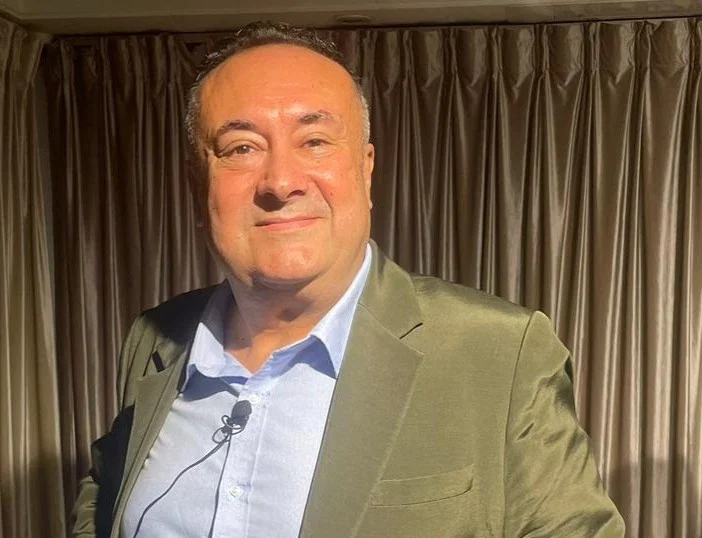
On Tuesday, May 12, the Rui Cunha Foundation hosted the presentation of the book “Media, Art, and Technology in the Nine Portuguese-Speaking Cultures,” organized and edited by José Manuel Simões and published by the University of Saint Joseph (USJ) in September 2025.
In an interview with PLATFORM, the director and associate professor in the Department of Media, Art, and Technology at USJ explains that the book is grounded in a strong cultural dimension and highlights the role of the Portuguese language as a link between different peoples and identities.
“They all represent us as a mother tongue and as a unifying language among all those who speak Portuguese,” he states, referring to the different cultures present in the Portuguese-speaking world.
The scholar also used metaphors to illustrate the various forms of the Portuguese language around the world. “The Portuguese spoken in Brazil is Portuguese with sugar. The Portuguese of Portugal is Portuguese with salt. And the Portuguese of Africa is Portuguese with coffee,” he remarks.
Read more: Lusophony: Macau’s new fund “opens doors” to Portuguese-speaking entrepreneurs
Among the topics covered in the book, José Manuel Simões highlighted the role of AI in education in Angola, the impact of AI on Cape Verdean journalism, and the importance of community radio stations in São Tomé and Príncipe.
In the case of Brazil, the book explores the relationship between art and cryptocurrencies, while the chapter dedicated to East Timor analyzes the role of investigative journalism in a country marked by the struggle for independence.
“Timor has journalism with a mission and a legacy,” states Simões, adding that Timorese journalists carry the memory of those who died for freedom and for the democratic construction of the country.
In Guinea-Bissau, the researcher highlighted the cultural richness, rituals, and cuisine, but also the fragility of the local media sector. “In Guinea, journalists are called ‘hired mouths,’ which is symptomatic of the state of journalism there.”

Professors José Manuel Simões (left), Carmen Monereo (middle), and Daniel Farinha (right) at the book presentation in the Rui Cunha Foundation on May 12th (Photo: PLATFORM).
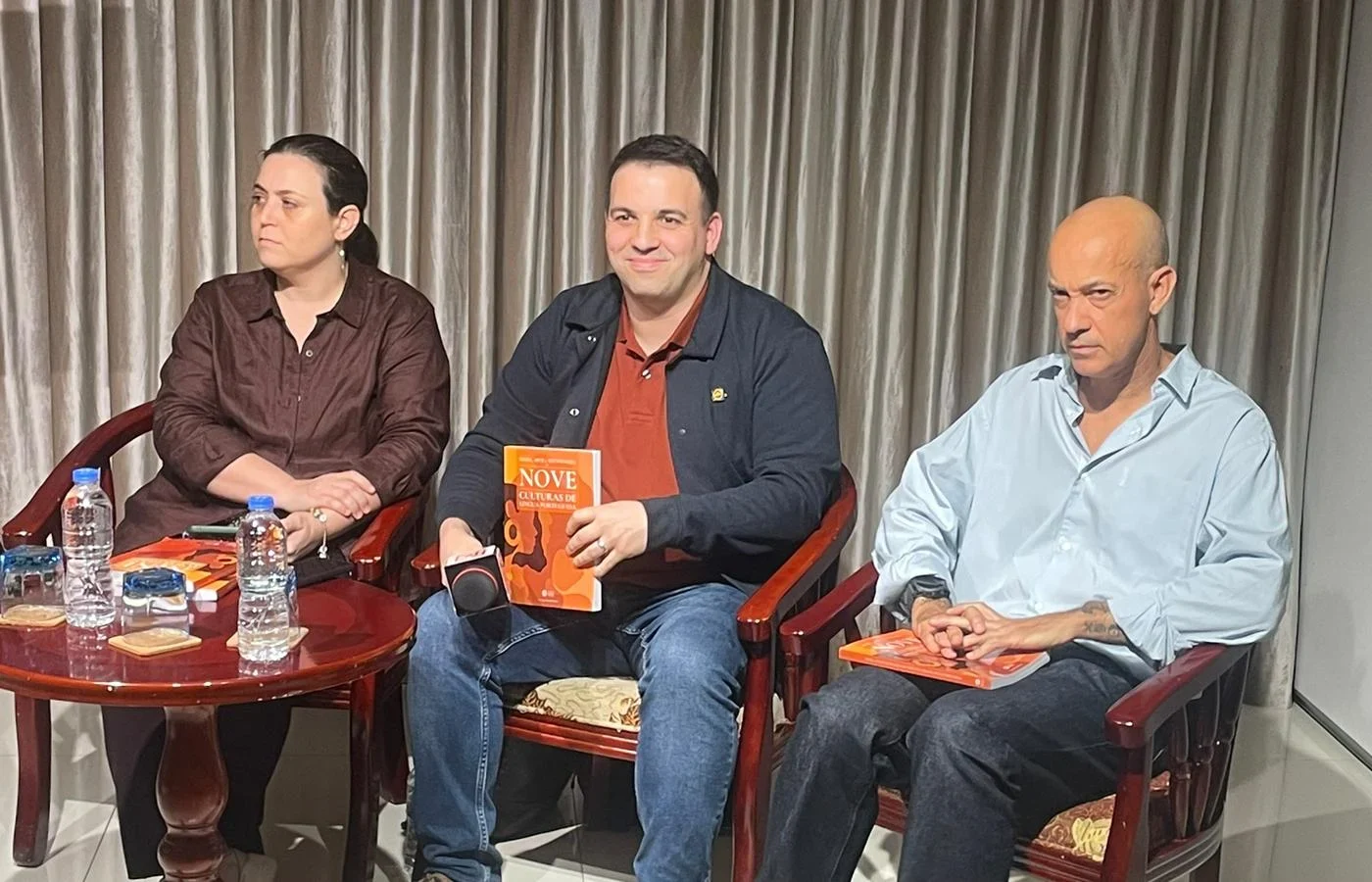
Professors Filipa Martins (left), João Brochado (middle), and Wilson Caldeira (right) at the book presentation in the Rui Cunha Foundation on May 12th (Photo: PLATFORM).
When asked about the future of the Portuguese language in the face of local Creole languages and dialects, José Manuel Simões advocated for the preservation of these cultural expressions, warning of the risk of their disappearance if they cease to be taught or used.
“Creole languages must continue to be spoken, but without books and without being studied in schools, they tend to disappear.”
The scholar cites the case of Macau’s Patuá as an example of the importance of cultural preservation through music, theater, and family traditions. “It is not because people speak both Portuguese and Patuá that Portuguese becomes weaker. On the contrary, it becomes stronger.”
José Manuel Simões also revealed that two new publishing projects are already in the works: “Portuguese in the Nine Portuguese-Speaking Cultures,” dedicated to the state of the Portuguese language in the various Portuguese-speaking regions, and “The Creative Industries in the Nine Portuguese-Speaking Cultures.”
Read more: University of Macau wins first prize in Portuguese language competition
Regarding AI, the researcher acknowledges the technology’s potential but warned of the ethical risks associated with its use.
“The important thing is for us to reflect on ethical issues. Without an ethical standard to oversee AI’s actions, we run the risk of it taking a stance that could be harmful,” he affirms.
The work, written in Portuguese and English, brings together texts that analyze the evolution of media, art, and technology in various lusophone contexts, addressing topics such as artificial intelligence (AI), journalism, entrepreneurship, creative industries, and cultural preservation.
With an introduction by José Manuel Simões and a foreword by João Nuno Brochado, the book includes contributions from Wilson Caldeira (Angola), Daniel Farinha (Brazil), Silvino Évora (Cape Verde), Camará Morto (Guinea-Bissau), Carmen Monereo (Macau), Vanessa Rodrigues (Mozambique), Rui Torres and Fernanda Bonacho (Portugal), José Manuel Simões (São Tomé and Príncipe), Paulo Faustino and Rui Novais (East Timor).
The publication aims to “project knowledge” and promote dialogue among different cultural realities united by the Portuguese language, according to José Manuel Simões.
“It is a book of affection that unites all Portuguese speakers,” said the scholar, emphasizing that the work seeks to reflect “on technology in the service of the fields of media and art, in education, in the information system, and in the construction of values, especially cultural ones.”
The publication also analyzes contemporary artistic practices as ways of understanding the sociocultural changes driven by technological evolution, exploring visual and verbal languages, transformations in the cultural market, and the impact of cultural commodification.
