

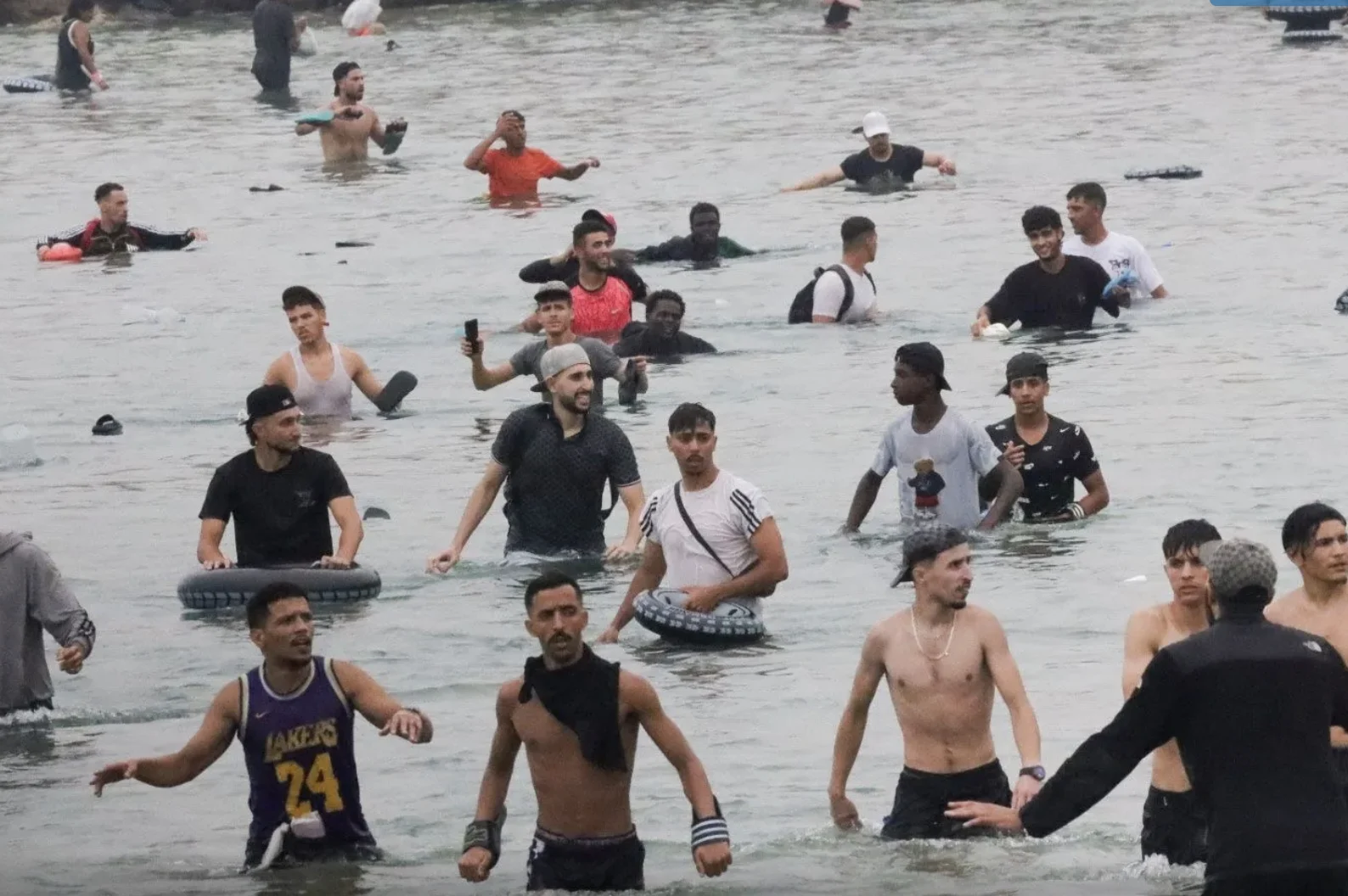
Roughly 49,000 migrants crossed into Spain’s North African territory of Ceuta from Morocco illegally over a 24-hour period by land and sea, according to estimates from Spanish officials, an extraordinary surge that has prompted a military response and reignited diplomatic tensions across Europe.
Footage circulating Thursday showed thousands of people swimming into the city, with local media reporting that crossings continued well into the night. Officials said at least 18 people have died in recent days attempting to reach the territory.
The wave of arrivals comes just weeks after Spain’s Supreme Court ruled that migrants intercepted at sea while trying to reach Ceuta or Melilla, another Spanish exclave, cannot be summarily returned to Morocco.
Ceuta, situated on Morocco’s northern coast and separated from mainland Spain by the Strait of Gibraltar, has long served as a flashpoint for migrants attempting to reach European soil. Local officials had already appealed to Madrid for assistance following a recent uptick in crossing attempts, but Thursday brought chaotic scenes as border controls appeared to collapse entirely.
Read more about this topic: Spain’s mass legalization of immigrants: What it is, and why 1 million applied? (with video)
The scale of the estimated figure is striking: it suggests the number of illegals who entered Ceuta in roughly a day may exceed half the city’s own population, which stands at around 83,600 according to recent local data.
Spain has since deployed its armed forces to strengthen security in both Ceuta and the neighboring city of Melilla, where between 300 and 400 additional crossings were reported overnight. Both territories, long claimed by Morocco, have repeatedly strained diplomatic relations between Rabat and Madrid. Spain maintains that both cities are integral parts of the country, holding the same status as its semi-autonomous mainland regions.
Their Spanish history dates back to the 15th century, and both have operated with limited self-governance as Autonomous Communities since 1995. Together, they represent the European Union’s only land borders with Africa.
Many of those crossing have been young men, though women, children and even infants were also among the crowds. Officials estimate that at least 7,000 of those who entered illegally over the past day were minors.
Read more about this topic: Spain’s mass amnesty program legalizes over 600,000 illegal immigrants
Migrants attempting to reach Ceuta typically swim several kilometers along the coast, but this time many appeared able to approach the border fence directly with little resistance. Early on, some even walked along the rocks of a jetty and around its edge before most had to swim the remaining distance to reach beaches on the Spanish side. It remains unclear where Moroccan border guards were positioned during this period, or why the crowds weren’t dispersed or stopped.
One migrant told Reuters he was heading back to Morocco, warning others against attempting the crossing and saying people are dying, pleading with those who hadn’t yet come not to try. Local media reported widespread fear and disruption across Ceuta since Thursday, with one resident telling Spain’s ABC that people are too afraid to leave their homes, describing the current wave as more intense and aggressive than anything seen before.
Another person interviewed by the outlet claimed those crossing weren’t in genuine need, alleging instead that they were exploiting the system, while 24-year-old migrant Yassine told the same outlet he had no future in Morocco and described the country as offering him nothing but hardship.
Thursday’s sudden surge followed several days of rising numbers of people swimming into Ceuta, with word of their success apparently spreading quickly. The last comparable spike occurred in 2021, though on a far smaller scale, when Moroccan authorities allowed roughly 8,000 people to cross following a diplomatic dispute with Madrid over the sovereignty of Western Sahara.
Read more about this topic: Spain to regularise 500k illegal migrants
That same dispute has resurfaced recently after Prime Minister Pedro Sánchez traveled to Algeria, a country that backs Western Saharan independence.
Spain’s interior ministry said it is coordinating with Morocco to ensure the swift return of everyone who crossed illegally. Sánchez is expected to visit Ceuta later Friday.
Italian Prime Minister Giorgia Meloni was quick to weigh in, calling the images from Ceuta shocking and describing the uncontrolled migration as a security threat to Europe as a whole on social media. She suggested Italy could consider suspending its Schengen free-movement agreement with Spain, though the practical implications remain unclear given the two countries don’t share a border and undocumented migrants are unlikely to attempt air travel between them.
Italy’s foreign ministry later clarified that any suspension would apply specifically to the Italy-Spain border under the Schengen agreement, rather than excluding Spain from the framework entirely. Regardless, the migrants who reached Ceuta remain confined there rather than on the Spanish mainland.
Read more about this topic: Spain: thousands in protest demanding Sánchez quit (with video)
Meloni’s comments echoed remarks from Italian Foreign Minister Antonio Tajani, who was accused by his Spanish counterpart, José Manuel Albares, of exploiting immigration for political gain. Albares called such remarks improper coming from a partner nation from which Spain expects European solidarity rather than partisan rhetoric, and summoned Italy’s ambassador to Madrid on Friday in response.
Finland’s Interior Minister Mari Rantanen backed Meloni’s proposal, arguing that Spain had failed to adequately secure its border. The Schengen Area encompasses 29 European countries that have formally eliminated border controls between them.
