

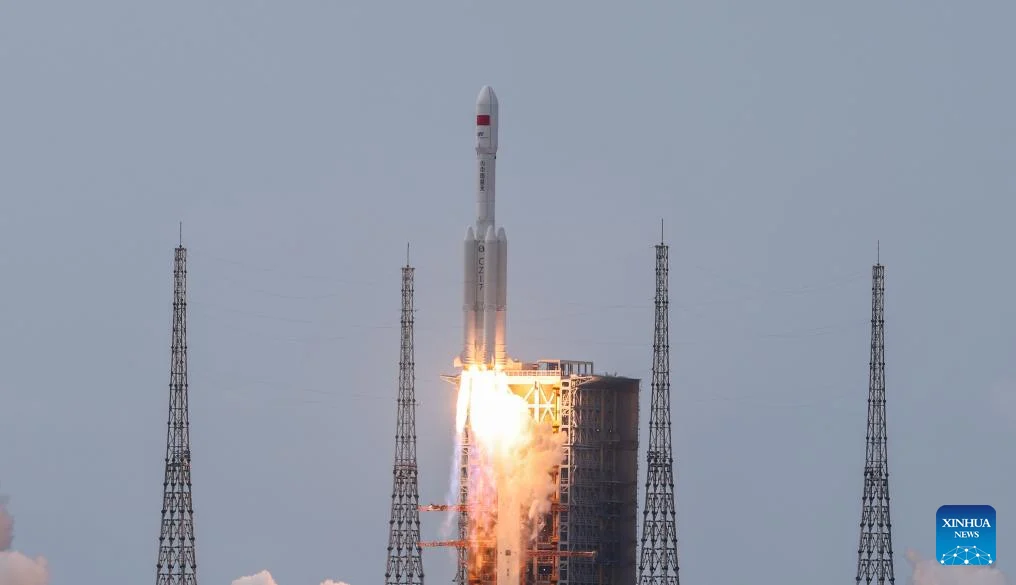
China successfully bolstered its presence in low Earth orbit this week as the robotic Tianzhou 10 freighter arrived at the Tiangong space station with nearly seven tons of vital supplies. The “Celestial Vessel” launched atop a Long March 7 rocket from the Wenchang Space Launch Site on Hainan Island at 8:14 a.m. local time on Monday, May 11, marking a major logistical milestone for the country’s permanent orbital outpost.
Following a precision ascent, the cargo ship completed a rapid five-hour journey to rendezvous and dock with Tiangong, also known as the “Heavenly Palace.” According to state broadcaster CCTV, the freighter’s massive haul consists of more than 220 individual items with a cumulative weight of approximately 6.9 tons. This delivery is essential for sustaining the three-module space station, which has been fully operational since late 2022.
The mission’s inventory reflects a balance of human necessity and cutting-edge research. Included in the shipment are 1,540 pounds of propellant to maintain the station’s orbit, alongside 620 pounds of scientific hardware designed for experiments in fluid physics and other advanced fields.
Perhaps most notably, Tianzhou 10 delivered the final of three new-generation spacewalking suits, following the delivery of the first two units by the previous Tianzhou 9 mission last year. To clear the way for this arrival, the Tianzhou 9 craft departed the station on May 6 to undergo a controlled atmospheric reentry.
Read more: “China becomes a solution for the world”
The cargo will be utilized by the Shenzhou 21 crew—astronauts Zhang Lu, Wu Fei, and Zhang Hongzhang—who have been living aboard the station since late October. As a disposable freighter, Tianzhou 10 will eventually serve as a waste disposal unit, burning up safely in Earth’s atmosphere once the crew has offloaded the supplies and refilled the vessel with refuse.
This 10th iteration of the Tianzhou program underscores the maturity of China’s space logistics. While the first vessel in the series launched in 2017 to service a prototype lab, the current fleet is the backbone of a permanent human presence in space.
With the Tiangong station now fully assembled and routinely staffed by rotating crews of three, these heavy-lift cargo runs ensure that the “Harmony of the Heavens” remains a self-sustaining hub for international science and exploration.
