

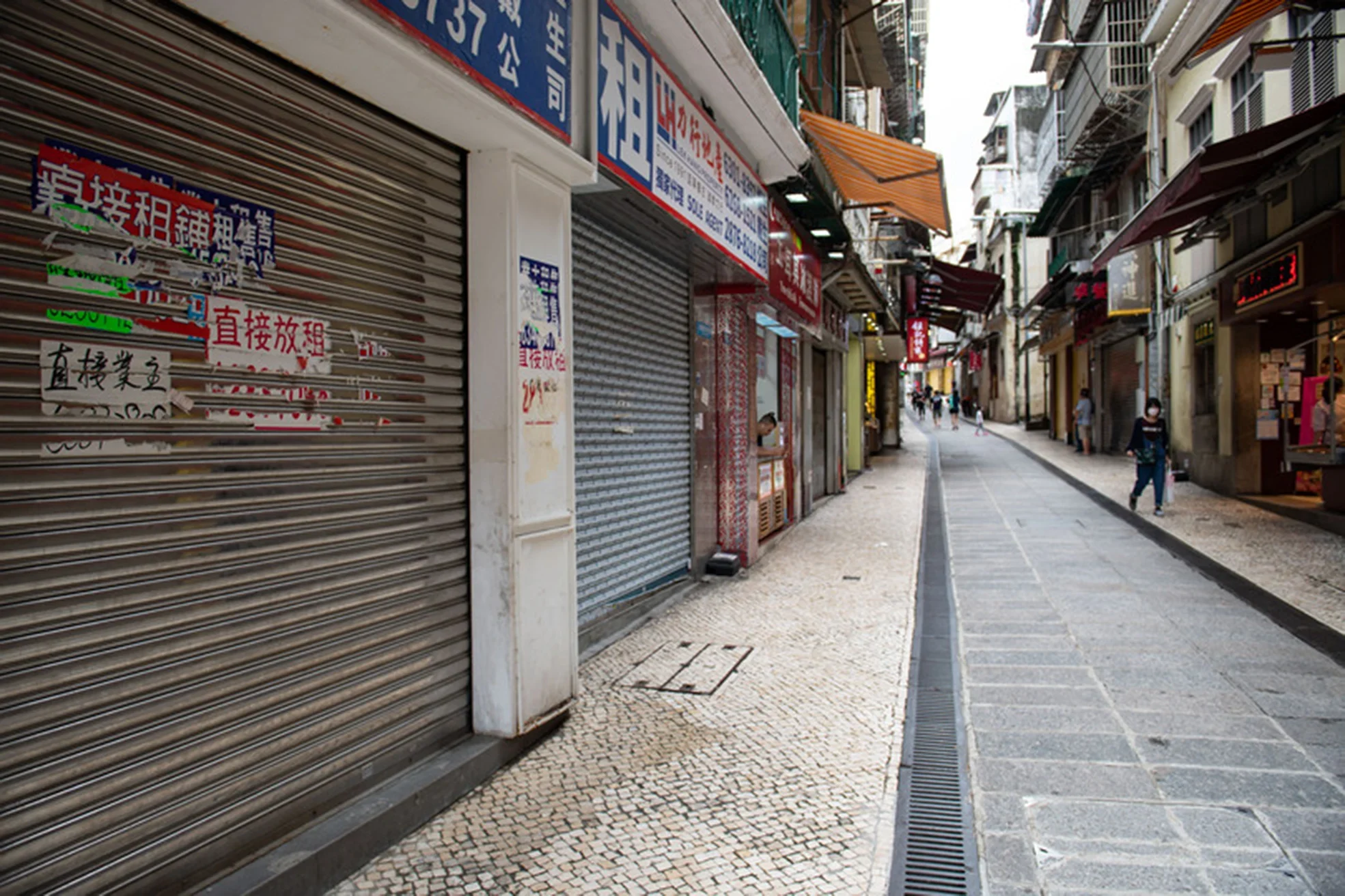
The default rate on SME loans reached 7.9% at the end of 2025, a new high, according to data from the Monetary Authority of Macau (AMCM). Although the volume of overdue loans fell slightly to MOP 5.3 billion, more than 70% had been in arrears for over a year, in a context where total credit to the sector dropped by nearly 14% to MOP 67 billion.
Nelson Kot, president of the Macau Association of Synergistic Socio-Economic Studies, believes the worsening defaults are linked to structural changes in consumer behaviour.
“The increase in default rates (…) is partially, but significantly, driven by structural shifts in demand,” he stressed, pointing to rising consumption in Zhuhai and other mainland Chinese cities as a key factor: “It permanently removes the stable flow of customers from local SMEs.”
Read also: Macau: SMEs can claim insurance payouts for Signal 10 typhoons
This analysis is echoed by economist Henry Lei, who sees the decline in domestic consumption as a clear sign of pressure on businesses. “The weak performance of retail sales (…) may reflect a deterioration in consumer confidence and weakening demand,” he said, highlighting the drop from “MOP 77.19 billion in 2019 to MOP 69.59 billion in 2025.”
The increase in default rates (…) is partially, but significantly, driven by structural shifts in demand — Nelson Kot
Lei also points to “the increasingly common practice of travelling to China on weekends to spend,” as well as the “growing weight of e-commerce,” supported by free delivery from major platforms. According to the 2023/24 Household Income and Expenditure Survey, external consumption rose by 21.8% compared to 2017/18, accounting for nearly a quarter of total monthly spending.
The “price gap with Zhuhai” further worsens the situation. For Kot, this disparity “has significantly distorted the local retail and F&B sectors,” creating a “persistent substitution effect in consumption.” The impact is direct: “Lower revenues, compressed margins,” and greater difficulty in “meeting financial obligations.”
Lei adds that price sensitivity has increased due to declining incomes and the fall in the property market. “Sensitivity to price differences (…) has increased,” he observed, also pointing to greater “integration with Zhuhai and Hengqin” as factors facilitating the “shift in consumption.”
Final destination: Insolvency
In this context, access to credit is becoming more restrictive. The AMCM notes that banks have been rejecting loan applications mainly due to “weak credibility” and “unsatisfactory performance.” For Kot, the risk is clear: “Tighter financing conditions will accelerate SME closures,” particularly in sectors most exposed to cross-border competition.
It is inevitable that banks will reject loan applications (…) with low repayment capacity — Henry Lei
“Liquidity pressures will intensify,” he added, warning of a cycle in which businesses lose “access to credit,” are unable to “cover fixed costs,” and are “pushed into insolvency.”
Lei believes the trend will persist: “It is inevitable that banks will reject loan applications (…) with low repayment capacity,” he said, anticipating a prolonged period of pressure on businesses, in a context where the loan-to-deposit ratio is likely to decline.
Read also: Macau: SME credit volume rose in 2025, default rates climbed 7.9%
In response, solutions will require a combination of immediate measures and structural reforms. Kot advocates direct support, including low-interest credit, public guarantees and reduced operating costs, but also a focus on differentiation.
“Consumption offerings (…) that are difficult to replace with cross-border alternatives” will be “essential to restore competitiveness,” he stressed, also calling for “optimisation of supply chains” and a “reduction in cost differentials” with neighbouring regions.
Lei, meanwhile, emphasises long-term solutions: “It is necessary to implement long-term structural policies,” he said, advocating the “repositioning” of SMEs and the development of more “unique” products and services capable of avoiding price-based competition. “Although this differentiation process takes time, it is essential to ensure the sustainable development of SMEs,” he concluded.
